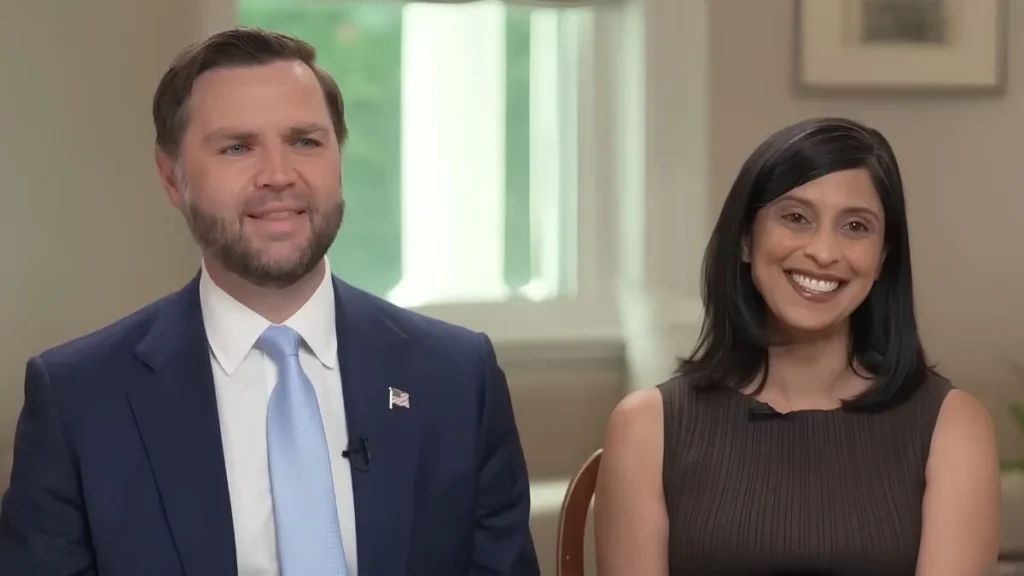

The intersection of political branding, media scrutiny, and personal lifestyle reached a viral peak this week as Usha Vance, wife of Vice President JD Vance, publicly addressed a New York Times report regarding her maternity fashion choices. The exchange, which played out across social media platforms, culminated in JD Vance jokingly suggesting his wife should oversee the United States federal budget after she revealed the deeply discounted price of a dress she wore during a public appearance. This incident highlights the ongoing tension between political figures and media outlets regarding the interpretation of personal aesthetics, as well as the strategic use of relatability in modern political campaigning.
The controversy began following the release of a report by The New York Times that sought to analyze the "political significance" of Usha Vance’s pregnancy style. The report suggested that her choice of attire was not merely a personal preference but a calculated component of the administration’s broader aesthetic strategy. Specifically, the publication pointed to a coral-colored dress worn by Usha during a Father’s Day episode of her YouTube series, "Storytime with the Second Lady." The report argued that the administration possesses an "intuitive and strategic understanding of the power of aesthetics," suggesting that an unspoken dress code exists within the inner circle to mirror the president’s image.
In a direct rebuttal to the analysis, Usha Vance, who is currently expecting the couple’s fourth child, took to X (formerly Twitter) to clarify the origins of the garment. She posted a digital receipt showing that the coral maternity dress, originally valued at $50, had been purchased from Old Navy for a mere $8.75. Her response was characterized by a sharp, sarcastic tone, aimed at what she perceived as the over-intellectualization of a simple, budget-conscious purchase.
"Now that we know the political significance of my $8.75 coral maternity dress from Old Navy, can’t wait to hear what the New York Times has to say about my elastic-waistband pants and compression socks!" Usha Vance wrote. She concluded her post by inviting the public to ignore the fashion analysis and instead focus on the content of her series, which features her and the Vice President reading stories to children.
JD Vance quickly amplified his wife’s response, sharing her post with his own commentary. "She bought a $50 dress for $8.75. America: meet your next director of the federal budget!" the Vice President quipped. While the comment was intended as a lighthearted defense of his wife’s resourcefulness, it resonated with a political base that values fiscal conservatism and the "everyman" persona that the Vance family has cultivated since JD Vance’s entry into national politics.
The Chronology of the Fashion Debate
The timeline of the event illustrates the speed at which a minor lifestyle detail can be transformed into a broader political narrative. On June 16, the Father’s Day episode of "Storytime with the Second Lady" was uploaded to YouTube. In the video, the Vances are seen in a domestic setting, reading to an audience of children. Usha Vance’s coral dress was visible but was not the focus of the content.
On June 24, The New York Times published its style analysis, titled "Usha Vance and the MAGA Pregnancy Style." The article attempted to link her wardrobe choices to the populist and traditionalist themes of the Republican platform. By the morning of June 25, the article had gained significant traction online, prompting Usha Vance to issue her response and share the receipt. Within hours, JD Vance’s "Director of the Federal Budget" comment had garnered thousands of likes and shares, effectively shifting the conversation from a critique of political aesthetics to a celebration of thriftiness.
Biographical Context and the Pivot to Relatability
To understand the impact of this exchange, it is necessary to consider the backgrounds of both JD and Usha Vance. JD Vance, a former venture capitalist and author of the memoir "Hillbilly Elegy," has long centered his political identity on his working-class roots in Middletown, Ohio. His narrative often emphasizes the struggle of the American middle class and the importance of traditional family values.
Usha Vance, a highly accomplished litigator with degrees from Yale University and the University of Cambridge, has generally maintained a more private profile than her husband. However, as the "Second Lady," her public appearances have become more frequent. The "Storytime with the Second Lady" series is her primary initiative, designed to promote literacy and family engagement. By revealing that she shops at accessible retailers like Old Navy and hunts for clearance deals, Usha Vance reinforces the campaign’s narrative that the family remains grounded despite their high-ranking positions in the federal government.
The use of an $8.75 dress as a political tool is not a new phenomenon in American history. Political spouses have frequently used fashion to signal their values. For instance, Michelle Obama was often praised for mixing high-end designer pieces with affordable items from J.Crew, a move that was seen as making the First Lady’s style accessible to the average American. Similarly, the Vances’ emphasis on a clearance-rack purchase serves to contrast them with the perceived "elitism" of mainstream media outlets like The New York Times.
Analyzing the Media’s Role in Political Aesthetics
The New York Times report that sparked the exchange is part of a long-standing tradition of fashion journalism that treats the clothing of political figures as a form of non-verbal communication. In the world of high-stakes politics, every choice—from the color of a tie to the brand of a watch—can be interpreted as a signal to a specific constituency.
The report’s assertion that the administration has a "strategic understanding of aesthetics" refers to the way visual branding is used to create a cohesive image of leadership. For the Republican ticket, this often involves a blend of formal business attire for men and "traditional yet accessible" styles for women. However, the backlash from the Vances suggests a growing frustration among political figures regarding what they view as "over-reading" by the press. By highlighting the mundane reality of her shopping habits, Usha Vance effectively dismantled the theory that her dress was a calculated political symbol, instead framing it as a practical choice made by a mother of three (soon to be four).
Economic Implications and the "Director of the Federal Budget" Quip
While JD Vance’s suggestion that his wife lead the federal budget was a joke, it touches upon a very real and serious theme in contemporary American discourse: fiscal responsibility. The United States is currently facing significant economic challenges, including a national debt exceeding $34 trillion and persistent concerns over inflation and the cost of living.
In this economic climate, the image of a political leader’s spouse finding a 82% discount on a dress is a potent piece of optical messaging. It suggests a mindset of "doing more with less," a principle that Republican fiscal hawks frequently advocate for at the federal level. By jokingly nominating her for the role of Budget Director, JD Vance tapped into the populist sentiment that the government should be run with the same frugality that a household uses to manage its own finances.
The Office of Management and Budget (OMB) is the largest office within the Executive Office of the President of the United States. Its director is responsible for overseeing the implementation of the President’s vision across the Executive Branch and managing the federal budget. While Usha Vance is a lawyer by trade, her husband’s comment served to bridge the gap between her personal resourcefulness and the broader goals of the administration’s economic policy.
Public Reaction and Political Impact
The reaction to the "dress drama" has been split largely along partisan lines. Supporters of the Vances have lauded Usha’s response as "authentic" and "refreshing," viewing her willingness to post a receipt as a sign of transparency. Critics, on the other hand, argue that the entire exchange was a choreographed attempt to deflect from more substantive policy critiques and to maintain a "common man" image that belies the couple’s actual wealth and status.
Regardless of the interpretation, the incident has succeeded in humanizing the Second Lady in the eyes of many voters. In a digital age where political figures are often seen through a highly filtered lens, the mention of "elastic-waistband pants and compression socks"—staples of late-stage pregnancy—adds a layer of relatability that is difficult to achieve through formal speeches or policy papers.
Conclusion: The Evolving Landscape of Political Communication
The exchange between the Vances and The New York Times serves as a case study in modern political communication. It demonstrates how social media allows public figures to bypass traditional media gatekeepers and directly challenge narratives they find unfavorable. By using humor and personal anecdotes, the Vances were able to turn a potentially critical style analysis into a moment of viral positivity for their brand.
As the campaign season continues, the role of the political spouse remains a delicate balance between private life and public service. For Usha Vance, the "Storytime" initiative and her occasional foray into the social media spotlight provide a platform to support her husband’s political goals while asserting her own identity as a professional and a mother. The "coral dress" incident, while seemingly trivial, underscores the reality that in the modern political arena, the personal is almost always political—even when it involves a clearance-rack find from Old Navy.
Moving forward, the administration is likely to continue leveraging these moments of "planned spontaneity" to connect with a broader electorate. Whether Usha Vance’s "budget-saving" skills will ever be applied to the actual federal budget remains a joke for the internet, but her ability to navigate the complexities of public scrutiny with wit and directness has undoubtedly left a mark on the current political cycle. The $8.75 dress, once just a piece of maternity wear, has now become a footnote in the history of the Vance family’s rise in American politics.