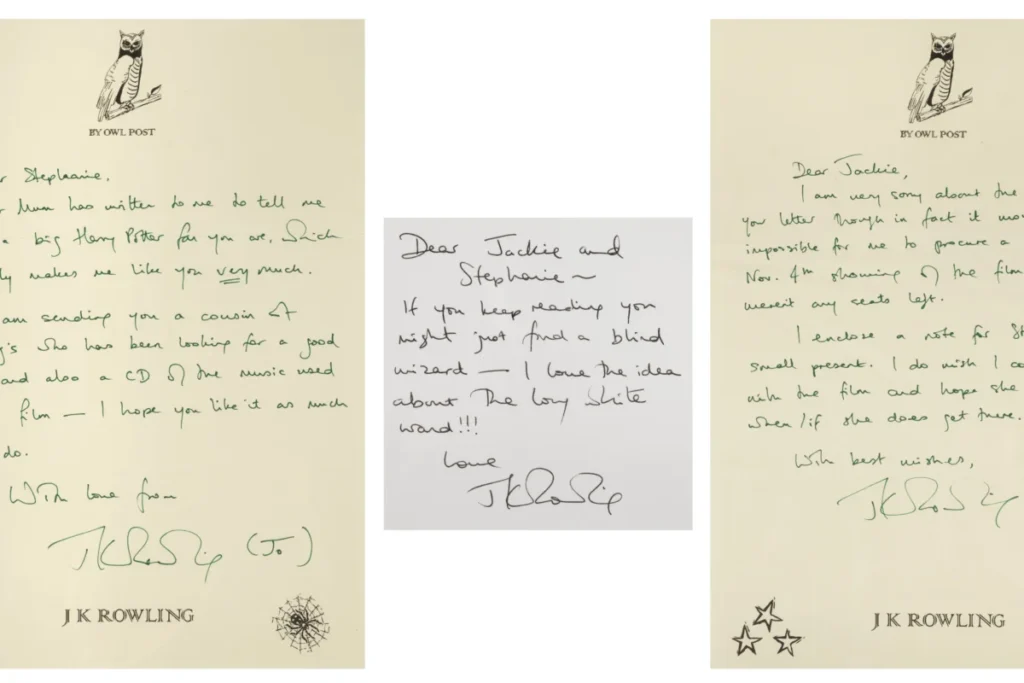

An intensely personal and profoundly moving archive of correspondence, comprising six signed letters, notes, and gifts from renowned author J.K. Rowling to a young, terminally ill fan of her global phenomenon Harry Potter series, has been successfully sold at auction for a significant sum, nearing £10,000. This collection offers a rare glimpse into the author’s compassionate engagement with her readership, underscoring the deep human connection fostered by her magical narratives, even amidst the grim realities of life-limiting illness.
The Poignant Auction and Its Outcome
The six-piece collection, dating back to the early 2000s, was sent by J.K. Rowling to Jackie Whitbread and her daughter, Stephanie, who was battling the severe neurological condition known as Juvenile Batten disease. The auction, held last week at Dominic Winter auctioneers, saw the collection realize a final price of £9,150. The successful bid was placed online by a private collector based in London, whose identity remains undisclosed, securing a unique piece of literary history that transcends mere monetary value. The sale price, just shy of the anticipated £10,000, reflects the immense sentimental and historical value placed on such intimate interactions between a celebrated author and one of her most devoted readers.
The items within the archive included not only letters but also thoughtful gifts, demonstrating Rowling’s personal investment in Stephanie’s well-being. These tangible pieces serve as a powerful testament to the author’s willingness to connect on a deeply personal level with fans, particularly those facing extraordinary challenges. The act of a world-famous author dedicating time and effort to comfort a sick child resonates far beyond the auction room, speaking to universal themes of empathy, hope, and the power of storytelling.
A Wizarding World Connection: Inside the Letters
Central to the collection are two letters signed by Rowling herself, notably penned on "owl post" headed paper, a whimsical nod to the postal system of the wizarding world that captivated millions. This small but significant detail illustrates Rowling’s dedication to immersing Stephanie within the magical universe she so adored, even in their correspondence. The letters are not just autographs; they are portals to a shared fantasy, crafted with care and consideration.

One particularly touching letter features Rowling’s apology for being unable to secure tickets for Stephanie to attend an early screening of the first Harry Potter film, Harry Potter and the Philosopher’s Stone (released as Sorcerer’s Stone in the U.S.). This reveals the author’s genuine effort to fulfill a young fan’s dream, even when faced with logistical constraints. In the same correspondence, Rowling expressed her affection, writing that Stephanie’s enthusiasm for her books "obviously makes me like you very much," a simple yet profound statement of connection. Accompanying this was a small stuffed owl, a tangible symbol of the wizarding world, meant to bring comfort and joy.
Another item of immense interest in the archive is a signed notecard. On it, Rowling praised Stephanie’s imaginative suggestion to introduce a "blind wizard" character into the beloved series. This interaction highlights Rowling’s openness to her readers’ creativity and her acknowledgement of Stephanie’s insightful engagement with the Harry Potter universe, even as her own vision was progressively failing due to her illness. Such a detail not only shows the author’s humility but also the fan’s remarkable spirit and intellectual curiosity despite her debilitating condition. The collection was further rounded out by a CD of the soundtrack to Harry Potter and the Philosopher’s Stone, alongside other related notes, all contributing to a comprehensive picture of this unique exchange.
Stephanie’s Battle with Juvenile Batten Disease
At the heart of this story is Stephanie Whitbread, a young fan whose life was tragically impacted by Juvenile Batten disease, also known as Neuronal Ceroid Lipofuscinosis type 3 (CLN3). This rare and devastating neurodegenerative disorder primarily affects children, typically manifesting between the ages of 4 and 10. The disease is characterized by a progressive decline in cognitive and motor functions, leading to debilitating symptoms such as vision loss, epilepsy, speech difficulties, and dementia. Over time, individuals with Juvenile Batten disease lose their ability to walk, speak, and see, requiring extensive care. The disease is ultimately terminal, with most affected individuals passing away in their late teens or early twenties. Stephanie Whitbread herself succumbed to the illness in 2013, at the age of 22, after years of battling its relentless progression.
For Stephanie, the world of Harry Potter offered an invaluable escape and source of comfort during her arduous fight. The magical narratives, filled with themes of friendship, courage, and overcoming adversity, likely provided a vital emotional anchor. J.K. Rowling’s personal outreach, therefore, was not merely a celebrity interaction but a profound act of solace, acknowledging Stephanie’s existence and offering a beacon of light in her darkening world. The auctioneers, Dominic Winter, aptly described the collection as "a poignant testament" to "Rowling’s generosity towards one of her readers at a particularly difficult moment in her life." This statement encapsulates the profound impact of Rowling’s compassion, transforming a fan-author relationship into something deeply meaningful and personal.
J.K. Rowling’s Philanthropic Spirit and Fan Engagement
J.K. Rowling, the award-winning author, is globally celebrated for creating the Harry Potter fantasy novels, which chronicle the adventures of a young wizard, Harry Potter, and his loyal friends, Ron Weasley and Hermione Granger, during their time at Hogwarts School of Witchcraft and Wizardry. The series, published between 1997 and 2007, became an unprecedented cultural phenomenon, selling over 600 million copies worldwide and translated into more than 80 languages. Its success was further amplified by the eight-film adaptations, starring Daniel Radcliffe, Rupert Grint, and Emma Watson, released from 2001 to 2011, which collectively grossed billions at the box office.

Beyond her literary achievements, Rowling has long been recognized for her significant philanthropic efforts and her genuine engagement with fans. She established the Lumos charity, dedicated to ending the institutionalization of children worldwide, and has supported numerous other causes. Her interactions with fans, particularly those facing illness or adversity, have frequently been reported, showcasing a consistent pattern of empathy and generosity. Instances range from visiting children in hospitals to sending personalized letters and gifts, often drawing on the magic of the Harry Potter universe to provide comfort and inspiration. This dedication to her readership, especially to those in vulnerable positions, has solidified her reputation not just as a brilliant storyteller but also as a compassionate individual. The correspondence with Stephanie Whitbread is a particularly powerful example of this aspect of her public persona, highlighting the human element behind the global brand.
The Enduring Legacy of Harry Potter
The Harry Potter series did more than just sell books and movie tickets; it fundamentally reshaped the landscape of children’s literature and popular culture. Its immersive world, complex characters, and universal themes of good versus evil, love, loss, and self-discovery resonated deeply with generations of readers across the globe. The books spurred a resurgence in reading among children and young adults, creating a shared cultural lexicon that continues to thrive decades after the final book’s release. The franchise has since expanded into theme parks, stage plays, video games, and a vast array of merchandise, maintaining its relevance and drawing in new legions of fans.
The ongoing fascination with Harry Potter memorabilia, as evidenced by the sale of these letters, underscores the series’ enduring impact. For many, these artifacts are not just collector’s items but cherished connections to a world that offered solace, adventure, and a sense of belonging. The intrinsic value of items related to the Harry Potter universe is consistently high, reflecting its status as a cultural touchstone. The letters to Stephanie Whitbread, however, possess an additional layer of significance: they are not merely commercial products but deeply personal relics of a profound human exchange, imbued with emotional weight that few other pieces of memorabilia can claim.
The Market for Literary Memorabilia and Human Connection
The auctioning of these letters also shines a light on the thriving market for literary memorabilia, particularly items connected to iconic authors and their most famous works. Autographed first editions, original manuscripts, and personal correspondence frequently command high prices, reflecting their rarity, historical significance, and the enduring allure of the literary world. For collectors, such items offer a tangible link to the creative process and the lives of those who shaped our cultural narratives. The market for Rowling-related items, in particular, has seen consistent strength, driven by the immense global fanbase and the series’ unparalleled success.
However, the value of Stephanie’s letters transcends typical market dynamics for celebrity artifacts. As Chris Albury, a director at Dominic Winter auctioneers, articulated, "At the heart of this is a deeply tragic story, but it also speaks to the lasting affection readers feel for JK Rowling and the Harry Potter books." He further noted, "Written four years after the publication of the first novel in 1997, these letters show Rowling to be a deeply kind and generous person, with a genuine warmth towards her young fan, Stephanie, and her mother, Jackie." Albury emphasized the humanitarian aspect of the sale, stating, "We knew the letters would resonate with people because of the compassion and humanity they convey, as well as the enduring passion for Harry Potter memorabilia, so it was wonderful to see them attract such strong interest and achieve £9,150 at auction."

This sentiment highlights that the market for these particular items is not solely driven by a desire for a celebrity’s autograph, but by an appreciation for the profound human connection they represent. The letters serve as a powerful reminder that even amidst the vastness of global fame, genuine empathy and kindness can bridge immense divides, offering comfort and hope where it is most needed. The buyer, a private collector, has acquired not just a piece of Rowling’s history, but a testament to the enduring power of compassion and the unique bond between a storyteller and her audience.
Broader Implications and Lasting Impact
The sale of J.K. Rowling’s letters to Stephanie Whitbread offers several broader implications. Firstly, it reaffirms the extraordinary power of literature to provide solace and meaning, especially in times of great hardship. For Stephanie, the wizarding world was a sanctuary, and Rowling’s personal engagement brought that sanctuary even closer. Secondly, it underscores the significant role public figures can play in individual lives, demonstrating that acts of kindness, however seemingly small, can leave an indelible mark. Rowling’s letters were more than mere words; they were gestures of hope and recognition that undoubtedly meant the world to Stephanie and her family.
Finally, this event contributes to the ongoing narrative of J.K. Rowling’s legacy. While her literary achievements are undeniable, these personal interactions highlight a deeper aspect of her public persona – that of a caring and compassionate individual who understands the profound impact her stories have on her readers. The archive will now reside with a private collector, ensuring its preservation, but its story will continue to resonate, serving as a poignant reminder of a remarkable connection forged between an author and a fan, bound by the magic of storytelling and the enduring spirit of human kindness. The value achieved at auction is not just a monetary figure, but a reflection of the deep emotional resonance these unique pieces of correspondence carry, echoing the compassion and humanity they convey to a world that continues to seek both.