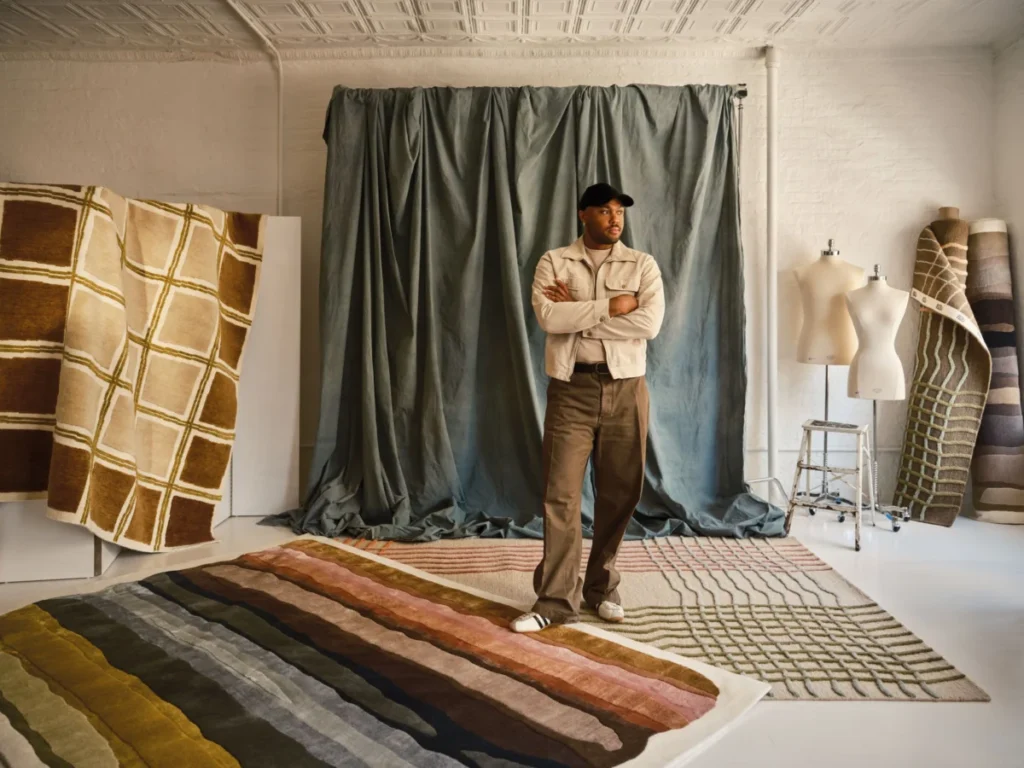

The collaboration between Louisiana-born, New York-based fashion designer Christopher John Rogers and The Rug Company represents a significant milestone in the evolution of luxury home textiles. By translating the tactile, raw processes of a fashion atelier into the durable, intricate medium of hand-knotted and woven rugs, the project bridges the gap between ephemeral runway garments and permanent architectural fixtures. The collection, developed in close coordination with The Rug Company’s creative director, Will Cooper, synthesizes Rogers’ signature bold aesthetic with the technical mastery of artisanal rug production.
A Convergence of Disciplines
For Christopher John Rogers, the garment-making process is as much about the journey as the finished product. His design philosophy centers on the preservation of the studio environment—the draping of fabric, the sharpness of chalk lines, the presence of loose threads, and the inevitable smears and imperfections that denote human labor. By applying this ethos to interior textiles, Rogers has created a collection that functions less as a static piece of decor and more as a narrative of creative labor.

The collection, titled The Studio by Christopher John Rogers, features six distinct designs that utilize a sophisticated blend of silk and wool. These pieces draw heavy inspiration from the abstract expressionist works of painters such as Morris Louis and Ellsworth Kelly, while simultaneously mining Rogers’ own extensive archival runway lookbooks. The result is a series of floor coverings that possess a distinct sense of movement, mirroring the fluidity of the textiles the designer is known for in the fashion world.
Chronology of the Collaboration
The partnership with The Rug Company is the latest in a long-standing tradition of fashion-forward collaborations for the brand. The Rug Company has previously partnered with global design icons, including Alexander McQueen, Diane von Furstenberg, and Vivienne Westwood, establishing a legacy of merging couture sensibility with interior design.
The genesis of this specific project can be traced back to Rogers’ 2022 pre-fall runway collection. During the development phase, Rogers experimented with simple marker tests on paper to map out garment construction and silhouettes. These "accidental" markings—the scribbles and lines created during the brainstorming process—eventually became the primary visual language for the rug collection.

Will Cooper, who serves as the creative director for The Rug Company, played a pivotal role in facilitating this transition. The two were introduced through a mutual association with the luxury paint and wallpaper company Farrow & Ball, a brand that shares a focus on high-pigment saturation and artisanal quality. The development process spanned several months, requiring a rigorous translation of Rogers’ two-dimensional sketches into high-density, multi-textured rugs.
Technical Craftsmanship and Design Intent
The six designs within the collection employ a variety of weaving techniques, ranging from flatweaves to high-pile knotting. Each piece is constructed using traditional methods that allow for the replication of complex patterns that might otherwise be lost in machine-made manufacturing.
Notable pieces within the collection include:

- Marker Test: A design that directly abstracts the scribbles from Rogers’ design process, creating a chaotic yet organized aesthetic that mimics the energy of an active studio.
- Chalk Line: This design utilizes raised cross-hatchings against a neutral backdrop, evoking the precise, geometric guides used by tailors to mark fabric before cutting.
- Paintstroke: A design that mimics the visual texture of wet pigment, capturing the fleeting moment of a brush or tool passing over a surface.
- Lattoro (in Agave): A piece that demonstrates the collection’s refined color palette, blending subdued primary colors with earthy, muted tones that provide a sense of historical patina.
The color theory applied here is intentional. Rather than relying on the neon or hyper-saturated hues often associated with modern runway fashion, Rogers and Cooper opted for a palette that suggests longevity. The goal was to create pieces that feel as though they could belong to any decade, functioning as contemporary heirlooms rather than trend-driven items.
Industry Context and Market Implications
The interior design market has seen a growing demand for "art-first" home products, as consumers increasingly view their living spaces as extensions of their personal style and creative values. The collaboration between a high-fashion designer and a luxury rug manufacturer is not merely a branding exercise; it is an analysis of how luxury markets are blurring the lines between fashion and furniture.
According to industry analysts, the luxury home textile market has grown steadily as high-net-worth individuals shift their spending toward home environments. By partnering with figures like Christopher John Rogers, heritage brands like The Rug Company remain relevant to a younger, design-conscious demographic that prioritizes storytelling and transparency in the production process.

The emphasis on "the hand" in the making of these rugs aligns with a broader consumer preference for artisanal goods. In an era dominated by mass production and digital design, there is a measurable premium placed on items that showcase the trace of the maker. The "imperfections" that Rogers sought to preserve in his designs are effectively elevated to a luxury standard, suggesting that the future of high-end home decor lies in the celebration of the human element.
Official Perspectives
Will Cooper, reflecting on the final output of the project, noted the seamless integration of Rogers’ vision into the home. "They reflect Christopher’s evolution and traces of the many hands involved in their making—histories that ultimately become part of the home," Cooper stated. The intention was to ensure that while the designs were undeniably modern, they carried a weight and texture that suggested a storied past.
Rogers himself remains committed to the idea that the "accidental" is a vital part of the creative lexicon. "I’ve always loved the idea that something accidental can become the very thing you want to preserve," he noted during the launch. By taking the discarded scraps of his fashion studio—the marker tests, the chalk lines, the paint streaks—and casting them into durable wool and silk, he has ensured that his creative methodology is physically memorialized.

Broader Impact on the Design World
The success of this collaboration may well set a precedent for future cross-industry partnerships. As fashion houses look for new ways to monetize their brand equity beyond clothing, the home category offers a stable and high-margin outlet. Conversely, interior design brands gain immediate access to the aesthetic prestige and cultural capital of fashion designers, allowing them to capture a broader audience.
Furthermore, the focus on "preservation" and "patina" highlights a shift in luxury aesthetics. There is a move away from the pristine and toward the lived-in. By intentionally incorporating the look of "mistakes" and "smears," the collection challenges traditional notions of perfection in luxury goods. It suggests that a high-end product is not defined by the absence of flaws, but by the intentionality of its creation.
As the collection enters the market, its reception will likely serve as a litmus test for how much further the boundaries between fashion and interiors can be pushed. With the backing of The Rug Company’s established distribution network and the creative force of Christopher John Rogers, the collection stands as a testament to the fact that, regardless of the medium, the most compelling design is often the one that tells a story of its own making.

This project reinforces the importance of collaboration as a driver of innovation. By inviting a fashion designer to view the floor not as a surface to be covered, but as a canvas for the expression of process, The Rug Company has successfully expanded the definition of what a luxury rug can communicate. The Studio by Christopher John Rogers is not just an addition to a room; it is an invitation to engage with the messy, beautiful, and precise work of a creator.