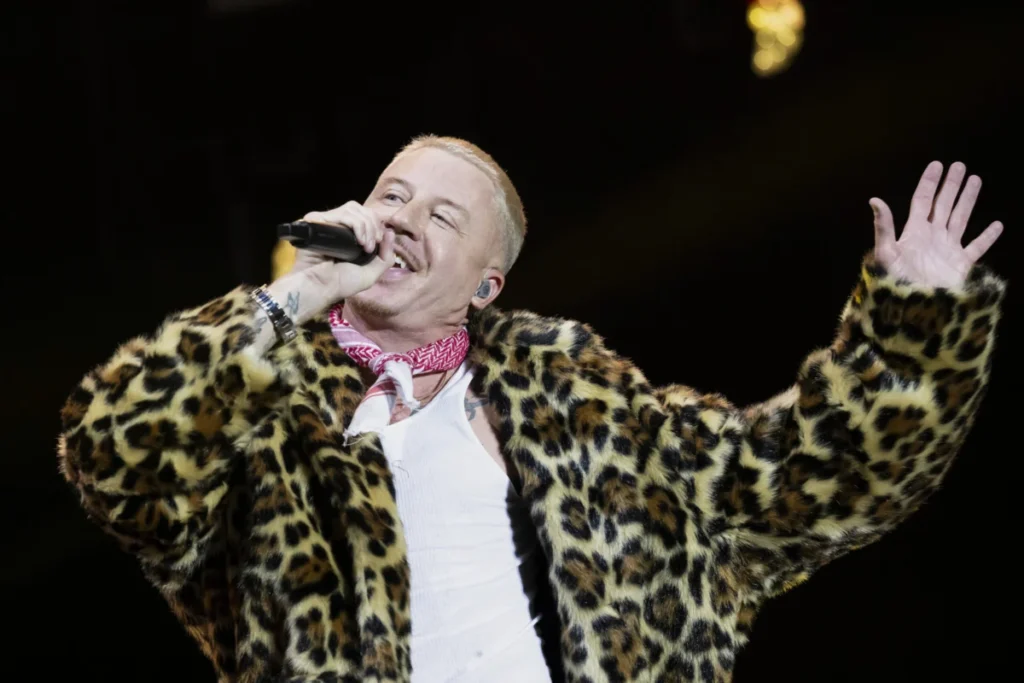

The global music industry is currently grappling with the intersection of high-profile entertainment and the volatile landscape of international geopolitics, as evidenced by the profound turmoil surrounding Ed Sheeran’s ongoing The Loop tour. The British singer-songwriter, one of the most commercially successful artists of the decade, recently admitted to deep personal and professional doubt regarding his future as a performer after a controversy involving the removal of US rapper Macklemore from his tour support lineup escalated into a full-scale crisis.
The incident, which saw multiple support acts and members of the backing band withdraw from scheduled performances, highlights the increasing pressure on artists to navigate complex moral and political landscapes while maintaining their professional commitments. As Sheeran returned to the stage at Lincoln Financial Field in Philadelphia, his candid address to the audience underscored the gravity of a week that left him questioning his fundamental identity as an artist.
A Chronology of the Controversy
The sequence of events leading to the current crisis began in early September 2026, when Macklemore used his platform during a performance at MetLife Stadium in New Jersey to address the ongoing conflict in Gaza and the West Bank. His comments, which were intended to express solidarity with civilians in the region, sparked an immediate and intense reaction from stakeholders, including venue owners and event promoters.

By the following Monday, Macklemore publicly announced on social media that he had been removed from the remainder of the tour. While the rapper initially attributed the decision to Sheeran and his management team, the narrative quickly shifted. On Tuesday, Sheeran issued a formal statement on Instagram, clarifying that the decision was driven by external pressure from promoters and venue operators. According to Sheeran, several venues had threatened to cancel upcoming dates if the rapper remained on the bill. Specifically, the artist noted that Robert Kraft, owner of Gillette Stadium, was among the stakeholders who communicated that they would pull the shows unless the lineup was altered.
The fallout was immediate. In an act of solidarity with the rapper, several supporting acts—including Grammy-winning artist Finneas, Irish singer Aaron Rowe, and Danish performer Lukas Graham—as well as Sheeran’s long-standing backing band, Beoga, withdrew from the tour. This mass departure left the production in a state of operational limbo, forcing Sheeran to contemplate the viability of the remaining 16 shows across North and South America.
Sheeran’s Return to the Stage
Performing for the first time since the turmoil broke, a visibly emotional Sheeran addressed the audience in Philadelphia. His remarks served as both a personal reflection and a formal attempt to navigate the polarized environment surrounding his tour. "I really didn’t know whether this tour would be carrying on," Sheeran confessed to the crowd. "I really didn’t know whether I’d be even getting on stage again, whether I even wanted to be an artist at all."
Sheeran, who has historically maintained a policy of avoiding political commentary in favor of promoting "unity" at his concerts, felt compelled to break his silence. He articulated a nuanced position, condemning the October 7 attacks on Israel and the Nova music festival as "horrific," while simultaneously labeling the subsequent military actions in Gaza as "catastrophic, unjustifiable, and disproportionate." He further acknowledged the systemic injustices in the West Bank, noting that these issues could no longer be ignored.
Contextualizing the Artist-Promoter Dynamic
The crisis surrounding The Loop tour serves as a case study in the power dynamics of the modern touring industry. When an artist of Sheeran’s stature embarks on a global tour, the logistical and financial interdependencies are vast. Promoters, venue owners, and corporate sponsors often hold significant leverage, particularly when contract clauses include "morality" or "community standard" provisions that can be triggered by political speech.
Historically, the "shut up and sing" mentality has dominated the touring industry to protect commercial interests. However, as social media has decentralized the public discourse, artists are increasingly expected to take stances on global crises. When those stances clash with the interests of venue owners—who are often influential figures with their own political or social alignments—the result is often a public clash of values. In this instance, the tension between the artist’s desire for creative freedom and the promoter’s desire for a neutral, controversy-free venue environment reached a breaking point.
Public Reaction and Protests
The atmosphere outside the Lincoln Financial Field in Philadelphia mirrored the discord found within the industry. A group of pro-Palestinian protesters gathered near the venue, reflecting a segment of the public that views the tour and its management decisions through a political lens. For some, the removal of Macklemore was a litmus test for the artist’s own moral standing.
Conversely, many attendees inside the stadium expressed a desire to separate the artist from the controversy. "I came here to have a good time and watch Ed Sheeran," said one concertgoer, Kassandra Rivera. "I’ve been waiting a whole year to come and see him, so I’m excited to see the show." This sentiment was echoed by others who maintained that a music concert should remain a neutral space, free from the weight of global political discourse.

However, this "neutrality" is increasingly viewed as a political stance itself. Hillary Steinberg, a Philadelphia resident who opted to protest rather than attend the concert after receiving a refund, noted: "I think all art is political, and all music is political, and so this choice—even though he was saying that he wasn’t complicit—is a political choice."
Economic and Logistical Implications
The operational impact of the tour fallout is significant. Managing a stadium-level tour requires the synchronization of hundreds of personnel, equipment, and logistical arrangements. The sudden departure of the backing band and multiple support acts forces a radical restructuring of the production. While Sheeran is known for his solo performances—often utilizing loop pedals to create complex arrangements—the loss of a band like Beoga and established support acts impacts the overall pacing and variety of the show.
Furthermore, the financial risk is substantial. If tour dates are cancelled or attendance drops due to boycotts or negative publicity, the losses for promoters and the artist are astronomical. The tour, which began in Auckland, New Zealand, in January 2026, is scheduled to conclude in Mexico City in December. With 16 dates remaining, the management team must now navigate a complex landscape of contractual obligations, potential public relations fallout, and the internal morale of the remaining crew.
Broader Societal Reflections
The situation with Ed Sheeran is part of a larger trend in which the music industry is becoming an arena for the battle over free speech and political expression. As the conflict in the Middle East continues to dominate international headlines, the pressure on cultural figures to align with specific narratives has intensified.

Sheeran’s struggle—his admission that he felt like a "political commentator" rather than a musician—reflects a common anxiety among modern stars. The expectation that they must possess an expert-level understanding of multifaceted global conflicts, and that their every word will be scrutinized, has created a high-stakes environment where any utterance can result in the immediate collapse of professional relationships.
As the tour moves toward its conclusion, the industry will be watching closely. Whether this crisis will change how major artists negotiate their tour contracts or how they approach public advocacy remains to be seen. For now, Sheeran’s journey through this crisis serves as a stark reminder that in an interconnected, digital-first world, the divide between the stage and the political arena has effectively vanished. The artist is no longer just a performer; he is a focal point for the tensions of a world that, in his own words, "is a scary place right now."