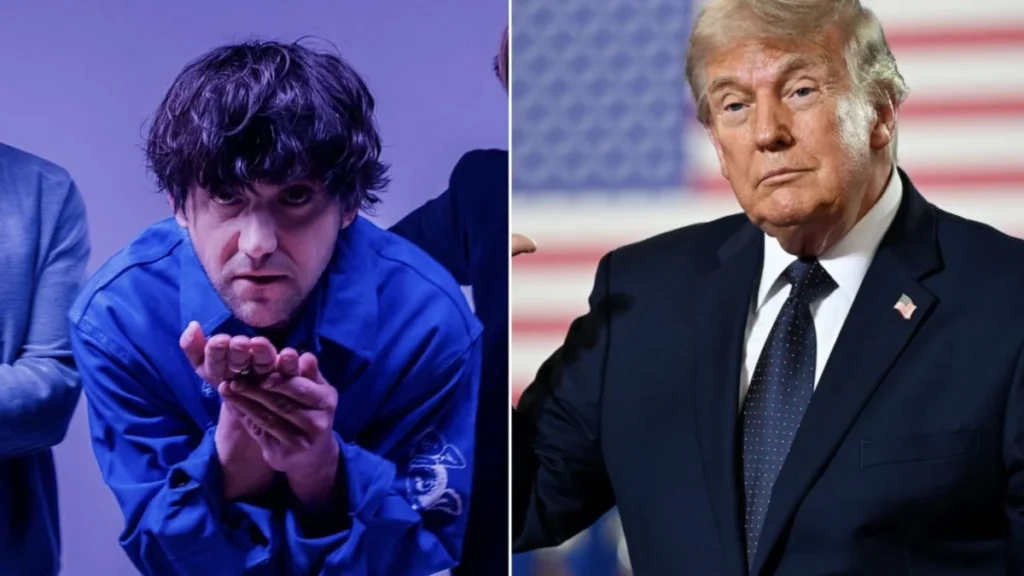

Conor Oberst, the acclaimed singer-songwriter known for his work with Bright Eyes and various solo projects, recently revealed his profound difficulty in channeling his signature protest songwriter voice during the Donald Trump presidential era. In a candid discussion during a New York Times “Popcast” interview posted on Thursday, Oberst articulated a struggle that many artists and observers have noted: the challenge of critiquing or satirizing a political landscape that often feels inherently absurd. This sentiment marks a stark contrast to his prolific and impactful political commentary during the George W. Bush administration, particularly exemplified by the iconic Bright Eyes track "When the President Talks to God."
Oberst’s remarks underscore a broader dilemma facing artists attempting to engage with contemporary politics. He explained, "It’s really hard for me to even articulate the Trump era." While he holds out hope that he might eventually find a way to express his thoughts on the former president in song, he finds the current political environment so "absurd" that it makes direct lyrical engagement exceptionally challenging. The core of his artistic paralysis, he clarified, lies in the nature of the political reality itself: "You can’t satirize, or whatever, what’s already like a parody" or a "disgusting, gross cartoon." This statement resonates with a widespread sentiment that the political theater of recent years has often outpaced conventional methods of artistic critique, blurring the lines between reality and caricature.
A Legacy of Protest: The Bush Years and "When the President Talks to God"
To fully appreciate Oberst’s current predicament, it is essential to recall his significant contributions to protest music in the early 2000s. During the administration of President George W. Bush, Oberst emerged as a prominent voice of dissent, actively incorporating social and political commentary into his music and live performances. His critique frequently targeted Bush’s policies, particularly the Iraq War, which began in March 2003 and became a focal point for anti-war movements globally.
The song "When the President Talks to God," released by Bright Eyes in 2005, stands as a quintessential example of Oberst’s protest ethos during this period. The track, a searing indictment of what Oberst perceived as the fundamentalist Christian rhetoric and policy decisions of the Bush administration, questioned the president’s moral authority and divine claims. Its lyrics, delivered with Oberst’s characteristic earnestness and vulnerability, struck a chord with a generation disillusioned by the political climate. The song’s impact was magnified by Oberst’s performance of the polemic on late-night television, a moment that quickly became symbolic of the opposition to the Bush administration. This performance was widely seen not only as a powerful act of artistic defiance but also as a continuation of a rich American tradition of protest songwriting, echoing the legacies of folk icons like Woody Guthrie, Bob Dylan, and Joan Baez.
At that time, Oberst reflected, "When the President Talks to God" felt like it carried significant weight and meaning. The socio-political context allowed for direct criticism to be perceived as impactful and genuinely provocative. However, he now observes a profound shift: "Now, I guess the bar has been lowered to such a degree societally in every kind of aspect of our lives." This perceived lowering of societal standards and public discourse, he suggests, renders traditional forms of protest less effective, as the shock value or critical edge is blunted by an already extreme reality.
The Unprecedented Nature of the Trump Era for Artists
The challenge Oberst describes is not unique to him but reflects a broader quandary for artists across various disciplines. The presidency of Donald Trump, from 2017 to 2021, was marked by a distinct communication style, frequent use of social media, and a political environment characterized by intense polarization and a rapid news cycle. For many, the sheer volume and nature of political events during this period made it difficult to process, let alone distill into artistic expression.
Artists often rely on exaggeration, metaphor, and satire to critique power structures. However, when political figures and events already seem to operate within a realm of hyperbole, the tools of satire can feel inadequate. As Oberst put it, "It’s such just an avalanche of insanity." This "avalanche" can overwhelm the creative process, making it difficult to find a coherent narrative or a novel angle for critique. The traditional role of the protest song, which often aims to expose hypocrisy or injustice, becomes complicated when the perceived transgressions are openly declared or seem to defy conventional moral frameworks.
Oberst revealed that he has indeed "contemplated and tried to write the protest songs of today," and the current political climate "permeates like everything I write." Yet, "to write directly towards it . . . I found it almost impossible." This suggests a distinction between general artistic reflection on the era and the creation of targeted, explicit protest anthems. The pervasive anxiety and tension of the times undoubtedly inform his artistic output, but a direct translation into protest material remains elusive.
The Chilling Effect: Fear and Intimidation
Beyond the aesthetic challenge of satirizing the seemingly unsatirical, Oberst posited another significant reason for the perceived lack of direct protest music: fear. "I think people are scared," he stated. "I think they have gone out of their way to try to intimidate all of us." This observation points to a potentially chilling effect on artistic expression, where creators might feel apprehensive about directly confronting powerful figures or deeply entrenched political ideologies.
In an increasingly polarized society, artists who take explicit political stances often face intense backlash, not only from political opponents but also from segments of the public and even their own fan bases. The rise of social media has amplified both support and criticism, allowing for rapid and widespread condemnation that can have significant personal and professional consequences. Economic pressures, the threat of boycotts, or even legal challenges could contribute to a climate where artists might self-censor or opt for more ambiguous forms of commentary. This isn’t just about fear of personal reprisal, but also the potential for misinterpretation or the futility of speaking into an echo chamber. When public discourse is so fragmented, the unifying power of a protest song might be diminished.
The Evolution of Protest and Artistic Response
While Oberst’s personal struggle is palpable, the landscape of protest art is continuously evolving. The absence of a direct "new ‘When the President Talks to God’" does not necessarily mean an absence of artistic engagement with political realities. Instead, it might signal a shift in how artists choose to respond. Some artists have opted for more abstract or metaphorical approaches, focusing on the emotional and psychological toll of political events rather than direct policy critiques. Others have engaged in activism outside of their music, using their platforms to support social causes or encourage civic participation.
Furthermore, the very nature of protest might have diversified. Online activism, viral memes, spoken word poetry, and various forms of digital art now contribute to the cultural conversation in ways that traditional protest songs once dominated. The immediate, often chaotic, nature of contemporary events might also necessitate a longer gestation period for artistic reflection. Historically, some of the most profound artistic responses to major societal shifts have emerged years, or even decades, after the events themselves, allowing for greater perspective and deeper analysis.
Bright Eyes’ Upcoming Tour and Continued Relevance
Despite the challenges of political songwriting, Conor Oberst remains an active and influential figure in the music world. Bright Eyes, the band he fronts, continues to connect with audiences, demonstrating the enduring power of their music, regardless of its explicit political content. The band is scheduled to perform at several festivals in August and September before embarking on a comprehensive U.S. tour. These performances offer fans an opportunity to experience Oberst’s artistry live, potentially hearing new material that subtly or overtly reflects the complex times, even if not in the direct protest style of his earlier work.
The upcoming Bright Eyes 2026 Tour Dates include:
- 08/08 – Omaha, NE @ Maha Festival
- 09/18 – Chicago, IL @ Riot Fest 2026
- 10/03 – Minneapolis, MN @ First Avenue *
- 10/05 – Detroit, MI @ Majestic Theatre *
- 10/06 – Cincinnati, OH @ Bogart’s *
- 10/07 – Philadelphia, PA @ Union Transfer *
- 10/09 – Washington, DC @ 9:30 Club *
- 10/10 – Asheville, NC @ The Orange Peel *
- 10/11 – Atlanta, GA @ Variety Playhouse *
- 10/12 – Nashville, TN @ Brooklyn Bowl *
- 10/13 – New Orleans, LA @ Tipitina’s *
- 10/15 – Austin, TX @ Stubb’s Waller Creek Amphitheatre *
- 10/16 – Dallas, TX @ Studio at The Factory *
- 10/17 – Kansas City, MO @ The Truman *
- 10/18 – St. Louis, MO @ The Sovereign *
-
- = w/ Lullaby for the Working Class
Fans interested in attending these shows can find tickets via Vivid Seats. A special offer allows purchasers to save $20 on their first order of $200 or more by using the promo code CONSEQUENCE20 at checkout.
Conor Oberst’s honest admission about the difficulty of writing protest songs in the Trump era serves as a poignant reflection on the state of contemporary political discourse and its impact on artistic creation. His struggle highlights the unique challenges posed by a political landscape that often defies conventional critique, leaving artists to grapple with how to effectively engage with an "avalanche of insanity" in an age where the "bar has been lowered to such a degree societally." As artists and audiences alike navigate these complexities, the evolving nature of protest and artistic response will continue to be a vital subject of discussion and innovation.