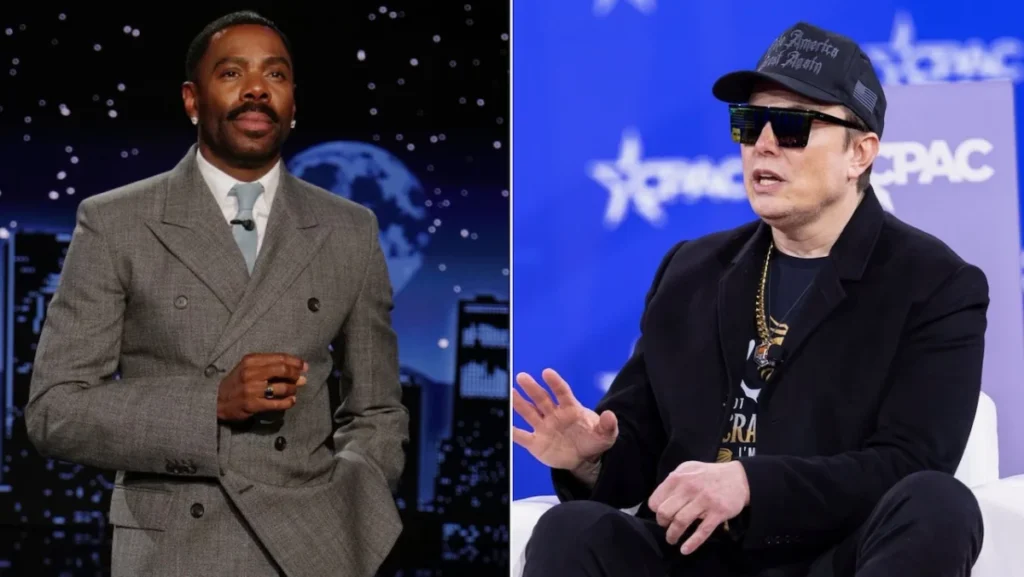

During his guest-hosting stint on Jimmy Kimmel Live on Wednesday night, acclaimed actor Colman Domingo brought Elon Musk’s recently announced AI-generated, “historically accurate” adaptation of Homer’s The Odyssey under sharp scrutiny, making it a central focus of his monologue. Domingo, known for his incisive wit and compelling performances, leveraged the late-night platform to deliver a pointed critique that resonated with ongoing debates about technology, artistic integrity, and representation in media.
Domingo wasted no time in dissecting the inherent contradictions of Musk’s proposed project. “By historically accurate,” Domingo quipped, “he means whiter than Christmas at Cracker Barrel.” This statement immediately highlighted the perceived racial undertones of Musk’s ambition, suggesting that the tech magnate’s pursuit of "accuracy" was implicitly linked to a preference for a Eurocentric, and specifically white, interpretation of ancient Greek mythology. The Oscar-nominated actor further elaborated, stating, “Of course, this is all because Elon and his Musketeers are upset over the diversity casting of The Odyssey.” This comment directly addressed the cultural flashpoint that has emerged around inclusive casting in historical and mythological narratives. Domingo then delivered a critical blow to the premise itself: “And I don’t want to get technical here, but you can’t make a historically accurate version of something that is totally made the fuck up.” He cemented this point by asserting, “The Odyssey is fiction, like The Hunger Games or the president’s cognitive exams,” drawing a humorous parallel that underscored the fantastical nature of the epic poem while also injecting a topical political jab.
The Genesis of Controversy: Elon Musk’s Vision for The Odyssey
Elon Musk, the prolific entrepreneur behind Tesla, SpaceX, and X (formerly Twitter), first signaled his interest in producing a new adaptation of The Odyssey earlier this year, primarily through his social media platform. His pronouncements indicated a desire to create a version that would be distinct from contemporary adaptations, emphasizing what he termed "historical accuracy" and a significant reliance on artificial intelligence for its production. This announcement emerged against a backdrop of increasing cultural debate surrounding diverse casting in classical and historical narratives.
Musk’s vision, as articulated in various posts and statements, seemed to position itself as a counter-narrative to recent trends in Hollywood that prioritize inclusive representation. The phrase "historically accurate," when invoked by figures like Musk in this context, has often been interpreted by critics as a coded preference for ethnically homogenous casts that align with traditional, often colonial-era, interpretations of historical figures and mythological characters. This perspective often overlooks the complex, multicultural nature of ancient societies and the inherently fluid, interpretive nature of mythology.
The integration of artificial intelligence is another cornerstone of Musk’s proposed project. As a leading figure in AI development, with ventures like xAI and the advanced AI capabilities in Tesla’s self-driving technology, Musk frequently advocates for the transformative potential of AI across various sectors. His plan to utilize AI for The Odyssey aligns with a broader industry discussion about the technology’s role in filmmaking, from scriptwriting and visual effects to entire scene generation. However, this also raises significant questions about artistic authorship, creative control, and the future of human employment in the creative industries, issues that have been central to recent labor disputes in Hollywood.
Colman Domingo’s Critique: Unpacking the Monologue
Colman Domingo’s commentary on Jimmy Kimmel Live was more than just a comedic routine; it was a carefully constructed critique informed by his background as an artist deeply engaged with storytelling and representation. Domingo, an Emmy Award winner for Euphoria and an Academy Award nominee for Rustin, has consistently used his platform to advocate for diversity and authenticity in narrative.
His opening jest, comparing Musk’s "historically accurate" vision to "whiter than Christmas at Cracker Barrel," is a culturally specific barb. Cracker Barrel, an American restaurant chain, is often associated with a traditional, rustic, and predominantly white Southern aesthetic. This analogy effectively communicated Domingo’s perception that Musk’s "accuracy" was less about scholarly rigor and more about a cultural preference that excludes diverse interpretations. It’s a direct challenge to the notion that "historical accuracy" in classical works necessarily equates to an all-white cast, especially given the rich tapestry of ancient Mediterranean cultures.
Domingo’s assertion that The Odyssey is "totally made the fuck up" strikes at the heart of the debate. Homer’s epics, The Iliad and The Odyssey, are foundational texts of Western literature, weaving together myth, folklore, and possibly echoes of historical events. While they offer insights into ancient Greek values, beliefs, and societal structures, they are fundamentally works of poetic imagination, populated by gods, monsters, and fantastical voyages. To demand strict "historical accuracy" from such a narrative is to misunderstand the very nature of myth and epic poetry. Historians and classicists widely acknowledge that while Homeric epics might contain grains of truth related to the Bronze Age or early Iron Age, they are not historical documentaries. Applying modern historical standards to ancient myths fundamentally misinterprets their purpose and genre.
The comedic comparison to The Hunger Games further solidifies this point, juxtaposing one fictional epic with another widely recognized fictional narrative. The inclusion of "the president’s cognitive exams" as another example of "fiction" serves as a contemporary political reference, adding a layer of humor and topicality that resonates with a late-night television audience. This specific jab, while humorous, also reflects a broader political climate where perceived mental acuity of leaders is a frequent subject of public discourse.
The Odyssey and Adaptation: A Legacy of Reinterpretation
Homer’s The Odyssey, an epic poem traditionally attributed to the blind poet Homer, narrates the ten-year journey of the Greek hero Odysseus (Ulysses in Roman mythology) as he struggles to return home to Ithaca following the Trojan War. Filled with encounters with mythical creatures, divine interventions, and human challenges, it is a timeless tale of perseverance, homecoming, and the human condition. Its themes of identity, loyalty, and the perils of hubris have ensured its enduring relevance for millennia.
The history of The Odyssey‘s adaptation is as long and varied as its initial telling. From ancient Greek tragedies and Roman epic poems that drew inspiration from Homer, to medieval retellings and Renaissance art, the narrative has consistently been reinterpreted through the lens of each new era. In modern times, it has inspired countless works across literature, theatre, and cinema. Notable film adaptations range from the 1954 Italian film Ulysses starring Kirk Douglas to Andrei Konchalovsky’s 1997 miniseries. More recently, the Coen Brothers’ 2000 film O Brother, Where Art Thou? famously recontextualized the epic in the American South during the Great Depression, demonstrating the narrative’s adaptability to vastly different cultural settings.
The question of diversity in classical adaptations has become particularly pronounced in recent years. Productions like Netflix’s Troy: Fall of a City and various stage interpretations of Greek tragedies have featured racially diverse casts, prompting both praise for inclusivity and criticism from those who argue for "historical accuracy." Proponents of diverse casting emphasize that these ancient stories belong to all of humanity and that casting actors of color not only reflects contemporary global audiences but also revitalizes the narratives, making them more accessible and resonant for new generations. They argue that mythological narratives, by their very nature, transcend specific historical racial compositions and offer fertile ground for imaginative and inclusive interpretation. The idea that ancient Greece was ethnically monolithic has also been challenged by historical scholarship, which points to significant cultural exchange and diverse populations within the broader Mediterranean world.
The Broader Context: AI, Representation, and the Culture Wars
Colman Domingo’s monologue touches upon several major fault lines in contemporary culture: the rapidly evolving role of artificial intelligence, the persistent demand for equitable representation in media, and the ongoing "culture wars" that often play out in the entertainment industry.
The discussion around AI in filmmaking is intensifying. While AI offers unprecedented tools for visual effects, animation, and even script generation, its integration raises profound ethical and economic questions. The recent Writers Guild of America (WGA) and Screen Actors Guild – American Federation of Television and Radio Artists (SAG-AFTRA) strikes saw AI as a central point of contention, with unions seeking protections against the displacement of human talent and the unauthorized use of actors’ likenesses. Musk’s explicit plan to use AI for The Odyssey places his project squarely within this contentious debate, fueling concerns about the future of creative labor and the nature of artistic expression when algorithms play a dominant role.
Simultaneously, the entertainment industry is grappling with persistent calls for greater representation. Studies consistently show that diverse casts and inclusive storytelling lead to better box office returns and higher viewership, reflecting an increasingly diverse global audience. However, resistance to these changes often manifests in arguments about "historical accuracy" or "authenticity," particularly when it comes to reimagining established narratives with non-traditional casting choices. This dynamic often pits artistic freedom and modern sensibilities against a more rigid, sometimes anachronistic, adherence to perceived historical norms.
Elon Musk, as a prominent figure who frequently engages in public discourse on social and political issues, often positions himself at the center of these "culture wars." His public statements and endorsements of specific viewpoints have made him a lightning rod for both fervent support and strong criticism. His Odyssey project, therefore, is not merely a film production but a cultural statement, consciously or unconsciously aligning itself with a particular side in the ongoing debates about tradition, innovation, and identity in storytelling.
Implications and Future Outlook
Colman Domingo’s public mockery, delivered from a high-profile late-night platform, is unlikely to derail Elon Musk’s ambitions for The Odyssey entirely, but it certainly contributes to the public discourse surrounding the project. It serves as a potent reminder that attempts to redefine or reclaim narratives under the banner of "historical accuracy" will face scrutiny, especially when they appear to dismiss efforts towards diversity and creative interpretation.
The incident underscores the continuing tension between technological advancement and artistic integrity. As AI tools become more sophisticated, the conversation about their ethical application and their impact on human creativity will only grow louder. Domingo’s critique suggests that a purely algorithmic approach, especially one driven by a controversial definition of "accuracy," may struggle to capture the nuance, emotion, and human insight that defines great storytelling.
Furthermore, this exchange highlights the enduring power of satire and celebrity commentary in shaping public opinion and challenging dominant narratives. Domingo, through humor and sharp observation, effectively articulated the concerns of many artists and cultural commentators regarding the potential pitfalls of a technologically driven, narrowly defined approach to classical literature. The debate surrounding Musk’s Odyssey is thus not just about a single film project; it is a microcosm of larger societal struggles over who gets to tell stories, how those stories are told, and what values they ultimately represent. The journey of Odysseus, a tale of overcoming formidable challenges, ironically continues to inspire new challenges and debates in the modern age, proving its timeless capacity to provoke thought and discussion.