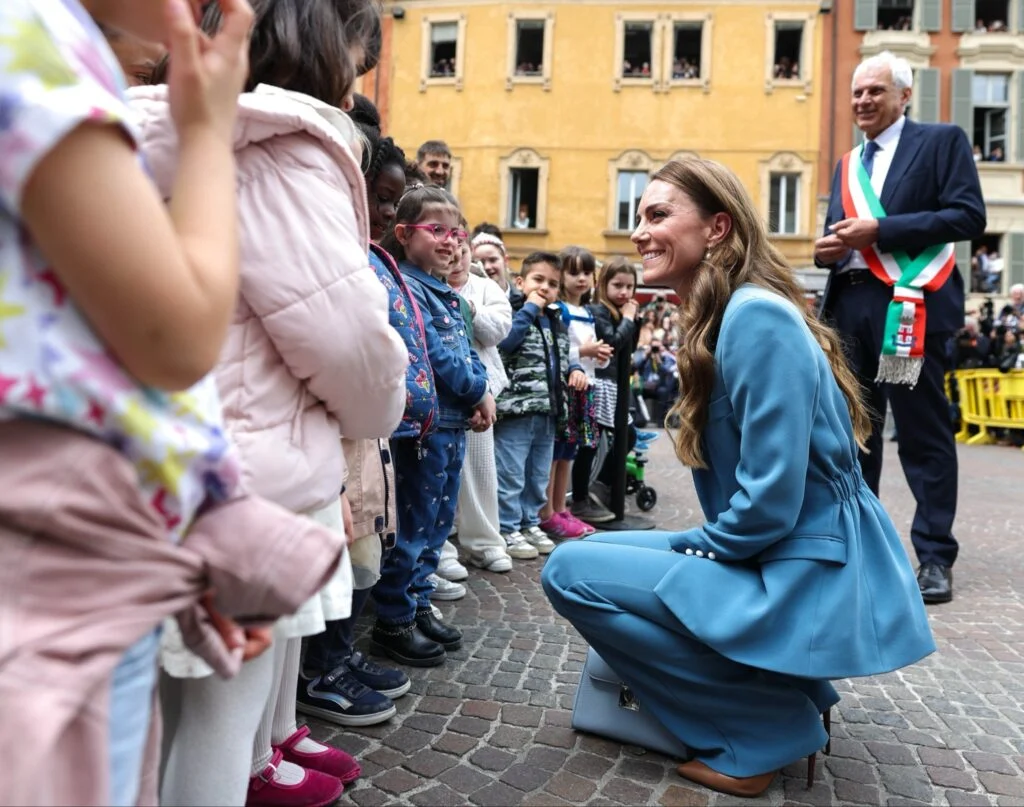

The Princess of Wales surprised and delighted royal watchers during her recent official visit to Italy by introducing herself in Italian as "Catarina." This charming linguistic display occurred during an engagement in Reggio Emilia, a city renowned for its innovative approach to early childhood education, marking a significant moment in her first overseas trip since undergoing cancer treatment. The Princess, who is widely known to the public as Kate Middleton, revealed her proficiency in the Italian language while interacting with children at the Loris Malaguzzi Centre, a globally recognized institution dedicated to child-centered learning. Her adoption of the Italian form of her name, "Catarina," resonated deeply with the local populace and underscored her engagement with the cultural fabric of her surroundings.
A Multilingual Monarch in the Making
The Princess’s use of Italian, even if limited, was a carefully orchestrated and warmly received gesture. While speaking with a group of children, she humbly stated, "I speak a bit of Italian," accompanied by a gesture indicating a modest command of the language. This was followed by a direct and engaging introduction: "What is your name? I am Catarina." This moment not only showcased her personal linguistic abilities but also added a new layer to the public perception of her evolving royal persona. "Catarina" is, of course, the Italian cognate of Catherine, a name that has been associated with the Princess throughout her public life. Prior to her marriage to Prince William, she was famously known as Kate Middleton. Upon their union in 2011, they became the Duke and Duchess of Cambridge. More recently, they were elevated to the esteemed titles of Prince and Princess of Wales by His Majesty King Charles III. It is also noteworthy that when in Scotland, the couple holds the distinct Scottish titles of Duke and Duchess of Rothesay. The Princess’s fluency in Italian is not entirely unexpected; she spent a period studying in Florence in 2000, a significant precursor to her university education. This visit, however, marks one of the most public and prominent instances where she has actively utilized her Italian language skills during an official royal engagement.
A Deep Dive into Early Childhood Innovation
The Princess of Wales’s visit to Italy was intrinsically linked to her ongoing and passionate work with The Royal Foundation Centre for Early Childhood. This initiative, which she personally launched, is dedicated to championing the critical importance of early childhood development and its profound impact on individuals and society as a whole. Reggio Emilia, her chosen destination, is globally celebrated for its unique pedagogical philosophy, which places the child at the heart of the learning experience, fostering creativity, curiosity, and a deep connection with their environment.
During her time at the Loris Malaguzzi Centre, the Princess was able to witness firsthand the implementation of these groundbreaking educational principles. The centre’s approach emphasizes the interconnectedness of children, educators, families, and the community, creating a rich and stimulating ecosystem for learning and growth. This visit provided a valuable opportunity for the Princess to engage with international experts and practitioners in the field, gathering insights and forging collaborations that can further advance her early years agenda. Her presence in Italy, a country with a rich cultural heritage and a deep appreciation for familial bonds, provided a fitting backdrop for her exploration of early childhood development.
A Message of Hope and Shared Vision
In a heartfelt message shared on social media platforms following her visit, the Princess of Wales articulated her profound admiration for Reggio Emilia. She described the city as "a city shaped by its belief in children and in the environments, relationships and connections that help them thrive in their early years." This statement eloquently encapsulates the core tenets of the Reggio Emilia approach and highlights the Princess’s alignment with its foundational principles. Her words resonated with those who share her vision for a future where every child is given the optimal opportunities to flourish from their earliest moments.
The Princess also made a poignant visit to the Anna Frank School, another institution that exemplifies the innovative spirit of early childhood education in the region. Her interactions with the excited crowds who gathered to welcome her demonstrated a genuine warmth and approachability, further solidifying the positive reception of her visit. These public appearances, coupled with her insightful pronouncements, underscore her dedication to her role as a global advocate for early years development.
The Significance of a Diplomatic and Personal Milestone
The Princess of Wales’s Italian sojourn carries multifaceted significance. On a diplomatic level, it represents a strengthening of cultural ties between the United Kingdom and Italy, particularly in the realm of education and child welfare. Her ability to communicate in Italian, even in a limited capacity, facilitates a more personal and authentic connection with the communities she visits, fostering goodwill and mutual understanding.
From a personal perspective, this visit is a powerful testament to her resilience and unwavering commitment to her public duties. Her recovery from cancer treatment has been closely followed by the public, and her return to international engagements signals a renewed vigor and dedication to her royal responsibilities. The choice of Italy and the specific focus on early childhood education also reveal a strategic alignment with her long-term philanthropic goals. The Princess has consistently championed the importance of the first five years of a child’s life, recognizing it as a critical period for cognitive, social, and emotional development. Her engagement with the Reggio Emilia model, which is globally recognized for its efficacy, allows her to draw inspiration and disseminate best practices to a wider audience.
Broader Implications for Royal Diplomacy and Advocacy
The Princess of Wales’s introduction as "Catarina" and her display of Italian language skills are more than just a charming anecdote; they are indicative of a evolving approach to royal diplomacy. In an increasingly interconnected world, the ability of public figures to engage with different cultures and languages can foster stronger international relationships. This approach moves beyond traditional diplomatic protocols, emphasizing personal connection and cultural understanding.
Her commitment to early childhood development, amplified by this international visit, positions her as a significant advocate on a global stage. The Royal Foundation Centre for Early Childhood has been instrumental in raising awareness and driving research in this crucial area. By engaging with leading educational models in Italy, the Princess is not only gathering valuable knowledge but also lending her considerable influence to promote these innovative approaches worldwide. This can translate into increased investment in early years programs, policy changes that prioritize child well-being, and a greater societal understanding of the long-term benefits of investing in children from birth.
The public’s positive reaction to her linguistic demonstration and her genuine engagement with the children and educators at the centres she visited highlights the effectiveness of this more personal and culturally sensitive form of royal engagement. It suggests a royal family that is adapting to the modern era, embracing opportunities to connect with people on a more profound level, and using its platform to champion causes of global importance. The Princess of Wales, through her visit to Italy and her introduction as "Catarina," has undoubtedly left a lasting positive impression, underscoring her growing stature as a compassionate and effective royal advocate. Her continued work in early childhood development, now bolstered by international collaboration and recognition, promises to have a significant and enduring impact.