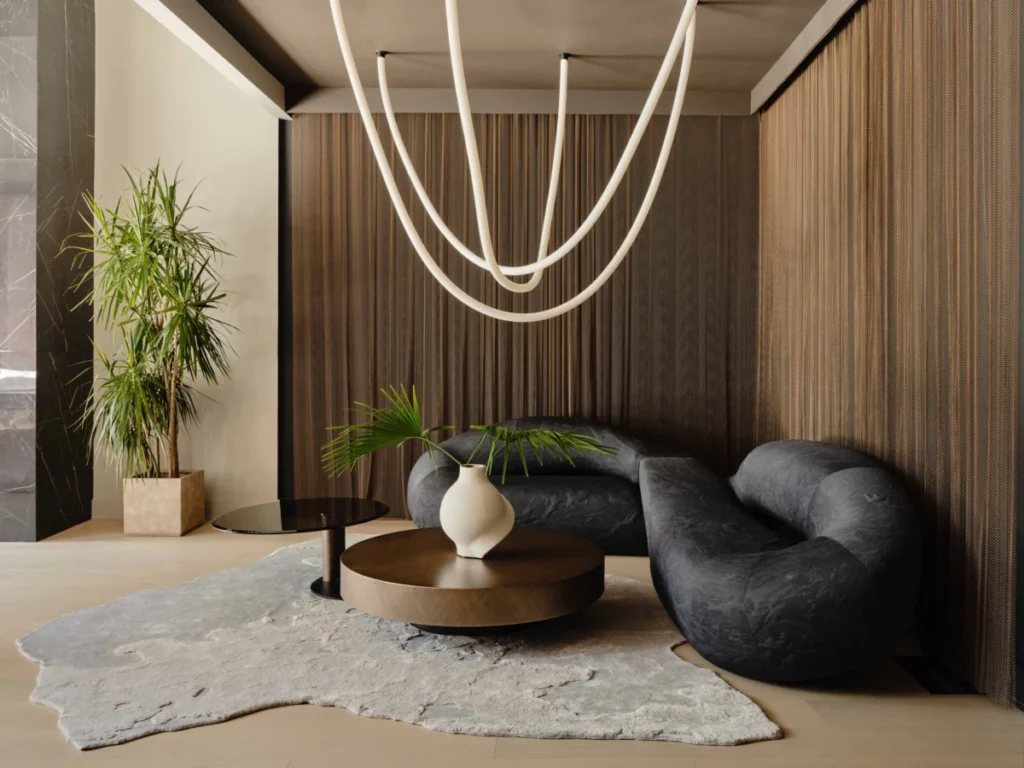

In the high-stakes environment of the Kips Bay Decorator Show House Dallas, held in November 2024, interior designers were tasked with transforming a sprawling, former commercial office space into a residential masterpiece. Among the most discussed installations was the work of Marcus Mohon of Mohon Interiors, who faced the daunting challenge of reconciling an 800-square-foot expanse characterized by flat, 10-foot ceilings and a lack of architectural character. His solution, which has since sparked a broader conversation within the design community, involved the use of a fine metal bead curtain to create an intimate evening lounge. By encircling a central dining area with shimmering metallic strands, Mohon successfully partitioned the room without the permanence of drywall, achieving what he described as a "gentle obscuring of vision" that maintained the room’s volume while fostering a sense of cloistered privacy.
This installation serves as a focal point for an emerging trend in both residential and commercial interior design: the strategic use of chainmail, ring mesh, and metal bead curtains as architectural tools. These materials, which bridge the gap between heavy industrial hardware and delicate textile drapery, are increasingly being utilized by top-tier design firms to navigate the complexities of modern open-plan living. As designers move away from the rigid boundaries of traditional walls, they are embracing materials that offer "material in motion"—elements that provide privacy, light filtration, and acoustic dampening while retaining a sense of transparency and fluidity.
The Kips Bay Catalyst and the Sensory Experience of Metal
The reaction to Mohon’s Dallas showroom was immediate and visceral. Early visitors to the space frequently paused, questioning if the dining area was shrouded in smoke or mist. This optical illusion is a hallmark of fine metal bead curtains; when light hits the rounded surfaces of the beads, it scatters, creating a blurred, ethereal effect that softens the surrounding architecture. Mohon noted that the material invited physical interaction, with guests frequently touching the curtains to confirm their composition.

The design objective was to provide architectural distinction in a space that possessed none. By avoiding traditional walls, the design team kept the 800-square-foot room from feeling cramped, instead opting for a "room within a room" concept. This approach addresses a common critique of modern architecture: the "nondescript" nature of large, open volumes. The metal curtain acted as a translucent boundary, allowing the eye to register the full scale of the office-turned-lounge while signaling a shift in purpose for the central dining zone.
Historical Lineage: From the Seagram Building to Modern Hospitality
While the current surge in metal mesh popularity feels contemporary, it draws on a prestigious mid-century lineage. One of the most significant historical precedents is the former Four Seasons Restaurant located within New York City’s Seagram Building. In the late 1950s, textile designer Marie Nichols collaborated with architect Philip Johnson to install horizontal chain panels as window treatments. These curtains were designed to ripple and shimmer with the movement of air from the building’s HVAC system, adding a dynamic, kinetic layer to the austere, modernist dining room.
The fact that these features remain in the space today—now operating as The Grill—underscores the durability and timelessness of the material. Modern designers are now expanding on this legacy. The firm Charlap Hyman & Herrero has been at the forefront of this experimentation, integrating chainmail into a variety of high-end projects. Adam Charlap Hyman, a principal at the firm, highlights the "contradiction" of the material: its ability to be both armorial and translucent. In their work at the Pocketbook Hudson hotel in Hudson, New York, the firm used swinging chainmail curtains to frame the restaurant’s dining room. By layering sconces behind the mesh, they created a glow that suggests a hidden depth, effectively using the material to manipulate the perception of space.
Technical Specifications and Material Science
The shift toward metal curtains is not merely aesthetic; it is rooted in the practicalities of material science and building regulations. In commercial and hospitality settings, fire safety codes are a primary concern. Traditional fabric curtains often require expensive chemical treatments to meet flame-retardancy standards, and even then, they can pose a risk. Metal mesh, typically fabricated from stainless steel, brass, or aluminum, is inherently non-combustible. This makes it an ideal choice for hotels, restaurants, and public venues where safety is paramount.

From a maintenance perspective, stainless steel mesh is exceptionally durable. Unlike textiles, it does not absorb odors, harbor allergens, or stain easily. Maintenance generally involves nothing more than light dusting with a feather duster or a vacuum attachment. However, the primary hurdle for this material lies in its installation and weight.
Supporting data from recent installations indicates the sheer scale of the engineering required. Marcus Mohon’s Kips Bay curtain, for example, weighed in excess of 400 pounds. Such installations require reinforced ceiling tracks and the expertise of specialized drapery installers who understand the load-bearing requirements of metal. While industrially produced chainmail is more cost-effective than hand-forged varieties, the "hidden costs" of structural support and professional installation must be factored into the project budget.
Residential Integration: The Lil Baby Atlanta Project
The trend is rapidly migrating from the public sphere into the private residences of the elite. Designer Annysa LaMantia recently utilized a brass-toned, honeycomb-patterned metal curtain for the Atlanta home of the performer Lil Baby. In this context, the curtain served as a wall treatment that allowed the homeowner to reshape the room’s atmosphere at will.
LaMantia’s use of the material highlights its versatility. Unlike a static wall, a metal curtain mounted on a ceiling track can be drawn back to reveal a larger entertaining space or closed to create an intimate sanctuary. This flexibility is particularly valuable in the homes of high-profile individuals who require spaces that can transition from private living quarters to public-facing event venues. LaMantia observes that the material "reveals or obscures" depending on the angle of light and the movement of the occupant, creating a living surface that evolves throughout the day.

Chronology of a Resurging Trend
The timeline of metal mesh in interior design reveals a steady progression from industrial utility to high-fashion decor:
- 1950s-1960s: Early adoption in modernist landmarks like the Seagram Building, primarily for window treatments in commercial spaces.
- 1990s-2000s: Increased use in industrial-chic architecture, often as exterior cladding or heavy-duty room dividers in lofts.
- 2010s: Development of "fine" meshes and bead curtains that mimic the drape of silk and linen, allowing for more delicate applications.
- 2020-Present: Post-pandemic design shifts focus toward "flexible zoning." Metal mesh becomes a primary tool for designers looking to create multi-functional spaces without permanent structural changes.
Broader Impact and Interior Design Implications
The resurgence of chainmail and metal beads signals a move away from the "recycled" aesthetics of previous decades. For much of the early 21st century, interior design was dominated by a tendency to revisit Mid-Century Modern or Art Deco palettes. Metal mesh, however, feels distinctly forward-looking despite its ancient origins in armor-making.
Industry analysts suggest that this trend reflects a broader architectural shift toward "soft architecture." As remote work and hybrid lifestyles continue to influence home design, the need for spaces that can perform multiple functions has never been higher. A chainmail curtain allows a dining room to serve as a conference room by day and a formal entertaining space by night, providing the necessary acoustic and visual separation without the "closed-in" feeling of a traditional office.
Furthermore, the material’s ability to interact with light—both natural and artificial—makes it a powerful tool for lighting designers. As seen in the Pocketbook Hudson project, metal mesh can act as a diffuser, a reflector, or a screen, allowing for complex layering of light that adds drama and mystery to an interior.

Future Outlook: From West Texas to the Global Market
The success of these high-profile installations is already influencing upcoming projects across the globe. Mohon Interiors has reported that the enthusiastic response to their Kips Bay room has led to the inclusion of chainmail in several upcoming residential projects, including a Spanish Colonial ranch in West Texas. In that specific application, the metal curtains will be used in a home gym, providing a contemporary, "tough" counterpoint to the home’s traditional Spanish architecture.
As manufacturing techniques continue to evolve, the cost of high-quality metal mesh is expected to become more accessible to the mid-market, likely leading to a proliferation of the style in high-end retail and boutique residential developments. Designers like Jamie Loren, who recently installed independent chain-link strands at the Pasadena Showcase House of Design, are pushing the boundaries of movement, using custom hook systems to allow each strand to hang freely. This increased movement further blurs the line between sculpture and drapery.
Ultimately, the rise of architectural metal mesh represents a sophisticated solution to the age-old design problem of how to divide space. By embracing the "allure of the hidden" and the technical benefits of metal, designers are creating interiors that are not only functional and safe but also deeply atmospheric. In an era where the home must be everything to everyone, the fluidity of chainmail offers a way to define our environment without being confined by it.