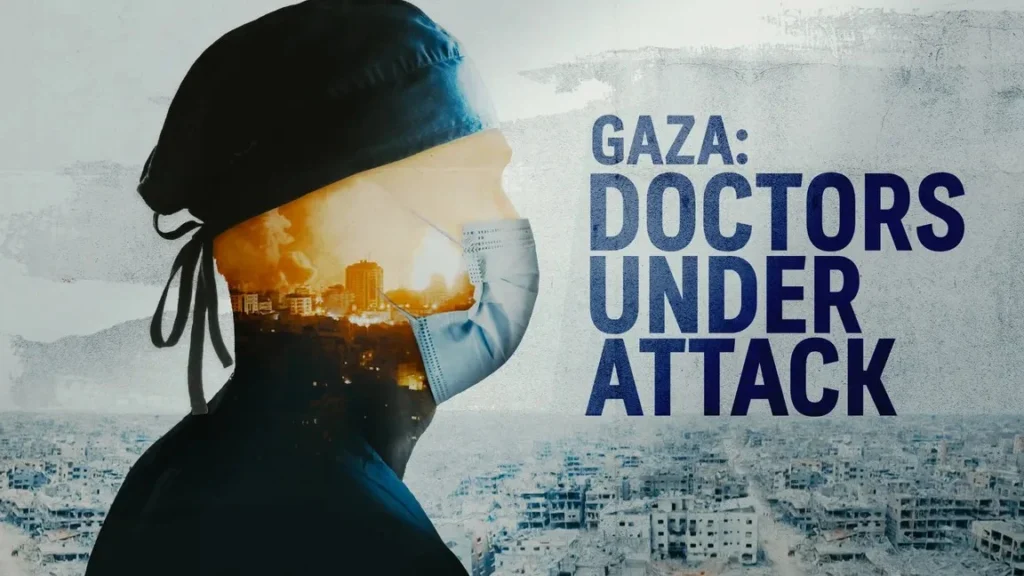

The team behind the Channel 4 documentary Gaza: Doctors Under Attack, a film originally commissioned and then controversially shelved by the BBC citing impartiality concerns, received a prestigious award at the 2024 BAFTA Television Awards on Sunday, May 12, and utilized their acceptance speech as a powerful platform to criticize both Israel’s actions in Gaza and the BBC’s editorial decisions. The unexpected and direct confrontation unfolded live on stage, injecting a potent political and ethical debate into an evening typically dedicated to celebrating television excellence.
The BAFTA Stage: A Platform for Protest
British journalist Ramita Navai, the documentary’s reporter, and Ben De Pear, the program’s executive producer and a former Channel 4 News editor, delivered impassioned speeches after Gaza: Doctors Under Attack secured the Current Affairs BAFTA during the second half of the ceremony, held at the Southbank Centre’s Royal Festival Hall in London. Their remarks immediately drew significant attention, resonating far beyond the confines of the awards venue.
Navai, clutching the golden mask trophy, began by acknowledging the significance of the award for the team. She then shifted focus, stating, "This award means so much to us. Israel has killed over 47,000 children and women in Gaza so far. Israel has targeted every single one of Gaza’s hospitals. It’s killed over 1,700 Palestinian doctors and health care workers. It has imprisoned over 400 in what the UN now calls a ‘medicide.’ These are the findings of our investigation that the BBC paid for but refuses to show. But we refuse to be silenced and censored." Navai’s statistics, while subject to the inherent difficulties of precise casualty counting in an active war zone, reflect figures widely reported by Palestinian health authorities and humanitarian organizations like the UN Office for the Coordination of Humanitarian Affairs (OCHA) and the World Health Organization (WHO), which have consistently highlighted the devastating human cost and the catastrophic impact on Gaza’s healthcare system since the escalation of hostilities in October 2023. The term "medicide," attributed by Navai to the UN, has been used by some human rights advocates and international legal experts to describe the systematic destruction of healthcare infrastructure and the targeted killing of medical personnel, though it is not yet a formally established term within UN legal frameworks akin to "genocide."
Following Navai, Ben De Pear reinforced the team’s message, dedicating the award to the two local journalists on the ground "who made this film for us." He emphasized the perilous environment they worked in, noting, "They did so amongst the killing spree that killed over 250 of their colleagues, journalists in Gaza." This figure, frequently cited by organizations such as the Committee to Protect Journalists (CPJ), underscores the unprecedented dangers faced by media professionals reporting from the besieged enclave, making the current conflict one of the deadliest for journalists in recent history. De Pear then concluded with a direct and provocative question aimed squarely at the BBC, which was scheduled to air a delayed broadcast of the BAFTA TV Awards later that evening. Looking directly into the camera, he challenged, "Finally, just a question to the BBC. Given you dropped our film, will you drop us from the BAFTAs screening later tonight?" This rhetorical query highlighted the tension between the BBC’s editorial independence and its role as a public broadcaster, while simultaneously drawing attention to the perceived censorship of their documentary.
The Shelved Documentary: Gaza: Doctors Under Attack
The documentary at the heart of the controversy, Gaza: Doctors Under Attack, was initially commissioned by the BBC but ultimately never aired by the corporation. The BBC cited "impartiality concerns" as the primary reason for its decision to shelf the film. This rationale is rooted in the BBC’s foundational charter and its strict editorial guidelines, which mandate impartiality and objectivity, particularly in reporting on politically sensitive and conflict-ridden regions. The BBC’s editorial policy states that its output must be "duly impartial," a standard that often involves balancing perspectives and avoiding content perceived as advocating for one side in a conflict. In the context of the Israeli-Palestinian conflict, the BBC has historically faced intense scrutiny from various factions, with accusations of bias originating from both pro-Israeli and pro-Palestinian camps. This constant pressure often leads the broadcaster to exercise extreme caution in its content decisions.
Following the BBC’s decision, Channel 4, another prominent UK public service broadcaster with a reputation for airing challenging and investigative documentaries, acquired and broadcast Gaza: Doctors Under Attack. Channel 4’s editorial remit, while also emphasizing accuracy and fairness, is often perceived as having greater latitude for programs that might take a more singular perspective or delve into highly sensitive subjects without the same level of perceived balancing act expected from the BBC. The documentary reportedly offered a harrowing account of the challenges faced by medical professionals in Gaza, documenting the severe strain on hospitals, the constant threat of violence, and the overwhelming humanitarian crisis impacting civilians. Its broadcast on Channel 4 brought these stories to a wider audience, making the BBC’s earlier decision to shelve it even more contentious in the eyes of the filmmakers and their supporters.
The Devastating Context: Gaza’s Healthcare Crisis and Civilian Toll
The claims made by Navai and De Pear at the BAFTA ceremony are set against the backdrop of an unprecedented humanitarian catastrophe unfolding in the Gaza Strip, particularly since the escalation of hostilities following the October 7, 2023, attacks by Hamas on Israel. The subsequent Israeli military operation has led to widespread destruction, displacement, and a severe healthcare crisis.
According to figures from the Palestinian Ministry of Health in Gaza, corroborated by various UN agencies, the death toll among Palestinians has surpassed 35,000, with a significant proportion being women and children. While exact figures for "47,000 children and women" specifically killed may fluctuate or represent combined categories over a longer period or include those missing and presumed dead, the overall trend of extremely high civilian casualties, especially among vulnerable populations, is consistently reported by international bodies. For instance, UNICEF and WHO have repeatedly highlighted that children and women constitute the majority of fatalities.
The state of Gaza’s healthcare system has been a central concern for international humanitarian organizations. Before October 7, Gaza’s healthcare infrastructure was already fragile due to years of blockade. The ongoing conflict has pushed it to the brink of collapse. WHO reports indicate that as of May 2024, only a fraction of Gaza’s 36 hospitals are minimally functional, and even those operate with severe shortages of staff, medicine, fuel, and equipment. Many hospitals have been directly hit or rendered inoperable due to siege, lack of resources, or military operations in their vicinity. Claims of hospitals being "targeted" refer to various incidents, including direct strikes, surrounding by military forces, or operations conducted within hospital compounds, which international law views with extreme gravity given the protected status of healthcare facilities in conflict zones. Physicians for Human Rights – Israel, along with other groups, has documented the severe impact on healthcare professionals, including killings and detentions, echoing the "1,700 doctors and healthcare workers" figure cited by Navai, which aligns with reports from Palestinian medical unions and international human rights watchdogs. The detention of medical staff, including hospital directors, has also been widely reported by human rights organizations like Amnesty International and Human Rights Watch, raising serious concerns about their treatment and the functioning of the remaining healthcare services.
Journalists Under Fire: An Unprecedented Toll
De Pear’s dedication to local journalists in Gaza underscored another grim reality of the conflict. The Committee to Protect Journalists (CPJ) has consistently reported that the current conflict is one of the deadliest on record for journalists. As of early May 2024, CPJ’s investigations indicated that at least 100 journalists and media workers have been killed, with the vast majority being Palestinian journalists in Gaza. Other organizations, including the International Federation of Journalists (IFJ) and the Palestinian Journalists’ Syndicate, have reported even higher figures, sometimes exceeding 150 or even 200, when including missing or presumed dead individuals. These numbers highlight the extreme risks faced by those attempting to document the conflict, often working without adequate protection or resources, and in an environment where media infrastructure has also been significantly damaged. The targeting or killing of journalists raises profound questions about press freedom and the ability of the international community to receive accurate, independent reporting from the ground.
The BBC’s Impartiality Challenge and Broader Implications
The BBC’s decision to shelve Gaza: Doctors Under Attack and the subsequent public rebuke at the BAFTA Awards reignited a long-standing debate about the nature of impartiality in conflict reporting, particularly for a public service broadcaster with a global reach. The BBC’s Royal Charter mandates it to act in the public interest, providing "accurate and impartial news, current affairs and factual programming." This strict interpretation often leads the BBC to avoid language or content that could be perceived as taking a side, even when reporting on situations with clear power imbalances or immense human suffering. Critics argue that such an approach can sometimes lead to a false equivalence or a reluctance to highlight specific atrocities, effectively "silencing" certain narratives or rendering the broadcaster overly cautious to the point of inaction.
The BBC has faced similar controversies in the past regarding its coverage of conflicts, including those in Ukraine, Syria, and Afghanistan, where balancing different perspectives without diminishing the impact on civilians or appearing to legitimize aggression has proven immensely difficult. The question posed by De Pear—whether the BBC would "drop" the segment from its delayed BAFTA broadcast—placed the corporation in a direct predicament. Omitting the speech would invite accusations of further censorship and hypocrisy, while including it would mean broadcasting a direct critique of its own editorial judgment and a challenge to its impartiality framework. This moment crystallized the tension between journalistic advocacy, the imperative to document human suffering, and the institutional demands of a public service broadcaster.
For media freedom advocates, the incident highlighted the increasing pressure on journalists and media organizations covering conflicts. The shelving of the documentary, combined with the high death toll among journalists in Gaza, underscores a global trend of diminishing space for independent reporting, particularly from conflict zones. Awards ceremonies, traditionally platforms for artistic recognition, are increasingly becoming venues for social and political commentary, allowing creators to amplify messages they believe are being suppressed elsewhere.
The 2024 BAFTA TV Awards: A Night of Mixed Emotions
The 2024 BAFTA Television Awards, hosted by comedian Greg Davies, aimed to celebrate the best of British television. While Gaza: Doctors Under Attack took home a significant award in current affairs, other notable winners included Netflix drama Adolescence, which led nominations with 11 nods, and Disney+’s A Thousand Blows with seven nominations. The ceremony saw a diverse range of programs and talent recognized across various categories, from drama and comedy to factual and entertainment. However, the powerful statements made by the Gaza: Doctors Under Attack team undoubtedly cast a different kind of spotlight on the evening, shifting focus from mere celebration to a more profound discussion about the role of media in shaping public understanding of global crises.
The incident serves as a stark reminder of the ethical tightrope walked by media organizations in an era of heightened geopolitical tension and instant global communication. The decision by the BBC to shelve the documentary, the courage of Channel 4 to broadcast it, and the bold use of the BAFTA stage by the filmmakers collectively underscore the ongoing struggle to balance impartiality with the moral imperative to bear witness to immense human suffering. The impact of their speech, whether it leads to a reassessment of editorial policies or further entrenches existing positions, will undoubtedly contribute to the broader conversation about the future of conflict reporting and the responsibilities of public broadcasters.