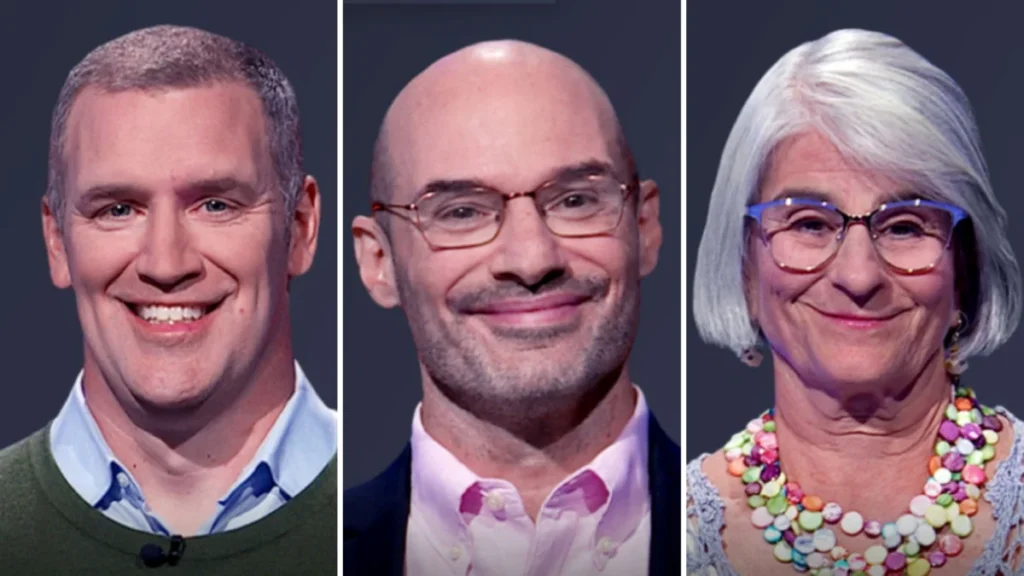

The intellectual arena of Jeopardy! witnessed a compelling contest on April 29th as Greg Shahade, a formidable chess master and recent conqueror of a Jeopardy! super champion, navigated a particularly demanding episode. While Shahade had demonstrated remarkable prowess in his previous appearances, accumulating an impressive two-day total of $54,601, his third outing presented a series of hurdles that tested his usually sharp intellect. The episode, which featured Shahade against fellow contestants Ian Samson, a firefighter from Matthews, North Carolina, and Beth Orlansky, a retired public interest attorney from Jackson, Mississippi, highlighted the unpredictable nature of the game and the significant pressure involved in high-stakes trivia.
The stakes were considerably elevated for Shahade following his decisive victory over Jamie Ding, a player who had carved out a significant winning streak, underscoring Shahade’s capability to perform under intense scrutiny. However, the April 29th broadcast revealed that even seasoned competitors can encounter moments of struggle. This particular game saw Shahade, a native of Philadelphia, Pennsylvania, grappling with a series of incorrect responses, a stark contrast to the near-flawless execution that had defined his earlier performances.
An Uncharacteristic Stumble in the First Round
The game began with Shahade in strong form, exhibiting his characteristic confidence. He maintained a perfect record on clues until he encountered the first Daily Double on clue six. At this point, with $4,400 in accumulated winnings, Shahade made a bold decision to wager his entire sum. The category was "Talking About Fight Club," and the clue pertained to an airline’s historical customer loyalty program. "Until 2005, this airline had a customer loyalty program called the Flying Dutchman," the clue read.
Following a brief hesitation, Shahade provided his answer: "What’s KLM?" This response, while correct, marked a moment where his usual swift certainty seemed slightly tempered. The successful wager doubled his score to $8,800. By the midpoint of the first round, Shahade had secured a lead, boasting $9,400, a testament to his ability to recover and capitalize on opportunities. He concluded the Jeopardy! round with $11,800. In comparison, Ian Samson, the firefighter, trailed with $2,400, and Beth Orlansky, the retired attorney, was in third place with $1,000.
Double Jeopardy: A Rollercoaster of Success and Setbacks
The Double Jeopardy! round commenced with Shahade continuing to demonstrate his acumen. He located the first Daily Double on clue three within the category "The English Romantic Poets." With $11,400, he strategically wagered $5,000. The clue focused on a famous line from Keats: "Keats tells this subject of an ode, ‘Thou wast not born for death, immortal bird!’" After a period of contemplation, Shahade correctly identified the subject as "What’s a nightingale?" This accurate response propelled his score to $16,400.
However, the tide of fortune shifted dramatically on the very next clue, which also happened to be a Daily Double. This time, Shahade wagered $6,000. The category was "On The ‘M’ap," and the clue involved a geographical riddle: "The name of this Alberta city refers to an actual accessory called a saamis." In a moment that would prove costly, Shahade incorrectly answered, "What’s Moose Jaw?" The correct response, Medicine Hat, was a significant miss that not only cost him his wager but also halved his current winnings, reducing his score to $10,400.
This single incorrect response marked a turning point in Shahade’s gameplay. While he managed to answer seven subsequent clues correctly, boosting his score to $17,600, the momentum had shifted. Ian Samson, demonstrating resilience, then answered three clues in a row, bringing his total to $8,000. The latter part of the round saw Shahade make a series of nine incorrect responses. This uncharacteristic string of errors allowed Samson to close the gap significantly. By the end of the Double Jeopardy! round, Shahade’s lead had dwindled to $16,000, with Samson close behind at $10,000. Orlansky remained in third place with $4,200.
Final Jeopardy!: A Strategic Wager Secures the Win
The crucial Final Jeopardy! round presented the contestants with a clue in the "Historic Destinations" category. The clue read: "The 1848 Seneca Falls Declaration added these 2 words to the Declaration of Independence line beginning, ‘we hold these truths…’"
Beth Orlansky, positioned in third place, correctly answered "What are ‘and women?’" She made a conservative wager of $33, bringing her final total to $4,233.
Ian Samson, facing an uphill battle, incorrectly responded, "What is self-evident?" Despite wagering his entire $10,000, this incorrect answer left him with $0.
Greg Shahade, holding the lead, correctly identified the missing words as "and women." He strategically wagered $4,001. This calculated risk brought his final score to $20,001, securing his third consecutive victory. His cumulative winnings now stand at an impressive $74,602 over three days.
Analysis of Shahade’s Performance and Broader Implications
Shahade’s performance on April 29th offers a fascinating case study in the pressures of competitive quizzing. After achieving a significant victory over a high-profile champion like Jamie Ding, the expectation was a continued dominant run. However, the episode demonstrated that even exceptionally intelligent individuals can falter under the unique pressures of the Jeopardy! stage. The rapid-fire nature of the game, the strategic complexity of Daily Double wagers, and the sheer breadth of knowledge required can present formidable challenges.
The incident with the "M’ap" clue highlights a common pitfall in trivia: geographical knowledge, while extensive, can be a specific area of vulnerability for even well-rounded contestants. The fact that Shahade, a chess master known for strategic thinking and pattern recognition, could misidentify a prominent Canadian city underscores the diverse nature of intellectual skills. Chess, while demanding abstract reasoning and foresight, does not necessarily translate to perfect recall of all world capitals or geographical trivia.
The analysis of Shahade’s game also implicitly touches upon the broader implications of Jeopardy!’s format. The show rewards not only knowledge but also quick reflexes, risk assessment (especially with Daily Doubles), and the ability to perform under duress. While Shahade’s initial success demonstrated his mastery of these elements, the April 29th episode showcased the inherent variability and the high stakes involved. The fact that he could still win despite a challenging game is a testament to his strong foundational knowledge and his ability to make a crucial correct response in Final Jeopardy!
Furthermore, the episode reinforces the idea that Jeopardy! champions are not simply repositories of facts but individuals who can strategize, adapt, and perform consistently across various categories and under varying degrees of pressure. Shahade’s journey, marked by both triumph and tribulation, provides a compelling narrative arc for viewers, emphasizing that even the most formidable contestants face moments where their expertise is truly tested. The continued presence of Shahade in the competition suggests that he is likely to learn from this experience, potentially refining his approach to challenging categories and further solidifying his position as a notable contestant.
The game’s outcome also serves as a reminder of the diverse talents of the contestants. Ian Samson’s strong showing as a firefighter, and Beth Orlansky’s success as a retired attorney, highlight the intellectual breadth of individuals from various professions who participate in Jeopardy!. The show continues to be a platform where a wide array of knowledge and cognitive skills are showcased, making each episode a unique intellectual spectacle. Shahade’s ability to secure a win despite significant setbacks in the Double Jeopardy! round underscores his resilience and strategic thinking, promising further compelling gameplay in his subsequent appearances.