
The 47th annual San Francisco Decorator Showcase has officially unveiled its 2026 transformation, selecting a storied Queen Anne-style residence in the heart of the Pacific Heights neighborhood. Perched atop one of the city’s iconic hills, the property offers expansive views of the Golden Gate Bridge and the San Francisco Bay, serving as a high-profile stage for the region’s premier interior design event. This year’s selection is historically significant, marking the first time in the showcase’s nearly five-decade history that a classic Victorian-era home has served as the venue.

Originally commissioned in 1897 and designed by the esteemed architect Moses J. Lyon, the mansion encompasses nearly 10,000 square feet of living space. For the 2026 event, 18 prominent interior design and landscape firms were tasked with reimagining the interior, turning the historic structure into a "blank canvas" for modern luxury and avant-garde aesthetic concepts. The project continues its long-standing philanthropic mission, having raised more than $21 million to date for the San Francisco University High School Financial Aid Programs.

Historical Context and Architectural Significance
The choice of a Queen Anne Victorian represents a departure from the Mediterranean and Neoclassical estates that have frequently hosted the showcase in recent years. Built during the late 19th-century architectural boom in San Francisco, the Moses J. Lyon house is a prime example of the era’s craftsmanship, characterized by its asymmetrical facade, intricate woodwork, and expansive bay windows.

To prepare the home for its role as the 2026 showcase, the property underwent the most extensive interior construction in the event’s history. This included structural modifications such as the addition of a second staircase to improve flow and accessibility for the thousands of visitors expected during the public tour season. Organizers noted that the renovation required a delicate balance between preserving the landmarked architectural integrity and providing the infrastructure necessary for high-concept modern design.

Design Themes: The Dominance of Blue and Textured Finishes
A prevailing theme across the nearly 30 designed spaces is the sophisticated use of blue palettes, ranging from powdery periwinkles to deep, lacquered navies. This trend was complemented by an emphasis on highly textured wall and ceiling treatments. Throughout the home, designers utilized traditional and modern techniques, including limewash, Venetian plaster, custom wallpaper, and floor-to-ceiling upholstery.

One of the most celebrated spaces is the third-floor game room, titled "Well Played," conceived by Alyson Gay of Aly Gay Design. Inspired by the contemporary resurgence of mahjong, the room features 14 windows that flood the space with natural light. Gay utilized a glossy pale blue—her firm’s signature hue—to create a seamless visual transition between the interior walls and the San Francisco sky. The room is anchored by a custom sofa and a playful photograph by Nick Mele titled Mahjong by Night, accented by gemstone-encrusted sconces.

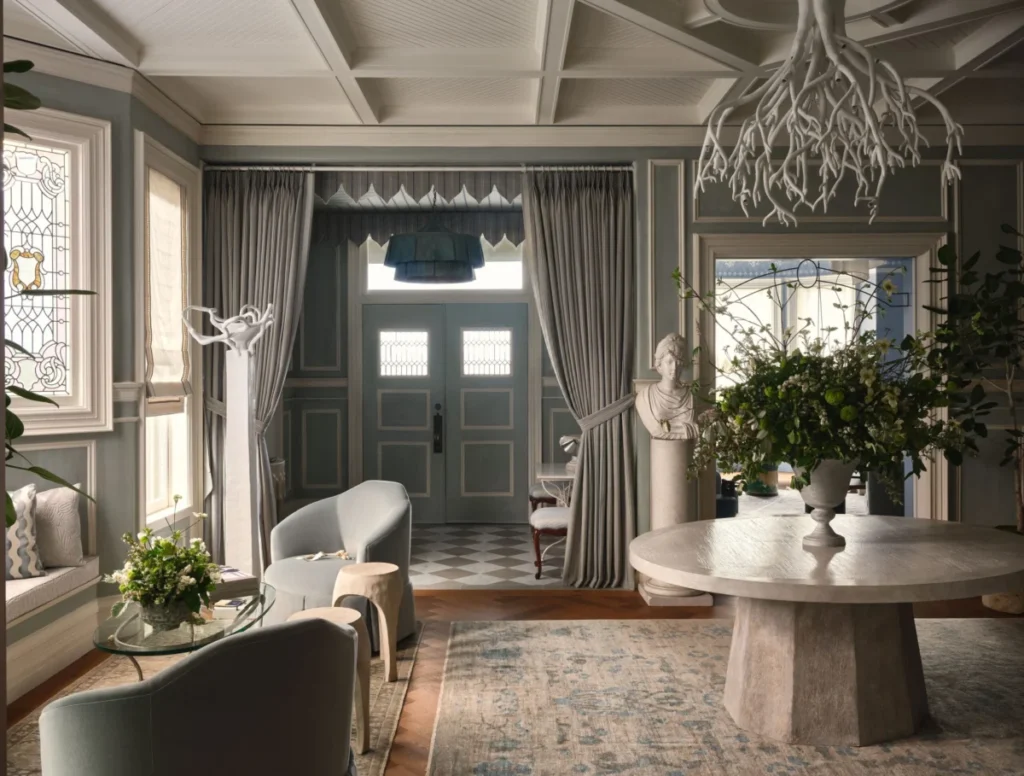
In the entryway and foyer, titled "L’Arrivée," designer Kendall Wilkinson drew inspiration from her recent travels to Paris, specifically the La Galerie Dior. Wilkinson’s design offers a French-inspired welcome, featuring pale blue-green limewashed walls that provide a soft, vintage-feeling backdrop. The space is furnished with custom pieces upholstered in Schumacher and Fabricut textiles and illuminated by Wilkinson’s modern lighting collection created in collaboration with Iatesta Studio.

Cultural Fusion and Global Influences
The 2026 showcase is notable for its integration of international cultural motifs within the framework of San Francisco’s historic architecture. Sindhu Peruri of Peruri Design Studio transformed the living room into a space shaped by memory and heritage. The walls and ceilings were finished in a powdery periwinkle inspired by the paintings of Claude Monet.

Peruri, a member of the AD PRO Directory, incorporated traditional Indian craftsmanship as a tribute to her roots. This included hand-cut Thikri work (mirror mosaic tiling) along the crown moldings and Jaali (perforated latticework) on the walls and cabinetry. The room also features custom-designed stools adorned with hand-painted miniature landscapes reminiscent of 17th-century Indian art.

Other rooms continued this trend of global inspiration:

- The Chapel Den: Designed by the firm AubreyMaxwell in collaboration with Perez Construction, this space offers a moody, contemplative atmosphere.
- The Slow Spin Laundry Room: Kimberley Harrison of Kimberley Harrison Interiors reimagined a utilitarian space with high-end finishes, emphasizing that even secondary rooms deserve architectural attention.
- Study Abroad Office: Briana Tunison and Matt Bissinger of Maker & Moss created a workspace that blends academic tradition with modern textures.
Innovations in Lighting and Fixtures
Lighting served as a primary focal point for many designers, with several rooms featuring "otherworldly" statement fixtures that challenge traditional interior norms. In the primary bedroom suite, designer Fernando Castellanos of Castellanos Interiors selected a molten glass cylinder fixture from Hersh Design to complement a palette of rosy accents and deep reds.

In a coastal-themed bedroom by Chantal Lamberto, an iron shrub chandelier decorated with porcelain flowers by Paul Ferrante provides a botanical element. Meanwhile, Tineke Triggs of the AD PRO Directory installed a Laurel Blossom 09 brass chandelier from Rosie Li Studio in the living room, bridging the gap between industrial design and organic forms.
.jpg)
Triggs also contributed to the home’s culinary and social spaces. She designed a gathering spot adjacent to the kitchen inspired by English hunting lodges, featuring gold-gilded pheasant-patterned wallpaper by Fromental. In the kitchen itself, Triggs took inspiration from 18th and 19th-century English bakehouses, installing hand-crafted cabinetry, marble countertops, and a striking golden-veined backsplash.

Philanthropic Impact and Financial Data
Beyond its role as a design exhibition, the San Francisco Decorator Showcase is a vital economic engine for the San Francisco University High School (UHS) Financial Aid Programs. Since its inception in 1977, the event has raised more than $21 million. These funds are used to support the school’s commitment to socio-economic diversity, ensuring that students from all financial backgrounds have access to the institution’s college-preparatory curriculum.

Data provided by the school indicates that approximately 20% to 25% of the student body receives financial assistance, with the showcase serving as the primary source of funding for these grants. The success of the 2026 event is expected to contribute significantly to the endowment, particularly given the high market value of the Pacific Heights location and the record-breaking number of participating firms.

Chronology of the Event
The timeline for the 2026 showcase reflects a year-long coordination effort:

- Early 2025: Selection of the Moses J. Lyon house and initial structural assessments.
- Mid-2025: Call for entries and selection of the 18 design and landscape firms.
- Late 2025: Commencement of major interior construction, including the installation of the second staircase and plumbing upgrades.
- Early 2026: Design firms take possession of their respective "blank canvases" to begin installation of finishes, furniture, and art.
- Spring 2026: Official opening to the public and philanthropic gala events.
Broader Implications for the Design Industry
The 2026 San Francisco Decorator Showcase serves as a barometer for current trends in the luxury residential market. The move toward "maximalist" textures—where every surface is treated with plaster, wallpaper, or fabric—suggests a shift away from the minimalist, white-walled aesthetics of the previous decade.

Furthermore, the integration of smart home technology within a 129-year-old Victorian shell demonstrates the increasing demand for "invisible technology" in historic preservation. Designers this year successfully hid modern climate control, lighting automation, and high-fidelity audio systems within period-appropriate millwork and upholstery.

As the showcase concludes its run, the Moses J. Lyon house will eventually transition back to a private residence, though with a significantly enhanced interior legacy. The event remains a testament to San Francisco’s unique ability to merge historical reverence with contemporary creative innovation, all while supporting the educational future of the city’s youth.