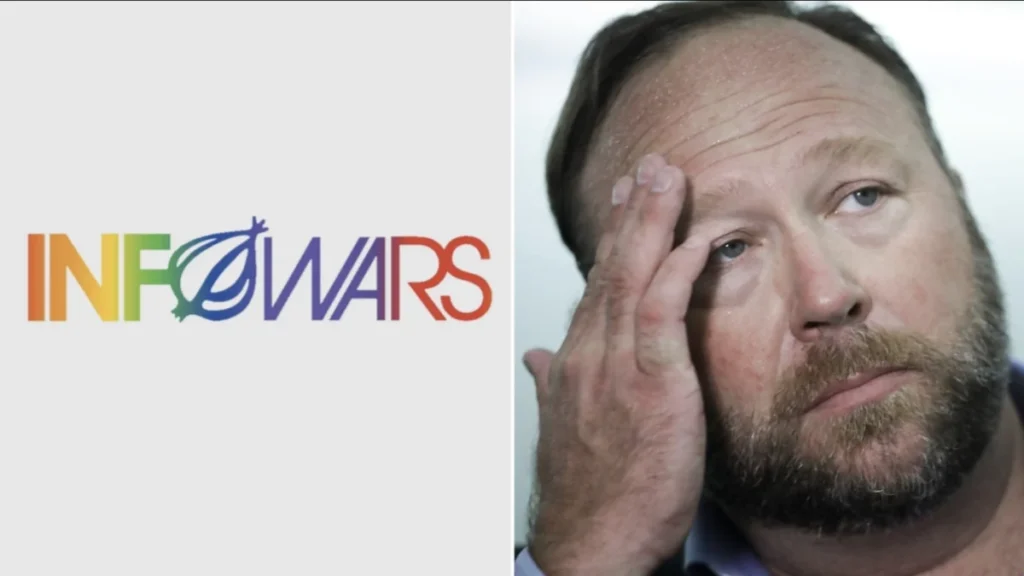

Right-wing provocateur Alex Jones engaged in a bizarre, bare-chested tirade during a recent livestream, primarily focusing on his epidermis and expressing outrage over the impending deal that would see satirical news outlet The Onion license control of his InfoWars brand. The incident, which quickly garnered significant media attention, underscores the contentious and convoluted trajectory of Jones’s media empire amidst his ongoing bankruptcy proceedings, initiated after colossal defamation judgments stemming from his false claims about the Sandy Hook Elementary School shooting.
The Shirtless Diatribe and "Skin Walker" Allegations
On April 20, 2026, Jones appeared shirtless during a broadcast, employing a strained metaphor centered on the concept of The Onion having "stolen the shirt off [his] back." The visual spectacle was accompanied by a rambling monologue where Jones proclaimed, "Just because you’re wearing my shirt don’t mean you’re me." This statement served as a springboard for a series of legally questionable assertions and increasingly surreal accusations regarding the nature of the licensing agreement.
A particularly striking element of Jones’s three-minute tirade was his repeated, almost obsessive, focus on "skin." He mentioned the term four times, escalating his rhetoric to accuse "the left" of being "bodysnatchers" and "skin walkers." According to Jones, these perceived adversaries "literally take your skin," directly applying this fantastical claim to The Onion‘s acquisition, stating they were "taking on our skin." This bizarre imagery suggests a deeply personal and almost primal sense of violation over the perceived appropriation of his brand identity.
Beyond the metaphorical and literal shedding of garments, Jones articulated a belief that The Onion‘s licensing of InfoWars constituted a deliberate act of defamation designed to "misrepresent that they’re us to confuse people and quote, ‘Rip people off like Alex Jones did.’" He further asserted that the satirical entity intends to profit from this misrepresentation, a move he believes is legally indefensible. "You can’t take something over and then act like you’re somebody, even if you say it’s a parody. You could do a parody of somebody, but not if you took something from them," Jones declared, claiming consultation with lawyers had confirmed The Onion was "in deep shit." He defiantly concluded, "So you guys just keep laughing," challenging those who might mock his predicament.
Chronology of Legal Battles and Bankruptcy
The shirtless outburst and the underlying InfoWars licensing deal are the latest developments in a protracted legal saga that began more than a decade ago.
- December 14, 2012: A gunman opens fire at Sandy Hook Elementary School in Newtown, Connecticut, killing 20 children and six adult staff members.
- Years Following: Alex Jones, through his InfoWars platform, repeatedly claims the Sandy Hook shooting was a hoax, an elaborate staging by government actors, and that the victims’ families were "crisis actors." These claims cause immense emotional distress and harassment for the bereaved families.
- 2018-2022: Multiple families of Sandy Hook victims file defamation lawsuits against Jones and his companies in Texas and Connecticut.
- August 2022: A Texas jury orders Jones to pay nearly $50 million in damages to the parents of Jesse Lewis, one of the child victims.
- October 2022: A Connecticut jury awards nearly $1 billion in damages to 15 plaintiffs, including Sandy Hook families and an FBI agent. This is followed by an additional $473 million in punitive damages. The total judgment against Jones and his Free Speech Systems company reaches approximately $1.4 billion.
- December 2, 2022: Facing overwhelming debt from these judgments, Jones and Free Speech Systems file for Chapter 11 bankruptcy protection. This move centralizes his assets and liabilities under court supervision, aiming to organize a plan for repayment to creditors.
- Late 2022 – Early 2024: The bankruptcy court appoints a receiver to manage InfoWars and other assets belonging to Jones, with the explicit mandate to leverage these assets to satisfy the massive judgments. The receiver’s role is to ensure that Jones’s brand, which he used to generate the wealth that contributed to his legal liability, is now used to compensate his victims.
- December 2024: An initial proposal for The Onion to purchase InfoWars outright is rejected by the bankruptcy judge. The exact reasons for the rejection were not explicitly detailed in the original reporting, but such rejections can occur due to concerns about valuation, the proposed structure of the deal, or its alignment with the best interests of the creditors.
- April 19, 2026: News breaks of a revised agreement: The Onion, the renowned satirical news publication, will license InfoWars as part of Jones’s ongoing bankruptcy case. This deal, unlike the previous one, is a licensing arrangement rather than an outright sale, allowing The Onion to operate the brand while a portion of the revenue flows back into the bankruptcy estate.
- April 20, 2026: Alex Jones broadcasts his shirtless rant, vehemently criticizing the licensing deal and the judge overseeing his bankruptcy, whom he labeled "corrupt." This public denunciation of the judge is unlikely to endear him to the court and could potentially complicate future proceedings.
The Details of The Onion‘s Licensing Deal
The newly revealed licensing agreement stipulates that The Onion will pay approximately $81,000 per month to utilize the InfoWars brand. This monthly payment will be directed towards the bankruptcy estate, ultimately contributing to the restitution owed to the Sandy Hook families and other creditors. The deal requires final approval from the bankruptcy judge, a common procedural step in such high-profile Chapter 11 cases involving significant assets and liabilities.
A pivotal aspect of this new venture is the announced appointment of Tim Heidecker as the creative director for the new iteration of InfoWars. Heidecker, a prominent comedian, musician, and one half of the acclaimed Tim and Eric comedic duo, is known for his absurdist humor and satirical take on media personalities and conspiracy culture. His involvement strongly suggests that the licensed InfoWars platform will pivot sharply from its previous incarnation as a purveyor of misinformation to a vehicle for biting satire and parody, directly targeting the very style and content that defined Jones’s original broadcasts.
Stakeholder Perspectives and Reactions
Alex Jones: Jones’s recent livestream clearly articulates his profound anger and sense of betrayal. His legal arguments, however, are viewed by many legal experts as tenuous. While intellectual property rights are protected, the context of bankruptcy and a court-appointed receiver fundamentally alters the owner’s control. The assertion that a parody, even one leveraging a bankrupt brand, constitutes defamation is challenging to prove, especially when the intent is clearly satirical and disclosed. His attacks on the judge further demonstrate his confrontational stance, which has historically complicated his legal standing.
The Onion (Inferred Strategy): For The Onion, licensing InfoWars represents a unique and potentially groundbreaking opportunity for meta-satire. Known for its deadpan delivery of absurd headlines and fabricated news stories, The Onion has a long history of lampooning serious subjects and media tropes. Taking direct control of a brand synonymous with conspiracy theories and misinformation allows them to engage in direct, immersive parody. Under Tim Heidecker’s creative direction, the new InfoWars is expected to turn Jones’s own brand against itself, transforming a platform of dangerous falsehoods into a stage for comedic critique of such content. This could be a significant brand extension, expanding The Onion‘s reach and influence into new, unconventional territory.
Sandy Hook Families and Legal Representatives: While the families have not issued direct statements regarding The Onion deal, their overarching goal throughout the bankruptcy proceedings has been to secure financial restitution for the damages inflicted by Jones’s defamation. The licensing agreement, by generating income for the bankruptcy estate, directly contributes to this objective. For the families, the control of InfoWars by a receiver, and subsequently its monetization for their benefit, represents a measure of justice and accountability, demonstrating that even a brand built on lies can be repurposed to pay for the harm it caused. The symbolic victory of seeing a satirical outlet take over the platform that tormented them is also likely significant, transforming a source of pain into a potential source of ridicule for the purveyor of those lies.
The Bankruptcy Court and Legal Experts: The bankruptcy court’s primary objective is to manage Jones’s assets fairly and efficiently to maximize returns for creditors. The judge’s decision to approve a licensing deal, after rejecting an outright sale, suggests a careful consideration of various options to achieve this goal. Legal experts generally agree that the court has broad powers in bankruptcy to manage and dispose of assets, including intellectual property like brand names, to satisfy debts. Jones’s claims of "lawfare" and illegal appropriation are largely dismissed as a misunderstanding of bankruptcy law, where the debtor relinquishes control of assets to the court for the benefit of creditors. The complexity arises in balancing the rights of the brand owner (Jones) with the imperative to pay creditors, all while navigating the unique nature of a media brand.
Broader Impact and Implications
The licensing of InfoWars to The Onion carries several significant implications for media, satire, and the consequences of misinformation:
1. The Evolution of Satire in the Digital Age: This deal blurs the lines between traditional satire and direct intervention. Instead of merely commenting on misinformation, The Onion will be taking over its very vessel. This could set a precedent for how satirical outlets engage with and dismantle platforms of harmful content, turning the tools of deception into instruments of comedic critique. It raises questions about the responsibility of satire when operating within the skin, so to speak, of a former misinformation giant.
2. Accountability for Misinformation: The deal serves as a stark reminder of the financial and legal consequences of spreading malicious falsehoods. Jones’s loss of control over InfoWars is a direct result of his defamation, reinforcing the principle that freedom of speech does not equate to freedom from consequences, particularly when it causes tangible harm. The fact that his brand is now being used to pay his victims underscores a unique form of justice.
3. The Future of InfoWars as a Brand: Under Tim Heidecker, the InfoWars brand is poised for a radical transformation. It will likely become a performative art project, a living commentary on the absurdity of the original platform. This presents both a creative challenge and an opportunity for The Onion to showcase its unique brand of humor while deconstructing the very mechanisms of conspiracy theory dissemination. The audience, accustomed to Jones’s fervent pronouncements, will now encounter deliberate irony, creating a jarring and thought-provoking experience.
4. Intellectual Property in Bankruptcy: The case highlights the complex interplay between intellectual property rights and bankruptcy law. While a brand is an asset, its value can be tied to the controversial nature of its original owner. The court’s decision to license, rather than sell outright, might reflect a nuanced approach to maximizing value while also considering the potentially problematic nature of the brand itself. It underscores the challenges receivers face in monetizing assets associated with high-profile legal liabilities.
5. Public Perception and Media Literacy: The spectacle of Alex Jones stripping in protest of a satirical takeover of his platform could inadvertently serve as a powerful lesson in media literacy. It starkly contrasts the earnest, often hyperbolic claims of InfoWars with the deliberate, critical distance of satire. For audiences, it might illuminate the mechanisms of both misinformation and its comedic deconstruction, prompting a deeper consideration of media sources and their underlying intentions.
In conclusion, Alex Jones’s shirtless rant is more than just a bizarre performance; it is a dramatic reaction to the culmination of years of legal battles, signifying his diminishing control over the empire he built. The licensing deal between The Onion and InfoWars is a landmark event, representing a unique intersection of legal accountability, financial restitution, and the evolving landscape of media satire. As Tim Heidecker prepares to steer the new InfoWars, the world watches to see how satire will reclaim a platform once synonymous with misinformation, transforming a legacy of falsehoods into a testament to absurdity and consequences.