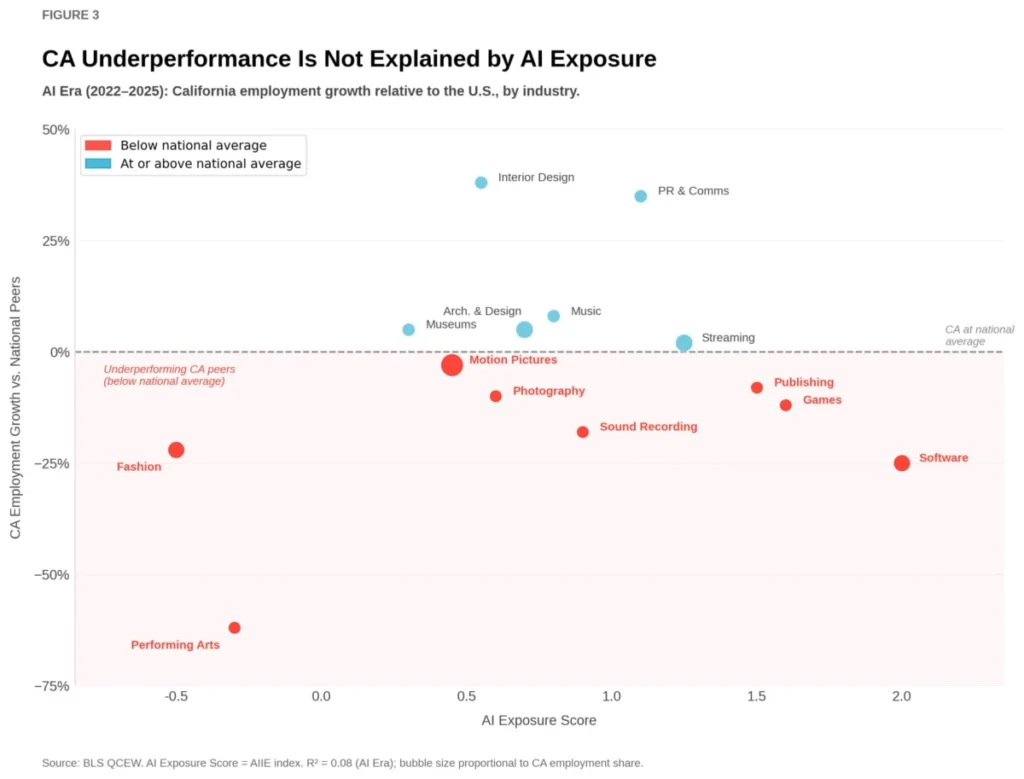

The narrative that generative artificial intelligence is the primary driver behind the recent dramatic job losses across California’s creative industries is a misconception, according to a pivotal new report from the L.A.-based Otis College of Art and Design. While the state’s creative economy witnessed a significant contraction between 2022 and 2025, shedding 14 percent of its workforce, or approximately 114,000 roles, the research unequivocally points to deeper, systemic issues—primarily cost-driven displacement and structural shifts within the entertainment sector—rather than direct AI-induced automation.
Industry observers and professionals have watched with bated breath as Hollywood and related creative fields underwent profound transformations. Over the past few years, a perfect storm of factors converged: the entertainment industry’s aggressive restructuring to satisfy an insatiable demand for streaming content, followed by a dramatic pivot towards profitability; a wave of major corporate mergers leading to consolidation; and the subsequent whittling down of budgets, widespread job cuts, and, in some instances, the outsourcing of work overseas. This period of intense contraction happened to coincide precisely with significant advancements in generative AI, exemplified by the public release of ChatGPT in late 2022—the very year Netflix and its industry counterparts began recalibrating their streaming strategies away from subscriber growth at all costs and towards sustainable financial models.
The Report’s Definitive Stance: AI Not the Primary Culprit
The report, titled "Creative Disruption: AI and California’s Creative Economy: 2022–2025," which was previewed by The Hollywood Reporter ahead of its April 7 release, challenges the prevailing anxiety surrounding AI-driven job displacement. Co-authored by Patrick Adler, a founding partner of Westwood Economics and Planning Consultants, and Taner Osman, the research combines quantitative analyses derived from public data with qualitative insights gleaned from interviews with numerous creative professionals.
"The pattern of job loss in terms of the types of jobs that are being lost and when they’re being lost does not support the fact that there’s been this displacement of workers by AI," Adler stated. Instead, the study reveals that "AI has, in the creative economy, dramatically changed how work is being done." This distinction is critical: AI is reshaping workflows and demanding new skill sets, but it is not, at least not yet, systematically eliminating entire creative professions.
The 114,000 jobs lost between 2022 and 2025 were not evenly distributed. The report highlights that these losses were heavily concentrated in two specific sectors: film, television, and sound, which experienced a nearly 30 percent decline in jobs, and traditional media, which saw an even steeper nearly 34 percent reduction during the same period. These sectors are precisely where the "Peak TV" bubble burst and where corporate consolidations had the most direct impact.

Counter-intuitively, the report notes that occupations considered most "exposed" to AI within the creative economy—such as writers, software developers, and artists—have actually seen their numbers grow rather than shrink. Furthermore, job postings for these roles have increased, suggesting a demand for talent capable of integrating or working alongside AI tools, rather than being replaced by them. This finding directly contradicts the widespread fear that AI would first target and eliminate these creative, often highly skilled, positions.
Contextualizing the Contraction: The "Peak TV" Hangover and Corporate Realignment
To understand the true drivers of job loss, one must look beyond AI to the broader economic and structural shifts that defined the early 2020s. The period leading up to 2022 was characterized by the "Peak TV" era, an unprecedented boom in content production fueled by a fierce streaming war. Companies like Netflix, Disney+, Max (formerly HBO Max), Apple TV+, and Amazon Prime Video engaged in an arms race to acquire subscribers, pouring billions into original programming. This led to an explosion of opportunities for writers, directors, actors, and production crews, particularly in California, the heart of the industry.
However, this aggressive spending proved unsustainable. By late 2022, Wall Street began demanding profitability over sheer subscriber growth. Netflix, a bellwether for the industry, announced its first subscriber loss in a decade, prompting a seismic shift across the entire sector. Suddenly, the focus pivoted to cost-cutting, content rationalization, and maximizing return on investment. This new paradigm led to significant budget reductions, the cancellation of numerous projects, and large-scale layoffs that rippled through studios, production companies, and related services.
Simultaneously, a wave of corporate mergers and acquisitions further exacerbated job instability. The integration of WarnerMedia into Discovery to form Warner Bros. Discovery, Disney’s acquisition of 21st Century Fox assets, and other consolidations were often followed by extensive layoffs as companies sought to eliminate redundancies and streamline operations. These strategic business decisions, driven by market pressures and financial imperatives, directly impacted the workforce in California, which hosts a disproportionate share of these corporate entities.
The report emphasizes that "the answer [for this job loss] lies in a combination of cost-driven displacement of lower-paying roles and structural changes within creative sectors that have hit California harder than the rest of the nation." California’s notoriously high cost of living plays a significant role, pushing individuals in lower-paying creative occupations out of the state. While these roles might be susceptible to automation in the long term, their immediate disappearance is more often linked to economic migration and the industry’s drive to reduce overhead, sometimes by relocating production to states with more favorable tax incentives or lower labor costs.
AI’s True Role: Augmentation, Not Wholesale Replacement

The good news for creative workers, as elucidated by the report, is that generative AI, so far, appears to be replacing specific tasks rather than entire job roles or workflows. Through interviews with professionals across California’s creative industries, the authors found that "No single respondent described AI as having replaced an entire role or workflow." Instead, AI is deployed for "well-defined activities where the output is verifiable, time savings are clear, and the quality of output meets expectations."
A prime example cited in the report is in film and television post-production. AI tools are proving adept at repetitive, laborious tasks such as rotoscoping (isolating objects in footage) or wire removal. However, these tools still "struggle with creative tasks," requiring human oversight and intervention. Moreover, the necessity of checking and correcting AI outputs is, paradoxically, creating additional work for human artists. One VFX company owner quoted in the report highlighted this economic paradox: "They have 15 artists that are sitting at workstations fixing the AI… When you multiply the rate of the artists by 15 and put that against the cost of the work you’re doing, it negates any savings that AI is giving you." This anecdote underscores that while AI can accelerate certain processes, the current need for meticulous human verification often negates the promised cost efficiencies, at least in complex creative environments.
The Human Element: Skepticism, Ethics, and Agency in Adoption
The report delves into the crucial human dimension of AI integration, noting that creative workers possess significant agency in determining the extent and manner of AI adoption in their fields. While company policies or supervisory directives may guide them, the ultimate application of AI tools often rests with individual workers. The authors observe, "A worker who believes in the technology will iterate patiently; a skeptical one may conclude that AI is not yet able to perform a particular task. Both views were present among interviewees."
This observation points to a significant psychological barrier to effective AI integration. Many workers expressed profound concerns about the ethics of using AI, particularly regarding intellectual property rights, data privacy, and the potential for AI to devalue human creativity. Some even admitted to hiding their use of AI tools, fearing that openly embracing the technology might brand them as expendable or signal a willingness to work for less, potentially undermining their value in a competitive market.
These anxieties are not unfounded. The widespread fear of AI-driven job displacement has been a major point of contention, particularly evident during the 2023 WGA (Writers Guild of America) and SAG-AFTRA (Screen Actors Guild – American Federation of Television and Radio Artists) strikes. Both unions made AI protections a central demand, seeking guarantees against the unauthorized use of their members’ likenesses, voices, and creative works, as well as safeguards against AI being used to diminish their compensation or replace their roles entirely. The Otis College report’s findings offer a nuanced perspective on these union concerns, affirming that while direct replacement isn’t the primary issue yet, the transformation of work and the potential for devaluing human input are legitimate worries.
The Shifting Nature of Creative Work and the "Good Enough" Dilemma

While the report largely absolves AI of direct job displacement, it firmly states that the technology is undeniably changing the very nature of creative work. Interviewees reported several key shifts:
- Increased Productivity Expectations: Managers, often influenced by the perceived speed of AI, are raising productivity benchmarks for human workers.
- Investment in Tools over Human Collaborators: There’s a growing trend among management to invest in AI software and infrastructure rather than expanding human teams or hiring additional creative talent.
- Pressure for Lower-Quality Work: Perhaps the most concerning implication, some creatives are facing pressure to produce work that is "good enough" rather than striving for artistic excellence, often a direct consequence of compressed timelines and reduced budgets, with AI as a tool to meet these new, lower standards.
One motion creative director poignantly recalled an experience illustrating this "good enough" dilemma: "The creative director said, ‘At a certain point, you just have to say it’s good enough,’ which I think is the biggest danger of AI. We lower our standards." This statement encapsulates a profound concern: if AI is primarily used to churn out content at speed and scale, rather than to elevate human creativity, the overall quality and artistic integrity of creative output could suffer. This raises significant questions for the future of artistic expression and the consumer experience.
Recommendations and Implications for the Future
In light of these findings, the report offers crucial recommendations for creative organizations grappling with AI integration. To counter the rank-and-file skepticism and uncertainty, the authors advise against rushing the implementation of AI tools. Instead, they advocate for a more thoughtful, human-centric approach. Crucially, they recommend fighting the stigma associated with AI use by implementing clear policies, such as "firing freezes."
"Workers who know they will not be adopting themselves out of a job will experiment more openly, share insights more freely, and invest genuine effort into making AI tools work," the authors explain. Adler further elaborates, stating, "There’s pretty good evidence that we’re uncovering that AI adoption would be a lot faster, a lot deeper if creative workers had more trust in it." Building this trust requires transparency, ethical guidelines, and a commitment from leadership to view AI as an augmentative partner rather than a replacement tool.
The implications of this report extend far beyond California’s borders. For unions, it reinforces the need for strong contractual language that protects human jobs and creative integrity, even as AI becomes more sophisticated. For studios and production houses, it suggests that a purely cost-driven approach to AI integration might be short-sighted, potentially leading to a degradation of quality and employee morale. For educational institutions like Otis College of Art and Design, it underscores the importance of adapting curricula to equip future creatives with the skills to collaborate with AI effectively, emphasizing critical thinking, ethical considerations, and the ability to leverage AI for enhanced creativity rather than just efficiency.
Ultimately, the "Creative Disruption" report serves as a vital corrective to an often oversimplified narrative. While generative AI is undoubtedly a transformative force, its immediate impact on job displacement in California’s creative economy is less direct than commonly feared. The real culprits, for now, are the turbulent economic currents of "Peak TV" era correction, corporate consolidation, and the relentless pressure to cut costs. AI’s true role is more nuanced: it is a powerful catalyst reshaping how creative work is done, demanding new skills, raising new ethical questions, and challenging the industry to redefine the very meaning of "creative quality" in an increasingly automated world. The future of California’s creative workforce hinges not on whether AI arrives, but on how human ingenuity and trust are fostered in its integration.