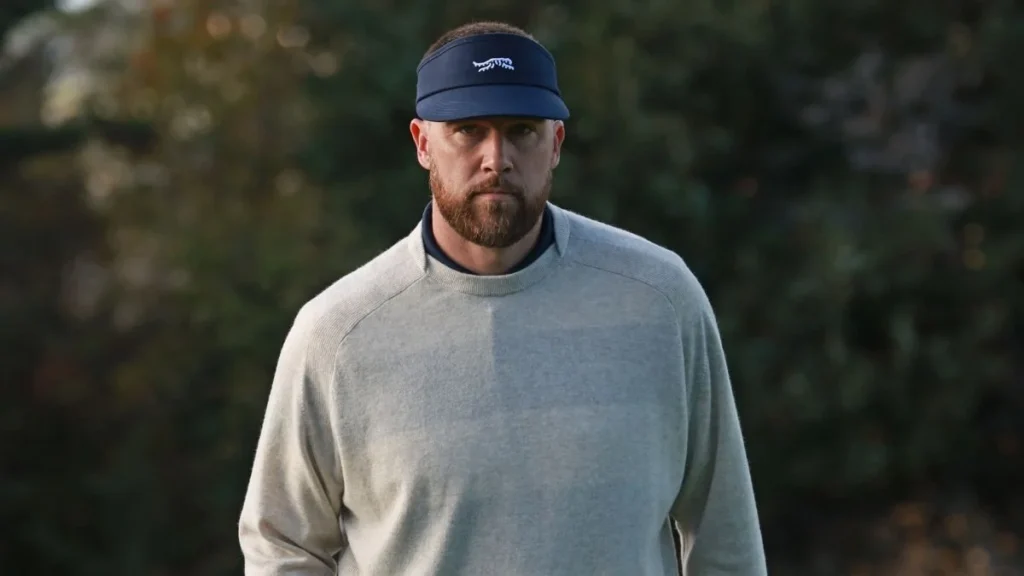

Travis Kelce, the three-time Super Bowl champion and perennial All-Pro tight end for the Kansas City Chiefs, recently provided a detailed account of a pivotal moment in his early athletic career when he nearly abandoned the football field for the basketball court. Speaking on the April 1 episode of the "New Heights" podcast, which he co-hosts with his brother, retired Philadelphia Eagles center Jason Kelce, Travis recounted the specific circumstances surrounding his recruitment process in 2007 and the critical intervention by his father, Ed Kelce, that ultimately solidified his path toward professional football.
The revelation emerged during a conversation with Jerrod Calhoun, the recently appointed head coach of the Utah State men’s basketball team. Calhoun, who previously served on the coaching staffs at the University of Cincinnati and West Virginia University (WVU), shared a history with the Kelce brothers that dates back to their shared time in Ohio. The discussion highlighted a "what if" scenario that could have fundamentally altered the landscape of the National Football League (NFL) over the past decade.
The Recruitment Crossroads of 2007
The narrative of Travis Kelce’s collegiate recruitment is inextricably linked to a period of significant coaching turnover in the Big East Conference. In 2007, Bob Huggins, a legendary figure in collegiate basketball, departed the University of Cincinnati to take the head coaching position at West Virginia University. Jerrod Calhoun followed Huggins to Morgantown as part of the coaching staff. At the time, Travis Kelce was a standout multi-sport athlete at Cleveland Heights High School in Ohio.
While Travis had already committed to play football for the University of Cincinnati (UC) Bearcats, the departure of the coaching staff he had grown close to sparked a period of uncertainty. Travis admitted on the podcast that he was actively "looking around for some basketball schools" during this transition. His connection to Calhoun and Huggins was significant; he described the West Virginia staff as treating him "like family" at a time when he was still largely overshadowed by the burgeoning reputation of his older brother, Jason.
"I go down to West Virginia. You’re my point of contact," Travis told Calhoun during the episode. "You guys treat me like family, like I had never been treated before." Travis noted that at that stage in his life, he was frequently identified primarily as "Jason’s little brother," and the personalized recruitment effort from the WVU basketball staff offered him a unique sense of individual identity and athletic validation.
The Role of Ed Kelce and the Principle of Integrity
The shift from Cincinnati football to West Virginia basketball was nearly finalized when Travis approached his father, Ed Kelce, to discuss the move. However, the elder Kelce’s reaction was not one of support for the change in scenery, but rather a firm lesson in personal accountability and the weight of a commitment.
According to Travis, Ed Kelce challenged the ethics of "decommitting" from a university after giving one’s word. Travis recalled his father’s stern guidance: "You are a man of your word. You want to be like these kids that commit to a university and then decommit, and now the integrity of your word doesn’t mean anything?"
This conversation proved to be the decisive factor. Despite Travis’s self-described status as a "hooper at heart," the emphasis on maintaining his commitment to the University of Cincinnati football program took precedence. This intervention not only kept Travis at UC but also ensured he remained on the gridiron, where he would eventually transition from a dual-threat quarterback to the tight end position that would define his professional legacy.
Travis Kelce’s Basketball Pedigree and Athletic Profile
The assertion that Travis Kelce could have succeeded in Division I basketball is supported by his high school athletic record. At Cleveland Heights High School, Kelce was a three-sport athlete, excelling in football, basketball, and baseball. On the basketball court, he was a dominant force, earning All-Lake Erie League honors. His physical dimensions—eventually growing to 6-foot-5 and approximately 250 pounds—combined with the lateral agility and hand-eye coordination required for high-level basketball, made him an ideal candidate for a power forward or "point forward" role in the collegiate ranks.
Jerrod Calhoun corroborated this assessment during the podcast, describing the young Kelce as a "beast" and a legitimate "hooper." The skill set Kelce developed on the hardwood—specifically the ability to box out defenders, high-point a ball during a rebound, and use his body to create space—has been frequently cited by NFL analysts as a primary reason for his success as a tight end. The "basketball background" has become a common trope in NFL broadcasts when discussing Kelce’s ability to find soft spots in zone coverage and out-muscle defenders in the red zone.
The Transition at the University of Cincinnati
Choosing to honor his commitment to Cincinnati did not immediately lead to stardom. Travis’s collegiate career was marked by significant obstacles, including a year-long suspension in 2010 for a violation of team rules. During this period, his brother Jason played a crucial role in advocating for Travis’s reinstatement and supporting him financially and emotionally.
Upon his return, Travis transitioned fully to the tight end position. In his final collegiate season in 2012, he recorded 45 receptions for 722 yards and eight touchdowns, earning First-Team All-Big East honors. This performance caught the attention of NFL scouts, leading to his selection by the Kansas City Chiefs in the third round (63rd overall) of the 2013 NFL Draft. The decision to stay at UC, mandated by his father’s insistence on integrity, ultimately provided the platform for his entry into the professional ranks.
The "Basketball to Tight End" Pipeline: A Broader Analysis
Travis Kelce’s near-diversion into basketball places him within a storied tradition of NFL tight ends who leveraged basketball skills to revolutionize the position. This "pipeline" includes Hall of Famers and future candidates such as:
- Tony Gonzalez: A star for both the football and basketball teams at UC Berkeley, Gonzalez is often credited with pioneering the modern athletic tight end archetype.
- Antonio Gates: Notably, Gates did not play collegiate football at all, instead leading Kent State to the Elite Eight in the NCAA basketball tournament before signing as an undrafted free agent with the San Diego Chargers.
- Jimmy Graham: Graham played four years of basketball at the University of Miami before playing a single season of college football, subsequently becoming one of the league’s most prolific scorers.
The commonality among these athletes is the transferability of basketball-specific movements to the football field. The ability to "shield" a defender (similar to post-play in basketball) and the spatial awareness required to navigate a crowded "paint" are directly applicable to a tight end operating in the middle of the field. Had Kelce chosen West Virginia basketball, he would have joined a Huggins-led program known for its physical, defensive-minded style—a style that might have prepared him for the physicality of the NFL, albeit through a much more circuitous route.
Statistical Impact and NFL Legacy
Reflecting on the decision to stick with football reveals the magnitude of what would have been lost to the sport had Kelce chosen the hardwood. Since entering the NFL in 2013, Kelce has amassed a resume that ranks among the greatest in league history:
- Super Bowl Titles: 3 (LIV, LVII, LVIII)
- Pro Bowl Selections: 9
- First-Team All-Pro: 4
- Career Receiving Yards: Over 11,300 (ranking him high on the all-time list for tight ends).
- Consecutive 1,000-Yard Seasons: 7 (an NFL record for tight ends).
Beyond the statistics, Kelce’s partnership with quarterback Patrick Mahomes has redefined offensive efficiency in the modern era. His ability to improvise routes and find openings in elite defenses is a direct extension of the "playground" instinct often fostered in basketball.
The "New Heights" Influence on Sports Media
The medium through which this story was shared—the "New Heights" podcast—also warrants examination. The show has become a cultural phenomenon, bridging the gap between professional athletes and fans through candid, long-form storytelling. By revealing these behind-the-scenes moments, the Kelce brothers have provided a blueprint for athlete-led media, where the nuances of recruitment, family dynamics, and career-defining choices are explored outside the constraints of traditional press conferences.
The episode featuring Jerrod Calhoun serves as a historical document of sorts, connecting the dots between the mid-2000s collegiate coaching carousel and the current state of the NFL. It highlights how the trajectory of a professional sports league can be altered by a single conversation between a father and his son.
Conclusion: The Lasting Implications of a Father’s Advice
The story of Travis Kelce’s near-departure for West Virginia basketball serves as a case study in the importance of mentorship and the long-term impact of personal values. Ed Kelce’s insistence on the "integrity of your word" did more than just keep his son at a specific university; it ensured that one of the greatest talents in the history of football remained in the sport where he could achieve his maximum potential.
As Travis Kelce continues to build on a Hall of Fame career, the 2007 recruitment saga remains a definitive "sliding doors" moment. While Jerrod Calhoun and the WVU staff saw a potential basketball star, the world ultimately gained a football icon. The revelation on "New Heights" underscores the reality that even the most legendary careers are often built on a foundation of early-life discipline and the firm guidance of family.