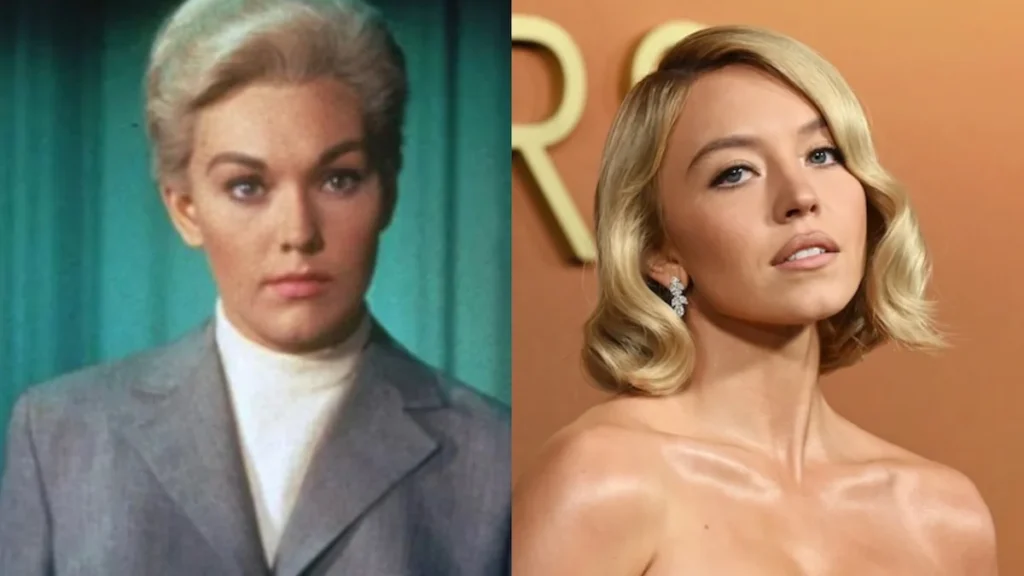

Retired screen legend Kim Novak has voiced strong disapproval regarding the casting of contemporary actress Sydney Sweeney in the upcoming biopic Scandalous!, a film slated to chronicle Novak’s brief but impactful romance with Sammy Davis Jr. in 1957. The star of Alfred Hitchcock’s iconic Vertigo, a figure synonymous with Hollywood’s Golden Age, expressed her firm stance to The Times of London, stating unequivocally that she “would never have approved” of Sweeney in the role. Novak’s primary concern centers on what she perceives as Sweeney’s inherently sexualized public image, fearing it will distort the true nature of her relationship with Davis Jr., which she emphasizes was founded on shared experiences and mutual understanding rather than mere physical attraction.
Novak elaborated on her reservations, noting that the Euphoria actress “sticks out so much above the waist,” a comment that underscores her apprehension that the film will disproportionately highlight the sexual dimension of her past relationship. “There’s no way it wouldn’t be a sexual relationship because Sydney Sweeney looks sexy all the time,” Novak asserted, concluding, “She was totally wrong to play me.” This candid critique from a veteran actress against a rising star has ignited a broader discussion within the entertainment industry about artistic interpretation, historical accuracy, and the complex interplay between an actor’s public persona and their ability to embody a historical figure.
The Scandalous! Project: A Director’s Vision
The film at the heart of this controversy, Scandalous!, marks the feature directorial debut of acclaimed actor Colman Domingo, known for his compelling performances in projects like Rustin and Euphoria. Domingo has previously characterized the film as a “fractured love story,” suggesting a nuanced exploration of the challenges faced by Novak and Davis Jr. He revealed plans to commence shooting following Sweeney’s completion of production for the third season of Euphoria. David Jonsson is set to star opposite Sweeney, portraying Sammy Davis Jr.
Domingo’s aspirations for the project articulate a desire to transcend a superficial narrative. “Hopefully we’ll make a beautiful, sweet film that’s really about the possibility of love, but under many eyes, trying to have privacy, trying to have love, trying to have a life,” Domingo articulated. He added a personal connection, suggesting, “And I think it’s something that Sydney and I both know very well. We’re trying to advocate for your humanity again in your life.” This statement implies a shared understanding between Domingo and Sweeney of navigating public scrutiny and striving for authentic human connection amidst intense media attention, a theme that resonates deeply with the experiences of both Novak and Davis Jr. in their time.
A Relationship Under Duress: The Novak-Davis Jr. Romance
The romance between Kim Novak and Sammy Davis Jr. in 1957 was, by all accounts, groundbreaking and fraught with peril in an era defined by rigid social conventions and widespread racial prejudice. Both were at the zenith of their careers when they first met as guests on The Steve Allen Show in 1956. Novak, a blonde bombshell groomed by Columbia Pictures, had become one of Hollywood’s most bankable stars following roles in films like Picnic (1955) and her collaboration with Alfred Hitchcock on Vertigo (1958), which would later solidify her status as a cinematic icon. Sammy Davis Jr., a member of the legendary Rat Pack, was a dynamic and trailblazing African American entertainer, a quadruple threat who captivated audiences with his singing, dancing, acting, and comedic talents.
Their romantic involvement in 1957 sent shockwaves through the segregated landscape of 1950s America and particularly through the conservative corridors of Hollywood. Interracial relationships were not only taboo but often illegal in many parts of the United States due to anti-miscegenation laws, which remained in effect in numerous states until the landmark Supreme Court ruling in Loving v. Virginia in 1967. While California had struck down its anti-miscegenation law in 1948, the societal prejudice persisted vehemently.
The relationship eventually crumbled under immense pressure, primarily from Columbia Pictures boss Harry Cohn. Cohn, a notorious studio mogul known for his autocratic control over his stars’ lives, feared that Novak’s interracial romance would irrevocably damage her career and, by extension, the studio’s financial interests. He reportedly went to extreme lengths, including alleged threats against Davis Jr.’s life and career, to force the couple apart. For Novak, whose image was meticulously crafted by the studio, such a relationship was seen as an unforgivable transgression against the carefully constructed facade of a white Hollywood leading lady. For Davis Jr., an African American man daring to publicly date a white star, the risks were even higher, potentially jeopardizing his burgeoning crossover appeal and exposing him to severe racial backlash. This historical context underscores the "scandalous" label attached to their romance, not by the lovers themselves, but by a society unwilling to accept it.
Kim Novak: A Star’s Evolution and Retreat
Kim Novak’s career trajectory and personal philosophy are crucial to understanding her current stance. Born Marilyn Pauline Novak in 1933, she was rechristened "Kim Novak" by Columbia Pictures, a strategic move to create a new persona distinct from Marilyn Monroe. She was marketed as a sophisticated blonde bombshell, a role she often found confining. Despite achieving immense fame and two Golden Globe awards, Novak consistently expressed discomfort with the rigid control exerted by the studio system and the manufactured image she was forced to uphold. She often clashed with Cohn over creative control and personal autonomy.
Her desire for authenticity and privacy led her to gradually withdraw from Hollywood in the late 1960s, seeking a life away from the relentless scrutiny of the public eye. She moved to a ranch, pursuing her passion for painting and living a more grounded existence. This retreat was not merely a retirement but a deliberate act of reclaiming her identity from the persona that Hollywood had created for her. Her past statements, including those made to The Guardian in August (presumed 2025 based on the original article’s publication date), reveal a consistent perspective: “I don’t think the relationship was scandalous. He’s somebody I really cared about,” she said. “We had so much in common, including the need to be accepted for who we are and what we do, rather than how we look. But I’m concerned they’re going to make it all sexual reasons.” This echoes her long-standing wish to be valued for her inner self rather than her external appearance, a sentiment that directly informs her critique of Sweeney’s casting.
Sydney Sweeney: A Contemporary Image and Performance
Sydney Sweeney has rapidly ascended to prominence in contemporary Hollywood, gaining widespread recognition for her roles in critically acclaimed television series such as Euphoria and The White Lotus, as well as successful romantic comedies like Anyone But You. Her performances have garnered praise for their emotional depth and raw vulnerability, particularly in portraying complex young women grappling with identity and societal pressures.
However, Sweeney’s public image, often highlighted in media and social discourse, frequently draws attention to her physical appearance. Her roles, particularly in Euphoria, have involved scenes that are explicitly sexual or involve partial nudity, contributing to a perception of her as a contemporary sex symbol. While this image is arguably a byproduct of the roles she chooses and the broader landscape of modern entertainment, it directly clashes with Kim Novak’s desire to de-emphasize the sexual aspects of her historical persona and relationship. Novak’s concern is not necessarily a judgment on Sweeney’s talent, but rather a perceived mismatch between Sweeney’s established public identity and the nuanced portrayal Novak believes her story requires, one that prioritizes shared humanity over physical allure.
The Biopic Conundrum: Authenticity vs. Artistic License
The controversy surrounding Scandalous! illuminates a perennial challenge in filmmaking: the delicate balance between historical accuracy, the subject’s personal narrative, and the artistic license of the creators. Biopics, by their very nature, condense complex lives into a digestible narrative, often requiring interpretation and selective emphasis. When the subject is still alive, as in Novak’s case, their direct input and approval (or lack thereof) can significantly impact public perception and the film’s legacy.
Historically, biopics have faced criticism for various reasons, from factual inaccuracies to perceived mischaracterizations. Examples abound, from families objecting to portrayals of deceased relatives to living subjects expressing dismay over their cinematic representations. The casting of an actor, particularly one with a strong public image, can be a potent symbolic choice, signaling the film’s thematic intentions. In this instance, Novak perceives Sweeney’s casting as a signal that the film will lean into a sensationalized, sexualized narrative, rather than the introspective, humanistic one she believes is true to her experience.
While film productions typically acquire rights to stories, the "life story rights" can be complex, and a film does not always require the subject’s explicit blessing, especially if it draws from publicly available information or is framed as a historical interpretation. However, the absence of a living subject’s approval, particularly one as iconic as Novak, inevitably adds a layer of scrutiny and moral consideration to the project.
Potential Implications and Broader Discussion
Novak’s forthright statements are likely to generate significant public discourse, intensifying interest in Scandalous! even before production begins. For Sydney Sweeney, while no official statement has been released, it is anticipated that she and her team would respond diplomatically, likely expressing profound respect for Novak’s legacy while reiterating her commitment to portraying the role with depth and sensitivity under Colman Domingo’s direction. Domingo himself may need to further articulate his vision to reassure audiences and Novak’s admirers that the film aims for a balanced and respectful portrayal.
The controversy also reignites important conversations about female representation in Hollywood, both past and present. Novak’s lifelong struggle against being reduced to her physical appearance resonates with contemporary discussions about objectification and the pressure on actresses to conform to certain beauty standards. Her critique of Sweeney’s “sexy” image, while directed at the casting choice, can be seen as a continuation of her own fight against being pigeonholed.
Ultimately, Scandalous! faces the challenge of navigating these complex expectations. It must deliver a compelling narrative that honors the historical context of Novak and Davis Jr.’s relationship, acknowledges the societal pressures they faced, and provides a nuanced portrayal of their connection, all while contending with the very public critique from one of its central figures. The outcome will not only determine the film’s reception but also contribute to the ongoing dialogue about how Hollywood interprets and presents its own rich, often controversial, history. As the production moves forward, all eyes will be on how Colman Domingo, Sydney Sweeney, and David Jonsson bring this fraught chapter of cinematic history to life, under the watchful gaze of Kim Novak and a discerning public.