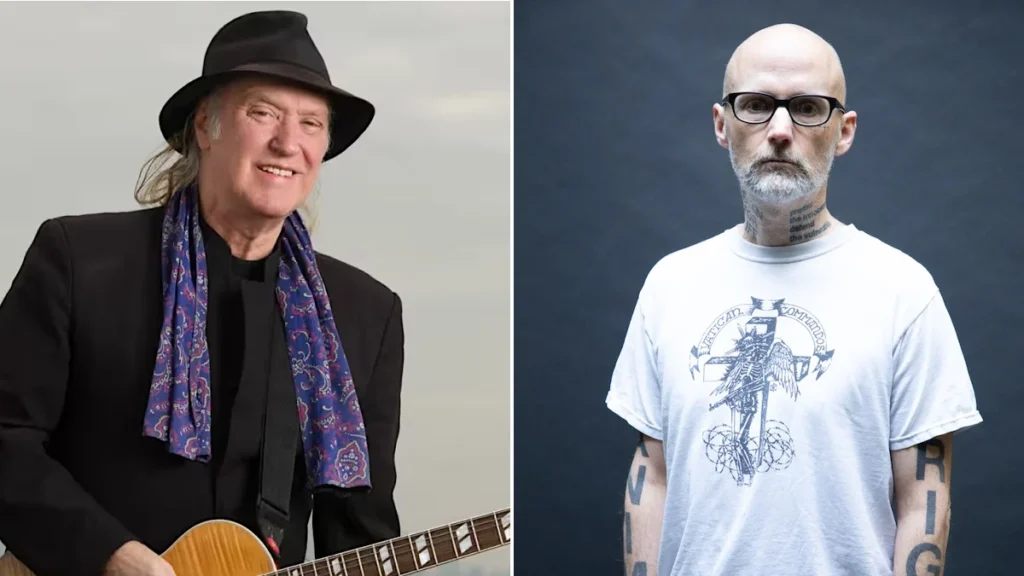

The veteran guitarist and founding member of the iconic British rock band The Kinks, Dave Davies, has publicly expressed profound indignation following recent remarks made by electronic music artist Moby. Moby, in a published interview, characterized The Kinks’ seminal 1970 hit "Lola" as "gross and transphobic," a judgment that Davies has vehemently rejected, rising to the defense of the song and his brother Ray Davies’ songwriting. This unfolding disagreement highlights a broader contemporary debate concerning the re-evaluation of historical cultural works through modern social lenses.
The Catalyst: Moby’s Remarks in The Guardian
The controversy originated from a "playlist" feature published in The Guardian newspaper over the weekend of March 22, 2026. In the recurring segment, artists are invited to curate a list of songs that have significantly impacted their lives, categorizing them under various themes. Moby, known for his vegan activism and electronic music career, shared his selections, which included tracks like The Clash’s "I Fought the Law" as "The first song I fell in love with" and Jane’s Addiction’s "Been Caught Stealing" for "The best song to play at a party."
However, it was Moby’s choice for the category "The song I can no longer listen to" that ignited the dispute. He singled out "Lola" by The Kinks, stating, "‘Lola’ by the Kinks came up on a Spotify playlist, and I thought the lyrics were gross and transphobic. I like their early music, but I was really taken aback at how unevolved the lyrics are.” This statement, coming from a well-known artist with a significant platform, immediately drew attention and prompted a swift rebuttal from The Kinks’ camp. Moby’s critique hinges on a perceived lack of evolution in the song’s lyrical content, implying that its narrative, while perhaps groundbreaking for its time, no longer aligns with contemporary understanding and respect for gender identity.
Dave Davies’ Resolute Defense and the Voice of Jayne County
Dave Davies wasted no time in responding to Moby’s criticisms. Taking to social media, he shared a powerful counter-narrative, primarily through a letter penned by openly transgender singer and pioneering punk rock figure Jayne County. Davies prefaced County’s letter with his own indignant remarks: “Regarding Moby’s criticism of our song ‘Lola’ in a recent Guardian interview these are the words sent to me and Ray from our dear friend trans icon Jayne County. I am highly insulted that Moby would accuse my brother of being ‘unevolved’ or transphobic in any way.”
Jayne County’s letter offered a starkly different interpretation of "Lola," one rooted in personal experience and historical context. Her words resonated deeply within the LGBTQ+ community and among fans of The Kinks, providing an insider’s perspective that directly challenged Moby’s assertion. County wrote, in part: “When I heard the song I was both thrilled and amazed that the Kinks would be singing a song about a trans person and wondered if anyone else had picked up on it! Who was cool or hip enough to realize what The Kinks were singing about! Lola will always be one of those songs that for me ‘broke the ice’ so to speak. I don’t think the radio stations picked up on the subject matter but a lot of the fans did and that’s what really matters!”
County continued to elaborate on the song’s profound personal significance: “‘Lola’ will always be a very special song to me! With this song, the Kinks projected themselves into the modern world. The REAL world! A world full of all kinds of people! Bisexual, Gay, Trans, not just a world full of straight heterosexuals! ‘Lola’ broke down the doors of narrow mindedness and I will always be grateful and happy that The Kinks gave me this incredible song with such a great story. Being Trans myself this will always be a very special song for me.”
Her testimony serves as a critical piece of evidence, suggesting that far from being "transphobic," "Lola" was, for many in the nascent LGBTQ+ community of the early 1970s, a moment of recognition and validation in mainstream culture.
The Significance of "Lola": A Cultural Touchstone
Released in 1970, "Lola" quickly became one of The Kinks’ most enduring and commercially successful singles. Penned by Ray Davies, the song tells the story of a young man’s romantic encounter with a person he meets in a club, only to discover later, "Well, I’m not the world’s most masculine man / But I know what I am and I’m glad I’m a man / And so is Lola." The famous line, "I met her in a club down in old Soho / Where you drink champagne and it tastes just like cherry-cola," was famously altered to "Coca-Cola" for radio play due to BBC regulations against product placement, illustrating the minor controversies the song faced even upon its initial release.
"Lola" reached number 2 on the UK Singles Chart and number 9 on the US Billboard Hot 100, cementing its place as a global hit and a cornerstone of The Kinks’ discography. Critically, the song was lauded for its innovative sound, featuring a distinctive distorted guitar riff (often mistakenly attributed to a Gibson Flying V, but actually achieved on a less conventional instrument) and its observational, often humorous, storytelling. Its lyrical content, which subtly (for the time) explored themes of gender fluidity and sexual ambiguity, was remarkably progressive for an era when such topics were rarely addressed in popular music, let alone with such widespread commercial success.
At the time of its release, the song was seen by many as daring and avant-garde. While it didn’t explicitly use terms like "transgender" (a term not widely in use in popular discourse in 1970), the narrative clearly depicted an encounter with a person whose gender presentation challenged conventional norms. For many, particularly those within or allied with the burgeoning gay rights movement, "Lola" was interpreted as a celebration of difference and an early, albeit imperfect, acknowledgment of diverse identities.
Historical Context and The Kinks’ Legacy
The Kinks, inducted into the Rock & Roll Hall of Fame in 1990, have a storied history of pushing boundaries and offering incisive social commentary through their music. From the gritty realism of "Dedicated Follower of Fashion" to the nostalgic longing of "Waterloo Sunset" and the class critique of "A Well Respected Man," the band consistently explored themes of identity, societal expectations, and British culture. Their music, often characterized by its wit, observational lyrics, and innovative guitar work, positioned them as one of the most influential bands of the British Invasion.
Dave Davies’ follow-up post further underscored the band’s historical openness and appreciation for diverse communities. He wrote, “I don’t wanna show the guy up, but Moby should be careful what he says. [Drag performers] the Cockettes and their friends used to follow us around on tour. We appreciated them. Why is Moby being so rude about this simple song? We’re not transphobic. Why does he have to have a go at us?”
The mention of The Cockettes, an outlandish, psychedelic, gender-bending drag troupe from San Francisco active in the late 1960s and early 1970s, provides crucial historical context. Their association with The Kinks on tour demonstrates a mutual respect and affinity between the band and a prominent queer performance group of that era. This anecdote directly refutes the notion of "transphobia" by illustrating The Kinks’ direct engagement with and acceptance of gender non-conforming individuals at a time when such interactions were far less common or publicly celebrated. It suggests that the spirit behind "Lola" was one of curiosity and acceptance, rather than derision or malice.
The Broader Discourse: Art, Evolution, and Interpretation
Moby’s critique of "Lola" as "unevolved" and "transphobic" touches upon a wider contemporary debate about how older artistic works should be viewed and judged in the present day. This discussion often revolves around several key questions:
- Authorial Intent vs. Modern Interpretation: Should a work be judged solely by the intent of its creators at the time of its creation, or by how it is perceived and impacts audiences today?
- Historical Context: How much weight should be given to the historical context in which a work was created, including the limitations of language and understanding prevalent at the time?
- Evolution of Language and Sensibility: As societal understanding of gender, race, and sexuality evolves, how do we reconcile the language and depictions in older works that may now be considered insensitive or harmful?
- "Cancel Culture" vs. Accountability: Is re-evaluating historical works a form of "cancel culture," or a necessary step towards greater social accountability and empathy?
In the case of "Lola," Jayne County’s statement emphasizes the perspective of those who found empowerment and representation in the song, challenging the idea that it is inherently "transphobic." Her experience highlights the subjective nature of artistic reception, particularly for marginalized communities who may interpret a work differently from the mainstream. For many, "Lola" was not about mocking or disparaging a trans person, but rather about capturing a real, albeit somewhat ambiguous, encounter in a way that defied the rigid gender norms of the time. The song’s gentle, almost bewildered, tone, rather than one of malice, has often been cited as evidence of its pioneering, rather than offensive, spirit.
The term "unevolved," used by Moby, implies a moral or social progress that older works might fail to meet. While contemporary society has indeed made significant strides in understanding and advocating for transgender rights and visibility, applying current standards rigidly to works from previous eras can be complex. It often overlooks the incremental progress and the role that such works, however imperfectly, played in challenging norms at their own time.
Social Media’s Role and Public Reaction
The exchange between Moby and Dave Davies, primarily unfolding on social media platforms, underscores the instantaneous and often confrontational nature of modern cultural debates. Social media allows for immediate responses from artists and direct engagement with public discourse, but it can also amplify disagreements and reduce nuanced arguments to soundbites.
The reactions to this dispute have been varied. Many Kinks fans and music historians have rallied behind Dave Davies, echoing Jayne County’s sentiment that "Lola" was groundbreaking rather than offensive. They point to the song’s pioneering spirit and the band’s general reputation for empathy and observation in their songwriting. Others have expressed understanding for Moby’s perspective, acknowledging that while the song might have been progressive in its time, certain lyrical elements could be viewed as problematic when judged by today’s more refined understanding of gender identity and appropriate language. The debate also drew attention to Moby’s own past controversies, including accusations of inappropriate behavior and misleading statements in his memoirs, which some users brought up in discussions, implicitly questioning his authority to pass judgment on others’ "evolved" status.
Conclusion
The disagreement between Dave Davies and Moby regarding "Lola" is more than just a clash between two musicians; it is a microcosm of a larger cultural conversation about the longevity and interpretation of art. While Moby views the song as a relic of an "unevolved" past, Dave Davies, supported by the lived experience of Jayne County, champions it as a pioneering piece of music that, however imperfectly by today’s standards, offered a glimpse into a more diverse and accepting world decades ago.
The enduring legacy of "Lola" and The Kinks lies not only in its commercial success and musical innovation but also in its ability to spark dialogue and provoke thought across generations. This latest controversy ensures that "Lola" remains relevant, prompting listeners to engage with its lyrics, consider its historical context, and reflect on the evolving nature of language, identity, and social understanding in the realm of popular culture. As debates over historical art and modern sensibilities continue, the story of "Lola" serves as a potent reminder that the meaning and impact of cultural works are rarely static, constantly re-evaluated and reinterpreted by each successive generation.