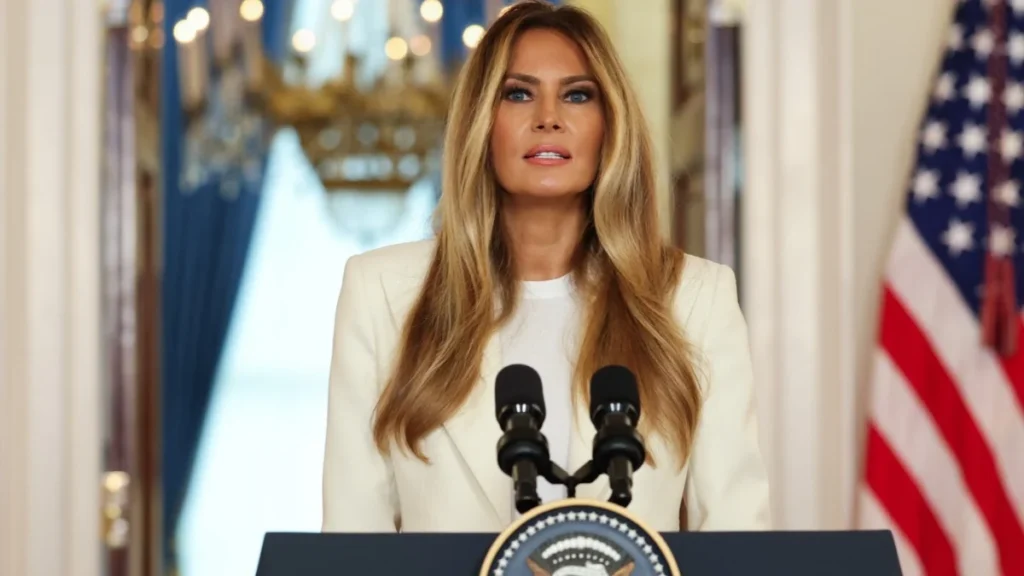

In an unprecedented diplomatic development that momentarily bypassed traditional State Department channels, First Lady Melania Trump hosted a high-stakes gathering at the White House on Thursday to commemorate a recently concluded localized ceasefire in the Russian-occupied Ukrainian city of Oleshky. The event, which brought together senior representatives from both warring nations, marked what historians and diplomatic aides believe to be the first time in modern American history that a presidential spouse has personally convened delegates from two countries actively engaged in active, large-scale warfare.
Addressing a distinguished audience of international diplomats, humanitarian workers, and political figures, Mrs. Trump delivered pointed remarks thanking both Russian President Vladimir Putin and Ukrainian President Volodymyr Zelensky for their direct cooperation. Notably absent from her public acknowledgments was any mention of her husband, President Donald Trump. This conspicuous omission occurred against the backdrop of the incumbent administration’s ongoing struggles to deliver on grand campaign promises to swiftly end the broader Russia-Ukraine conflict, which originated with Russia’s full-scale invasion.
The localized truce in Oleshky, a strategic municipality located in the Kherson region, officially concluded on November 1 after holding firm for a tightly managed six-day window. According to humanitarian tallies shared during the White House event, the brief suspension of hostilities successfully facilitated the evacuation of nearly 800 civilians from the heavily contested and damaged urban center, while simultaneously allowing critical medical supplies, food, and clean water to reach those unable to flee.
Anatomy of an Unlikely Diplomatic Breakthrough
Describing the arrangement as a sophisticated ceasefire, Mrs. Trump offered rare insight into her behind-the-scenes involvement in orchestrating the corridor. Eschewing the traditional ceremonial role often assigned to first ladies, she detailed her active participation in every planning stage of the humanitarian operation. Her workload, according to administration sources and her own public admissions, included personally reviewing complex logistical data, analyzing deteriorating road conditions, and negotiating secure evacuation routes with military and civilian intermediaries from both Moscow and Kyiv.
“This cooperation establishes a meaningful precedent for advancing peace throughout the region,” Mrs. Trump told the gathered delegates, emphasizing that the delicate humanitarian corridor would never have materialized without the direct political will of Putin and Zelensky.
According to the First Lady’s timeline, her personal involvement began in September, when she was first alerted to the acute humanitarian crisis unfolding in Oleshky. Rather than routing the issue through standard diplomatic channels—such as the National Security Council or the U.S. State Department—Mrs. Trump stepped into the vacuum, operating what she described as an exclusive intermediary role between the two hostile governments.
The strategy, though unorthodox, yielded tangible results on the ground. For six days, the guns fell silent over Oleshky, a city that has suffered severe infrastructure damage and isolation since falling under Russian occupation. Humanitarian organizations praised the pause as a vital lifeline for vulnerable populations trapped in the crossfire, particularly elderly residents and children who had been cut off from regular aid deliveries for months.
International Reactions and Official Delegations
The unusual diplomatic summit drew varied reactions from the international delegations present at the White House, highlighting the complex geopolitical currents swirling around the event.
Kirill Dmitriev, a special envoy representing the Kremlin, took to the podium to validate Mrs. Trump’s central role in coordinating the operation and resolving what he termed the Oleshky situation. Dmitriev underscored that the initiative required authorization from the highest levels of the Russian government.
“President Putin personally gave all of the necessary instructions to ensure the successful implementation of the local ceasefire in Oleshky,” Dmitriev stated to the audience. In a nod to Washington’s broader political dynamics, the Kremlin envoy also remarked that Putin appreciates President Trump’s stated peacemaking efforts regarding the broader Ukrainian crisis. To underscore the humanitarian spirit of the gathering, Dmitriev concluded his remarks by presenting the First Lady with a symbolic drawing crafted by an 11-year-old child living in the conflict zone.
From the Ukrainian perspective, the assessment of the First Lady’s intervention was equally enthusiastic, though distinctly separate from the executive branch of the United States government. David Arakhamia, a senior Ukrainian politician and negotiator, addressed the room directly, declaring that Mrs. Trump had executed an amazing job under impossible circumstances.
The climax of the Ukrainian delegation’s presentation came when President Volodymyr Zelensky, appearing via a pre-recorded or remote diplomatic link, bestowed upon Mrs. Trump the Order of Princess Olga, 1st Class. This decoration stands as Ukraine’s highest state honor reserved specifically for women, recognizing outstanding personal contributions to state, public, and charitable activities.
Furthermore, Mrs. Trump took a moment to single out Ukraine’s parliamentary commissioner for human rights, praising the official’s dedication. “The incredible bravery and heart you show in serving your people every day is an inspiration to the world,” the First Lady remarked, reinforcing the personal bonds forged during the humanitarian negotiations.
The Personal Letters and the Domestic Political Subtext
As the summit drew to a close, the proceedings took a notably personal turn that underscored the independent diplomatic footprint carved out by the First Lady. Before the international officials departed the White House complex, Mrs. Trump handed each delegation a sealed, personal letter to carry back to their respective capitals. One missive was explicitly addressed to Vladimir Putin, while the other was directed to Volodymyr Zelensky.
Observers within the diplomatic corps quickly noted the striking absence of President Donald Trump’s name in both the correspondence and the First Lady’s public addresses. Throughout the entire event, Mrs. Trump did not publicly thank, credit, or mention her husband, despite the summit taking place inside the executive mansion and dealing with a major theater of foreign policy that has remained a central pillar of the Trump administration’s foreign agenda.
This notable omission has fueled intense speculation among political analysts and Washington insiders. President Trump has repeatedly claimed on the public stage that he could negotiate a definitive end to the Russia-Ukraine war within twenty-four hours. However, as the months have progressed, those ambitious pledges have largely gone unfulfilled, bogged down by intractable territorial disputes, security guarantees, and deep-seated animosities between Moscow and Kyiv.
By successfully brokering a localized, albeit temporary, humanitarian pause—and doing so through direct engagement with the primary belligerents—Melania Trump achieved a tangible diplomatic breakthrough that has eluded formal administration envoys. While the Oleshky ceasefire was strictly limited in scope and duration, expiring on November 1, its successful execution stands in sharp contrast to the broader diplomatic stalemate that has characterized the official U.S. approach to the conflict.
Broader Implications for Regional Diplomacy
The White House summit and the events leading up to it carry significant implications for how humanitarian crises may be managed in ongoing asymmetric conflicts. Analysts suggest that the Oleshky model demonstrates how non-traditional intermediaries, leveraging humanitarian necessity rather than grand political bargains, can carve out temporary zones of safety even when comprehensive peace talks are entirely frozen.
However, international relations experts caution against overstating the long-term geopolitical impact of such localized truces. While the evacuation of 800 civilians and the delivery of vital aid represent a profound victory for the individuals affected, a six-day pause in a single municipality does not fundamentally alter the strategic military balance or the core political objectives of either Russia or Ukraine. Both nations remain deeply entrenched in their respective war aims, with Moscow continuing its occupation of vast swaths of Ukrainian territory and Kyiv demanding the complete restoration of its internationally recognized borders.
Nevertheless, the willingness of both the Kremlin and the Ukrainian government to coordinate logistics directly with the American First Lady illustrates a pragmatic flexibility when specific humanitarian corridors are at stake. It also highlights a growing trend of parallel diplomacy, where individual figures outside traditional diplomatic corps utilize personal influence to achieve specific, contained outcomes.
As the dust settles on the White House event, the legacy of the Oleshky ceasefire remains two-fold: it provided an essential lifeline to hundreds of desperate civilians caught in the machinery of war, and it established a fascinating political precedent regarding the independent diplomatic capabilities of a United States First Lady. Whether this singular event will serve as a catalyst for future humanitarian corridors—or remain an isolated diplomatic anomaly—depends entirely on the evolving dynamics on the ground in southern Ukraine and the shifting priorities of leadership in Moscow, Kyiv, and Washington.