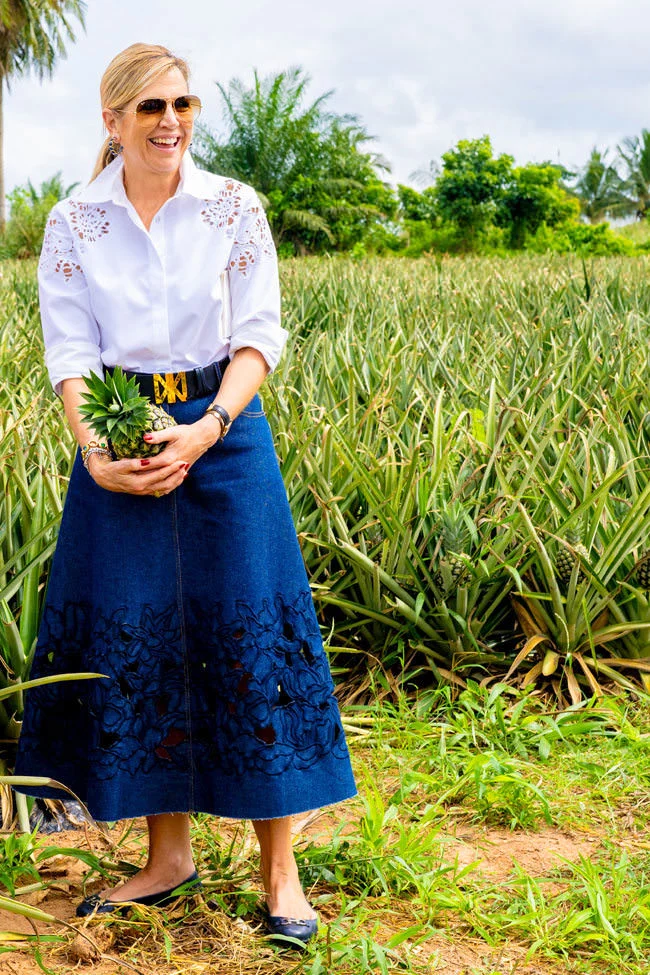

Queen Máxima of the Netherlands arrived in the Republic of Ghana for a high-profile, multi-day official visit carried out in her prestigious capacity as the United Nations Secretary-General’s Special Advocate for Inclusive Finance for Development (UNSGSA). The royal visit is designed to evaluate, support, and accelerate the advancement of financial health, digital financial services, and economic resilience for underserved populations, women, and micro-, small, and medium-sized enterprises (MSMEs) across the West African nation. Throughout her engagements, the Queen has maintained a rigorous schedule of high-level diplomatic meetings, field visits to local enterprises, and policy discussions with government officials, international development partners, and leaders within Ghana’s burgeoning financial technology sector. While her professional itinerary remains the primary focus of her international mission, her sartorial selections—specifically a thoughtfully curated ensemble by contemporary fashion label Chorus—have drawn significant international attention for blending practical diplomatic utility with modern style.
Background Context of the Royal Visit to Ghana

The diplomatic and developmental mission to Ghana represents a continuation of Queen Máxima’s long-standing global advocacy under the United Nations framework. Appointed as the UN Secretary-General’s Special Advocate in 2009, the Queen has traveled extensively to emerging economies to champion universal access to affordable, secure, and responsible financial services. Financial health has become a core pillar of her recent advocacy, shifting the global development conversation beyond mere account ownership to focus on the actual resilience, security, and stability of individuals’ financial lives.
Ghana was selected for this mission due to its progressive strides in digital public infrastructure, mobile money interoperability, and a dynamic fintech ecosystem that serves as a regional benchmark within West Africa. Despite these advancements, significant disparities remain in financial access, particularly for rural communities, agricultural workers, and female-led enterprises. The joint mission aims to address these systemic hurdles by fostering public-private partnerships, encouraging regulatory frameworks that protect consumers, and mobilizing investments that empower vulnerable economic sectors.
Timeline and Chronology of the Official Itinerary

The official visit began upon Queen Máxima’s arrival at Kotoka International Airport in Accra, where she was received by senior Ghanaian government officials and representatives of the Kingdom of the Netherlands.
Day One commenced with formal bilateral meetings at Jubilee House, the presidential palace in Accra. The Queen sat down with key economic stakeholders, including representatives from the Ministry of Finance, the Bank of Ghana, and leading commercial financial institutions. Discussions centered on expanding the reach of digital credit, lowering transaction costs for remittances, and scaling up digital identification systems to facilitate secure banking for unbanked populations.
Day Two shifted from institutional boardrooms to the field. Queen Máxima traveled outside the capital to engage directly with local entrepreneurs, market traders, and smallholder farmers who utilize mobile money platforms to manage their businesses. These field visits provided the UNSGSA with qualitative insights into how digital financial tools are transforming day-to-day commerce in local markets, while also exposing ongoing challenges such as high interest rates, digital literacy gaps, and cybersecurity vulnerabilities.

Day Three involved a roundtable symposium hosted in collaboration with local fintech innovators, commercial bank executives, and civil society organizations. The dialogue focused on fostering inclusive green finance, ensuring that the transition to a sustainable economy does not leave marginalized populations behind. The visit concluded with a debriefing session with international development agencies and diplomatic missions to coordinate ongoing financial inclusion strategies in the region.
Supporting Data and Economic Context of Financial Inclusion in Ghana
To fully contextualize the importance of Queen Máxima’s mission, it is essential to examine the socio-economic and financial landscape of Ghana. According to recent economic and development reports from the World Bank and the Central Bank of Ghana, the country has made remarkable progress in financial inclusion over the past decade, driven largely by the exponential growth of mobile money services.

Key statistical indicators highlight the current state of Ghana’s financial sector:
- Mobile Money Penetration: Over 60% of the adult population in Ghana actively uses mobile financial services, making the country one of the most dynamic mobile money markets in Sub-Saharan Africa.
- Gender Gap in Financial Access: While overall account ownership has risen, a noticeable gender gap persists, with women significantly less likely to access formal credit or hold formal business bank accounts compared to men.
- MSME Contribution: Small and medium-sized enterprises account for approximately 85% of total employment in Ghana and contribute over 70% to the nation’s Gross Domestic Product (GDP), yet they face an annual financing deficit estimated in the billions of dollars.
- Digital Infrastructure: Ghana’s implementation of universal QR code payment systems and interoperable payment switches has drastically reduced transaction friction, serving as a model for neighboring nations.
Statements and Reactions from Related Parties
While diplomatic missions of this nature are measured primarily by policy outcomes and economic commitments, the intersection of international diplomacy and public profile frequently generates widespread public commentary. Representatives from the Dutch Ministry of Foreign Affairs emphasized the constructive nature of the discussions between Queen Máxima and Ghanaian leadership, noting that the Kingdom of the Netherlands remains fully committed to supporting sustainable trade and development initiatives in West Africa.

Local business owners and market traders who interacted with the royal delegation expressed optimism regarding the visibility the visit brings to grassroots economic challenges. Financial sector analysts in Accra noted that the high-level endorsement by a UN Special Advocate helps accelerate regulatory reforms aimed at lowering borrowing costs and expanding digital safety nets for informal workers.
In the realm of international fashion and style commentary, the Queen’s wardrobe choices during the tour garnered considerable praise. Opting for a coordinated ensemble from the fashion house Chorus—comprising the "Hyacinth" shirt and the "Waterlily" denim skirt featuring intricate eyelet cutout detailing, paired with Olympia Babylonia earrings and Ray-Ban sunglasses—Queen Máxima successfully balanced royal protocol with practical, climate-appropriate attire suitable for field engagements in a tropical climate. Fashion analysts highlighted the modern silhouette, noting that the inclusion of a polished denim skirt and functional flats demonstrated a pragmatic approach to royal wardrobe planning during demanding working visits.
Fact-Based Analysis of Broader Implications

The long-term implications of Queen Máxima’s visit to Ghana extend far beyond immediate media coverage. By leveraging her international platform, the UNSGSA effectively amplifies the urgency of institutional reforms that can unlock capital for millions of unbanked and underbanked individuals.
From an economic perspective, enhanced financial health directly correlates with poverty reduction and macroeconomic stability. When MSMEs gain secure access to affordable credit and digital payment tools, they exhibit higher survival rates, generate more employment opportunities, and contribute more robustly to domestic tax revenues. Furthermore, by focusing specifically on women’s economic empowerment, the initiatives championed during the visit address systemic inequities that restrict broader economic growth.
The cooperative framework reinforced during this visit between Dutch institutions, Ghanaian regulators, and international bodies such as the United Nations underscores a broader trend in modern diplomacy: the convergence of public sector policy goals with private sector innovation to solve complex global challenges. As digital transformation continues to reshape the global economy, missions of this caliber serve as crucial catalysts for ensuring that technological advancements translate into tangible, equitable benefits for all segments of society.