
Queen Mary of Denmark has once again captured the attention of royal watchers and jewelry historians worldwide by integrating a remarkable, centuries-old piece of European heritage into the modern Danish royal collection. Known for her thoughtful approach to royal fashion and her respectful nod to historical continuity, Queen Mary’s latest revelation centers on the "Lava Parure"—an extraordinarily rare set of antique jewelry crafted partially from volcanic rock over two centuries ago.
This historic acquisition and its impending public exhibition at Rosenborg Castle highlight a broader strategy by Queen Mary to revitalize underappreciated royal heirlooms. By bringing pieces with deep genealogical and geopolitical ties back into the public eye, the Queen is actively curating a visual narrative that bridges the gap between Europe’s complex monarchical past and the contemporary Scandinavian monarchy of King Frederik X.
The Origins of the Lava Parure
The Lava Parure is an exceptional testament to 19th-century craftsmanship and the romanticism of the European "Grand Tour." Originally belonging to Queen Désirée of Sweden—an ancestor of King Frederik X—the set includes a tiara, a necklace, two bracelets, a brooch, and a pair of earrings, all meticulously fashioned from volcanic material.
During the late 18th and early 19th centuries, travelers touring the cultural landscapes of Italy frequently collected fragments of rock and stone from historical sites like Pompeii and Mount Vesuvius. Transforming these geological mementos into high-fashion jewelry became a trend among the European aristocracy. In the case of the Lava Parure, the volcanic material was carved into delicate, pale-blue cameos, which were then set into intricate gold mountings. This combination produced a striking contrast between the earthy, unconventional medium of raw earth and the opulent gold framework demanded by royal status.
Queen Désirée’s ownership places the parure within a fascinating web of Napoleonic-era European royalty. Born Désirée Clary in Marseille, she was famously engaged to a young Napoleon Bonaparte before he broke off their engagement to marry Joséphine de Beauharnais. Désirée subsequently married Jean-Baptiste Bernadotte, one of Napoleon’s most trusted generals and politicians. In 1810, Bernadotte was elected as the heir presumptive to the Swedish throne, eventually reigning as King Karl XIV Johan, with Désirée taking the name Queen Desideria. Though she notoriously delayed her return to Stockholm for over a decade, preferring the social climate of Paris, her personal collection of jewels eventually wound up distributed among European dynastic branches.
The complete Lava Parure was recently acquired at a high-profile auction shortly after King Frederik X ascended to the Danish throne. This strategic purchase ensured that a crucial piece of family heritage returned to the direct lineage of the Swedish-Danish royal houses.
Rosenborg Castle Exhibition and Public Access
The journey of the Lava Parure continues as royal historian and expert The Royal Watcher confirmed that the entire set is scheduled for public exhibition at Rosenborg Castle. Located in the heart of Copenhagen, Rosenborg Castle serves as the secure vault and museum housing the Danish Crown Jewels and royal regalia.
Displaying the parure alongside other legendary Danish treasures—such as the emerald parure tiara, which is legally restricted from ever leaving Danish soil and can only be worn by a reigning queen—offers visitors a rare glimpse into the tangible history of the monarchy. Museum curators anticipate a significant surge in domestic and international visitors eager to view the volcanic set up close.
While museum officials have maintained standard security and display protocols, the physical presence of the Lava Parure within the castle’s treasury has naturally fueled widespread speculation. Observers and fashion analysts strongly suspect that Queen Mary intends to debut the tiara and matching accessories at a major state banquet or diplomatic gala in the near future, adding another chapter to the jewels’ storied existence.

A Pattern of Historic Revivals Under Queen Mary
The introduction of the Lava Parure is not an isolated incident; rather, it forms part of a deliberate and ongoing effort by Queen Mary to redefine royal style through historical curation. Since King Frederik X and Queen Mary succeeded to the throne, the Queen has systematically introduced previously unseen or dormant pieces from the royal vaults, adapting them with modern sensibilities while honoring their origins.
Early in her tenure as queen, she famously repurposed a set of family diamonds into a sleek, contemporary bandeau tiara, which she has worn with great versatility on multiple occasions. Her sartorial reverence for the 19th century was further underscored in early 2025 when she debuted a gold tiara encrusted with stones collected by Queen Caroline Amalie during an Italian tour. Much like the lava cameos, Caroline Amalie’s jewels incorporated authentic fragments of Pompeii, reflecting a shared aesthetic affinity across generations of Danish consorts.
Furthermore, just weeks prior to the announcement of the Lava Parure exhibition, Queen Mary stunned attendees at a State Banquet honoring the President of Vietnam by wearing a newly reworked sapphire and diamond tiara. Originally belonging to Queen Alexandrine of Denmark, those specific gemstones had been presented as a wedding gift to Alexandrine by Tsar Nicholas II and Tsarina Alexandra of Russia. By transforming the historical stones into a modern bandeau silhouette, Queen Mary demonstrated a deft ability to balance heritage conservation with contemporary fashion trends.
Genealogical Ties to the Swedish Cameo Tiara
The entry of the Lava Parure into the Danish royal collection also highlights a remarkable familial connection to another famous piece of European royal jewelry: the Swedish Cameo Tiara.
The Swedish Cameo Tiara features large, exquisitely carved cameos set within a semi-coronet structure. Its lineage traces directly back to Empress Joséphine, Napoleon’s first wife. Upon her death, Joséphine left the tiara to her son, Eugène de Beauharnais. His daughter, also named Josephine, married the future King Oscar I of Sweden in 1823, bringing the magnificent heirloom into the Swedish royal family.
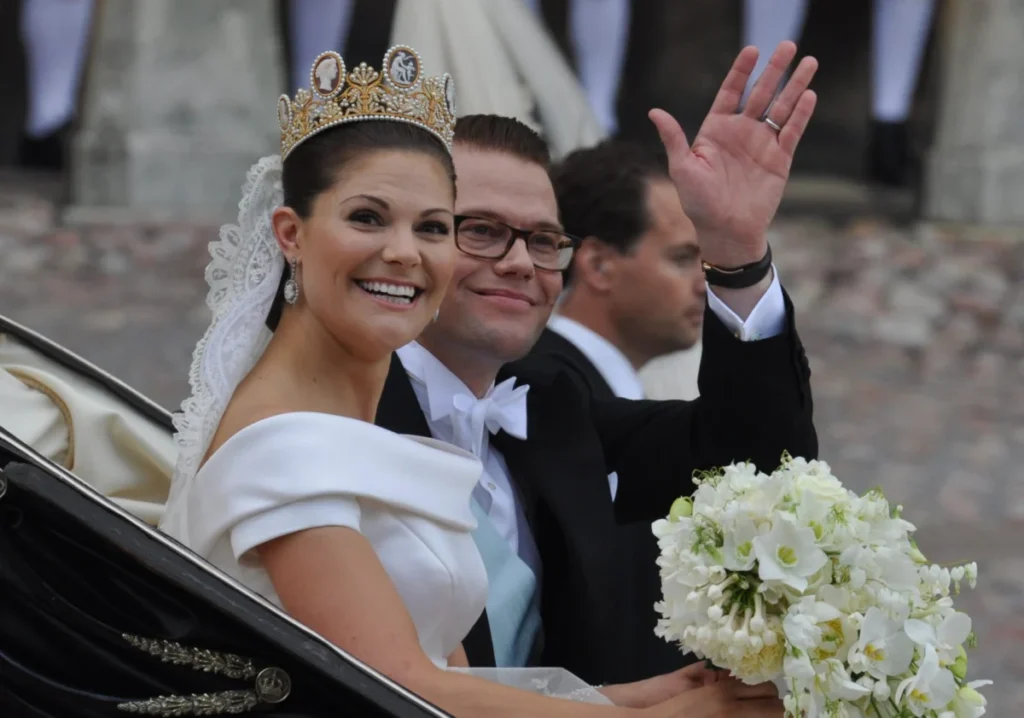
Crucially, King Oscar I was the only child of King Karl XIV Johan and Queen Désirée—the very same Queen Désirée who originally commissioned or owned the Lava Parure now held in Denmark. This historical convergence means that the family lines connected to the Swedish Cameo Tiara, worn on their wedding days by prominent royals such as Queen Silvia and Crown Princess Victoria, share a direct ancestral root with Queen Mary’s newly acquired volcanic treasure.
Implications for Modern Monarchy and Cultural Diplomacy
The curation and exhibition of historic jewels like the Lava Parure carry significant implications for modern monarchies, particularly in terms of cultural diplomacy and public engagement. In an era where European royal houses must continually justify their cultural relevance and institutional value, the preservation and display of historical artifacts serve as a powerful bridge to the public.
By transforming Rosenborg Castle into a dynamic space where the public can witness these revivals firsthand, the Danish royal house reinforces its role as a custodian of national and European heritage. Educational institutions and historians have praised these initiatives, noting that the exhibition of such artifacts provides tangible entry points for younger generations to study European history, geology, and 19th-century decorative arts.
Moreover, Queen Mary’s personal involvement in selecting, commissioning adjustments for, and ultimately wearing these historic pieces functions as a subtle form of soft power. Each appearance of a revived heirloom generates international media coverage, elevating Denmark’s cultural profile on the global stage. It signals stability, continuity, and a deep respect for the intertwined histories of European dynasties.
As anticipation builds for the public unveiling of the Lava Parure at Rosenborg Castle, the overarching narrative remains clear: Queen Mary is masterfully blending archival stewardship with modern regal elegance. Whether or not the volcanic tiara makes a dramatic debut on the royal head in the coming months, its return to the family fold ensures that a fascinating piece of 19th-century history will continue to spark wonder, debate, and admiration for generations to come.