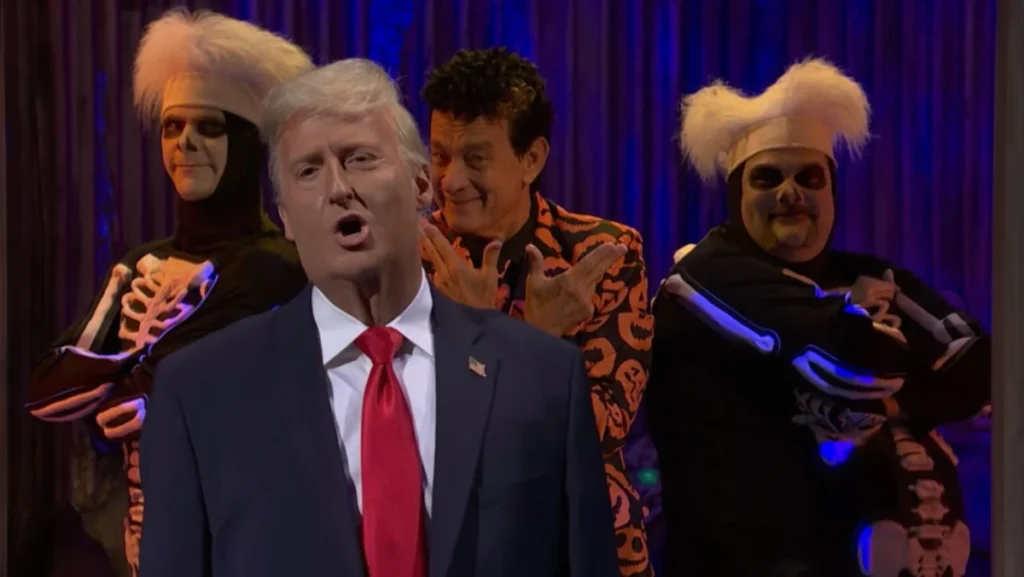

The long-awaited return of David S. Pumpkins to the Saturday Night Live stage during this week’s Halloween episode proved to be a jarring exercise in contemporary political satire. Tom Hanks, who first debuted the character in 2016, reprised his role as the neon-suited, dance-obsessed specter in a sketch that echoed the premise of the original haunted elevator ride. However, the performance took an unexpected turn when James Austin Johnson’s impression of Donald Trump effectively hijacked the narrative, transforming a nostalgic comedy bit into a direct commentary on the saturation of political discourse in American entertainment.
The Evolution of David S. Pumpkins
To understand the significance of this disruption, one must first look at the cultural footprint of David S. Pumpkins. When the character first appeared on October 22, 2016, in a sketch titled "Haunted Elevator," it became an instantaneous viral sensation. The absurdity of a man in a pumpkin-patterned suit, accompanied by two skeleton-clad backup dancers, defied the typical logic of SNL sketches. The character was intentionally inexplicable, relying on physical comedy and a catchy, nonsensical catchphrase: "Any questions?"
The character’s resonance was so profound that it spawned a 2017 animated special, The David S. Pumpkins Halloween Special, and solidified a place in the pantheon of iconic SNL characters. For many fans, the appeal of Pumpkins lies in his isolation from the real world; he is a creature of pure, surrealist comedy. By forcing this character into an environment dominated by political parody, the production team at Saturday Night Live signaled a shift in how the program balances its comedic identity against the relentless gravity of the current political cycle.
Chronology of the Disruption
The sketch began with familiar beats: a young couple, played by current cast members, entering a haunted elevator and encountering the strange, rhythmic presence of David S. Pumpkins. The pacing was deliberate, mirroring the 2016 original. However, as the elevator ascended to different floors, the thematic consistency was shattered.
The arrival of James Austin Johnson’s Donald Trump character served as the turning point. Johnson, widely praised for his nuanced and often surreal approach to the former president, entered the space with a cadence that instantly eclipsed the absurdist atmosphere of the Pumpkins bit. Rather than remaining a brief, cameo-style intrusion, the character dominated the remainder of the segment. The sketch transitioned from a character-based parody into a broader critique of the inescapable nature of the 2024 presidential election cycle.
Data on Political Satire in Comedy
The intrusion of political figures into non-political sketches is a recurring tactic in SNL’s history, but the frequency has shifted alongside the political climate. According to audience engagement metrics and analysis from media research firms, the "Trump-effect" on late-night television has been profound. Since 2015, shows like Saturday Night Live, The Late Show with Stephen Colbert, and The Daily Show have seen a statistically significant increase in the percentage of airtime dedicated to political topics compared to the early 2000s.
During election years, this focus often reaches a saturation point. Internal data from NBC and industry analysis suggest that during the final weeks before a national election, viewers are subjected to a "saturation threshold," where the demand for escapism via traditional comedy often clashes with the necessity of political commentary. By injecting a political figure into a legacy sketch, SNL attempted to highlight this tension, perhaps inadvertently alienating viewers who sought a reprieve from the headlines.
Reactions and Industry Perspective
While official statements from the show’s producers regarding the creative decision-making process are rarely released, the reception among media critics has been divided. Supporters of the segment argue that the intrusion was a deliberate meta-commentary: if the American public cannot escape the presence of Donald Trump in their daily lives, why should the residents of a haunted elevator?
Conversely, critics have pointed to the "lazy" nature of the writing. By utilizing a proven character like David S. Pumpkins only to have him overshadowed by a political impression, the show may have undermined the integrity of its own creative output. Industry insiders have noted that SNL has historically struggled with the "Trump paradox"—the need to cover a ubiquitous political figure while maintaining the variety-show spirit that made the program a cultural pillar for five decades.
The Role of Bobby Moynihan
A notable element of the recent performance was the inclusion of Bobby Moynihan, who originated the role of one of Pumpkins’ skeleton dancers. His return was a highlight for long-time fans of the show, representing a bridge between the "golden era" of the 2010s and the current cast. However, the frustration expressed by viewers stemmed from the perception that such a high-profile cameo was subordinated to a political sketch. The consensus in fan communities has been that if legacy characters are to be brought back, they should be allowed to occupy the spotlight without the interference of high-intensity political satire.
Broader Implications for SNL
The structural decision to integrate Trump into a legacy sketch serves as a microcosm of the challenges facing late-night television in the digital age. With social media discourse dominated by political polarization, comedy programs are constantly negotiating their role as either a public square or a place of refuge.
This specific sketch highlights a shift toward a more aggressive, inescapable style of satire. In previous election cycles, political cold opens were strictly separated from the rest of the show. The current trend of bleeding political motifs into recurring characters suggests a shift in the show’s editorial philosophy. Whether this is an effective strategy to keep the show relevant in a hyper-polarized environment or a symptom of creative fatigue remains a subject of ongoing debate.
Looking Ahead: The Post-Election Landscape
As the nation moves toward the conclusion of the current election cycle, the cultural cachet of political figures—and the impressions of them—will likely face a period of recalibration. The "Trump-ification" of every aspect of American media, from news to sketch comedy, has provided ample material for writers but has also created a form of fatigue among the viewership.
The results of the upcoming election will undoubtedly dictate the trajectory of SNL’s writing room for the coming months. If the political climate stabilizes, there may be a return to the more character-driven, surrealist comedy that defined the popularity of David S. Pumpkins in the first place. If not, viewers should prepare for continued friction between the worlds of fantasy and political reality.
For now, the return of David S. Pumpkins stands as a reminder of the fleeting nature of pure comedy in an era defined by political urgency. While the performance left many wanting more of the character and less of the surrounding discourse, it successfully captured the exact mood of the country: a desperate attempt to find a moment of levity, only to be confronted by the inescapable realities of the modern political machine. The producers of Saturday Night Live will continue to navigate these waters, balancing the legacy of their past creations with the heavy demands of the present day. Whether the audience chooses to embrace this fusion or demand a return to tradition will be reflected in the ratings and social media engagement metrics in the weeks to follow.