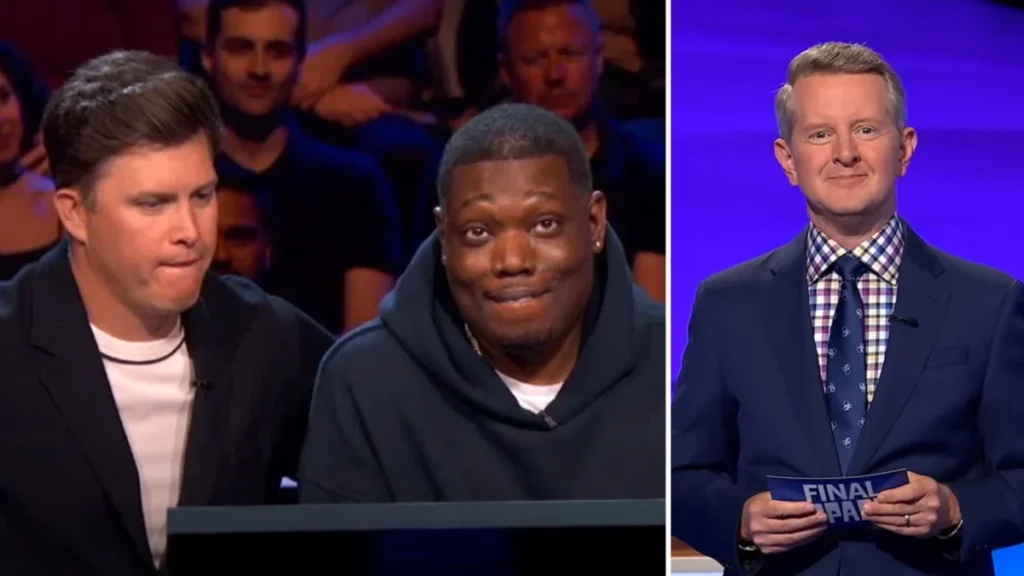

The intersection of television’s most iconic quiz shows recently provided a moment of high-stakes comedy and genuine tension when Saturday Night Live head writers and Weekend Update anchors Colin Jost and Michael Che appeared as contestants on ABC’s primetime revival of Who Wants to Be a Millionaire. Hosted by late-night personality Jimmy Kimmel, the episode saw the comedic duo navigate their way through the game’s progressively difficult tiers, eventually reaching a $500,000 threshold that forced them to exhaust their "Phone a Friend" lifeline. Their choice for that lifeline was none other than Jeopardy! G.O.A.T. and host Ken Jennings, creating a rare crossover event that highlighted both the camaraderie of the television industry and the unpredictable nature of trivia.
The $500,000 Dilemma
The gameplay reached a critical juncture when Kimmel presented a question concerning the operatic legend Luciano Pavarotti. The query asked, "As a good luck charm, Luciano Pavarotti liked to keep what small object in his pocket during performances?" The provided options were: A) A pebble, B) A 20 lire coin, C) A lock of his mother’s hair, and D) A nail.
For Jost and Che, the decision-making process was a study in balancing intellectual deduction with comedic instinct. Che remarked on the eccentricity of the options, noting that each item carried a strange, superstitious weight. Jost, maintaining his penchant for irreverent humor even under the pressure of a half-million-dollar question, suggested that "a nail" was a potential answer, theorizing that the tenor might have kept it to ensure he "nailed" his performance. Despite the levity, the stakes were tangible; a wrong answer would drop the pair’s bankroll from $250,000 down to a mere $32,000.
The Phone a Friend Call
With the clock ticking and the pressure mounting, the duo opted to utilize their lifeline to consult Ken Jennings. The call itself underscored the personal relationship between the three television fixtures. Upon answering, Jennings expressed genuine surprise, questioning how the SNL duo had managed to progress so far into the game’s late stages.
The exchange quickly shifted to the trivia task at hand. Jennings, a man whose career is built upon an encyclopedic knowledge of history, literature, and culture, admitted that the specific superstition of Luciano Pavarotti was outside his immediate area of expertise. "I’ve never heard this fact, you guys," Jennings admitted to the pair. He provided an honest assessment, suggesting that while "a nail" seemed like a plausible, albeit unlikely, answer, he could not provide a definitive recommendation with enough confidence to risk their winnings. As the 30-second window closed, the call was disconnected. Following the abrupt end to the conversation, Jimmy Kimmel jokingly quipped to the audience, "You heard what he said. He’s 100 percent sure," further diffusing the tension for the studio audience.
Strategic Withdrawal and The Outcome
Following the inconclusive call, Jost and Che engaged in a brief deliberation. Recognizing the volatility of the question and the uncertainty surrounding Jennings’ feedback, the pair chose to exercise caution. They elected to walk away with their accumulated $250,000, which was designated for their respective charities: the Food Bank for NYC and Answer the Call, an organization that provides financial assistance to the families of fallen first responders in New York City.
Once the contestants were no longer at risk of losing their funds, the official answer was revealed to be "a nail." The revelation sparked a moment of irony, as the specific option Jost had jokingly proposed as a potential "pun" turned out to be the factual answer. In a post-game reflection, Che noted that his gut instinct had leaned toward the nail, while Jost had favored the pebble. Had they trusted their intuition, they would have been one step closer to the show’s top prize.
Historical Context and Trivia Landscape
The appearance of Ken Jennings as a lifeline participant is significant given his own history with the program. In the previous season, Jennings appeared as a contestant alongside actor Matt Damon, where they successfully navigated the board to win $1 million for their chosen charity. This established a precedent for the "Jeopardy!" host’s proficiency in the "Millionaire" format, which is why the audience—and the contestants themselves—held such high expectations for his potential insight.
The resurgence of "Who Wants to Be a Millionaire" in primetime, hosted by Jimmy Kimmel, has relied heavily on the "celebrity contestant" model to maintain viewership. By bringing in stars from the broader ABC/Disney ecosystem—including those from Saturday Night Live and Jeopardy!—the network has successfully turned the game show into a cross-promotional hub. These interactions provide viewers with a glimpse of the social dynamics between famous personalities when they are removed from their scripted environments and forced to grapple with the pressures of high-stakes trivia.
Public Reception and Social Media Discourse
The episode triggered an immediate and widespread response within the online "Jeopardy!" community, particularly on platforms like Reddit. Discussions centered on three primary pillars: the contestants’ decision-making, the integrity of the lifeline, and the broader appeal of Ken Jennings as a cultural touchstone.
Many viewers expressed admiration for Jennings’ honesty. In an era where digital tools allow for near-instantaneous information retrieval, the fact that Jennings refused to guess or attempt to "fake" an answer was viewed by many as a testament to his professional integrity. One Reddit user noted, "Good for Ken for not cheating. I’d pull Google up within milliseconds," highlighting the difficulty of maintaining authenticity under the pressure of a televised lifeline request.
Conversely, other viewers debated the strategic merit of the duo’s choice to walk away. Some argued that when a "Jeopardy!" legend—a man who has spent years perfecting the art of trivia—tells you that a certain option feels like a "good guess," that is a signal to trust the process. However, the prevailing consensus among the fanbase was one of relief; by walking away, Jost and Che ensured that a substantial donation was secured for their charities, avoiding the potential for a catastrophic drop in the prize total.
Broader Implications for Prime Time Game Shows
The success of this crossover event highlights a shift in how legacy game shows are produced for modern audiences. By integrating the hosts and stars of other major franchises, networks are able to create "appointment television" that appeals to multi-generational demographics. The inclusion of SNL stars provides a layer of improvisational comedy that balances the rigid, high-tension structure of "Millionaire," while the involvement of figures like Ken Jennings provides a "stamp of approval" that maintains the show’s reputation for intellectual rigor.
Furthermore, the philanthropic aspect of these celebrity appearances serves as a vital component of the show’s brand identity. The $250,000 contribution to the Food Bank for NYC and Answer the Call represents the tangible impact of these segments, moving them beyond mere entertainment and into the realm of public service. As "Who Wants to Be a Millionaire" continues to evolve under Kimmel’s direction, the strategy of utilizing a high-profile "Phone a Friend" to bridge the gap between different fanbases will likely remain a staple of the production, provided the participants remain as engaging and high-stakes as Jost, Che, and Jennings.
Ultimately, while the episode did not result in a top-tier prize win, it provided a memorable moment of television history. It served as a reminder that even the most well-read individuals, such as Ken Jennings, have limits to their knowledge, and that in the high-pressure environment of the "Millionaire" hot seat, even the most seasoned comedians are subject to the same anxieties as any other contestant. The episode leaves behind a legacy of laughter, a significant charitable donation, and a renewed appreciation for the trivia expertise that continues to captivate American television audiences.