
In the early morning hours of September 5, 1548, Katherine Parr, Queen of England and the final wife of King Henry VIII, passed away at Sudeley Castle in Gloucestershire. Her death occurred mere days after she gave birth to her first and only child with her fourth husband, Thomas Seymour. While traditional historical narratives have long attributed her demise to puerperal fever—commonly known as childbed fever—a closer examination of contemporary accounts, the political volatility of the mid-Tudor court, and an exceptionally unusual burial ritual reveal a far more complex and murky historical puzzle.
For centuries, history has remembered Katherine primarily through the reductive moniker of the "survivor"—the clever consort who successfully navigated the perilous caprices of Henry VIII’s declining years, managing to keep both her marriage and her head intact until the king’s death in January 1547. Yet, the dramatic chapters of her life did not conclude with the monarch’s passing. Within months, Katherine made the fateful decision to marry Thomas Seymour, Lord Admiral and uncle to the newly crowned, ten-year-old King Edward VI. This union, driven by ambition and passion, ultimately placed Katherine at the epicenter of a dangerous political storm that would cut her life tragically short at the age of thirty-seven.
Chronology of a Rapid Decline: The Final Weeks at Sudeley Castle
To understand the trajectory of Katherine Parr’s final days, historians must reconstruct a tight chronology from the summer of 1548. Seeking refuge from the intense factional politics of London—where Thomas Seymour was increasingly marginalized by his older brother, Edward Seymour, the Lord Protector—the couple retreated to the relative tranquility of Sudeley Castle.
By August 1548, heavily pregnant, Katherine appeared to be in good health, preparing for an event that should have solidified her dynastic security. On August 30, she safely delivered a baby girl, Mary Seymour. Initial reports suggested a routine recovery. However, the situation deteriorated rapidly over the subsequent days.
According to the sole surviving eyewitness account, penned by her close companion and lady-in-waiting, Elizabeth Tyrwhit, the queen’s physical and mental state shifted dramatically around September 3. Tyrwhit noted that while Katherine initially seemed strong, she suddenly became gripped by a fatalistic conviction that she was about to die. In a chilling accusation recorded by Tyrwhit, the ailing queen openly charged her husband, Thomas Seymour, with hastening her end. Within forty-eight hours of these utterances, in the predawn hours of September 5, Katherine Parr was dead.
The Speed of Death and the Prompt Departure of Thomas Seymour
The swiftness of Katherine’s physical collapse has long fueled historical debate. In the decades following her death, rumors of foul play circulated widely across England. Contemporaries whispered that her demise was "not without suspicion of poison," a reflection of the paranoid political climate of the Tudor era where sudden deaths of high-ranking figures were rarely viewed as natural.
It was not until the 18th century, amid a surge of antiquarian interest and the nascent development of medical science, that scholars formally applied the diagnosis of childbed fever to Katherine’s case. Her sudden behavioral shifts—interpreted by modern medical historians as delirium brought on by a severe postpartum bacterial infection—seemed to fit the emerging clinical profiles of puerperal sepsis.
Yet, this medical consensus relies heavily on the testimony of Elizabeth Tyrwhit, whose account was recorded under heavily biased circumstances. Tyrwhit did not document Katherine’s physical symptoms in medical detail; rather, her narrative of the queen’s final days emerged later as part of the formal treason proceedings against Thomas Seymour. By the time Tyrwhit’s statement was compiled, Seymour had been arrested and locked in the Tower of London for attempting to abduct the young King Edward VI and seize control of the state. Critics argue that Tyrwhit’s portrayal of a cruel, neglectful, and potentially murderous husband served a broader political narrative designed to brand Seymour as a villain beyond redemption.
Despite the political motives behind the testimony, Seymour’s subsequent behavior did little to dispel suspicions. Known as an intensely reckless gambler for power, Seymour had already strained his marriage through inappropriate advances toward the teenage Lady Elizabeth (later Queen Elizabeth I), who had been residing in Katherine’s household. Furthermore, following his wife’s death, Seymour made a remarkably hasty departure from Sudeley Castle, abandoning the estate almost immediately—an action that deviated sharply from traditional aristocratic mourning customs.
An Unprecedented Protestant Funeral
The handling of Katherine Parr’s remains further deepens the historical enigma. In Tudor England, the organization of a royal funeral was a massive logistical undertaking that typically required weeks, if not months, of preparation to properly honor a monarch or consort. Yet, Katherine was interred a mere 48 hours after drawing her last breath.
Given that Sudeley Castle sat more than 100 miles from London, the royal court in the capital was barely aware of her passing—if at all—before her body was placed in the ground. While as a devout Protestant, Katherine would have strongly opposed the traditional, elaborate Catholic requiem masses held in grand cathedrals, the complete absence of royal pomp remains startling. Despite her status as a dowager queen of England, she was laid to rest in a modest chapel with minimal ceremony.
The service itself marked a historic milestone: it is widely regarded as the first public Protestant funeral for a major English public figure. This was facilitated by the presence of Miles Coverdale, Katherine’s almoner and a prominent religious reformer who had recently returned from exile. Coverdale presided over a service notable for its simplicity, aligning with the theological preferences Katherine had championed throughout her life.
However, the liturgical simplicity of the funeral contrasts sharply with the bizarre and elaborate physical preparation of her corpse.
The Lead Casket and the Question of Plague
During the brief 48-hour window between her death and burial, Katherine’s body underwent a peculiar preservation process. Rather than being simply shrouded, she was wrapped in numerous layers of cerecloth—waxed fabric designed to seal out air—and encased in a tightly fitted lead coffin.
Historically, heavy embalming and lead coffins were reserved for monarchs whose bodies had to endure arduous, cross-country journeys for burials weeks or months after death. In Katherine’s case, however, no such journey was required; she was buried mere yards from the chamber where she died.
This meticulous, airtight sealing has prompted modern researchers to question the true cause of her passing. Did someone of high status intentionally seek to make her body permanently inaccessible to prevent post-mortem examinations for poison? Or had the queen fallen victim to another terrifying and highly contagious scourge of the Tudor era? Given the suddenness of her collapse and the extreme containment measures, some historians have raised the grim possibility that Katherine Parr succumbed to the plague.
A Macabre Posthumous Odyssey
The mystery surrounding Katherine Parr did not end at her burial. During the English Civil War in the 17th century, the chapel at Sudeley Castle fell into ruin, and the precise location of the queen’s tomb was lost to history.
For more than a century, her final resting place remained a forgotten footnote until the late 18th century, when a group of curious sightseers persuaded a local farmer to excavate the chapel floor. Upon unearthing the lead casket and peeling back the layers of cerecloth, the excavators made a astonishing discovery: due to the airtight preservation of the lead casing, Katherine’s corpse was found in an extraordinary state of natural preservation, with her skin, hair, and features remaining intact after more than two centuries.
Unfortunately, this archaeological find triggered a macabre spectacle. Over the subsequent decades, the queen’s grave was repeatedly opened by opportunistic visitors, souvenir hunters, and amateur antiquarians. Each exposure to the elements degraded the remarkable preservation of the corpse, leading to the rapid decay of her remains.
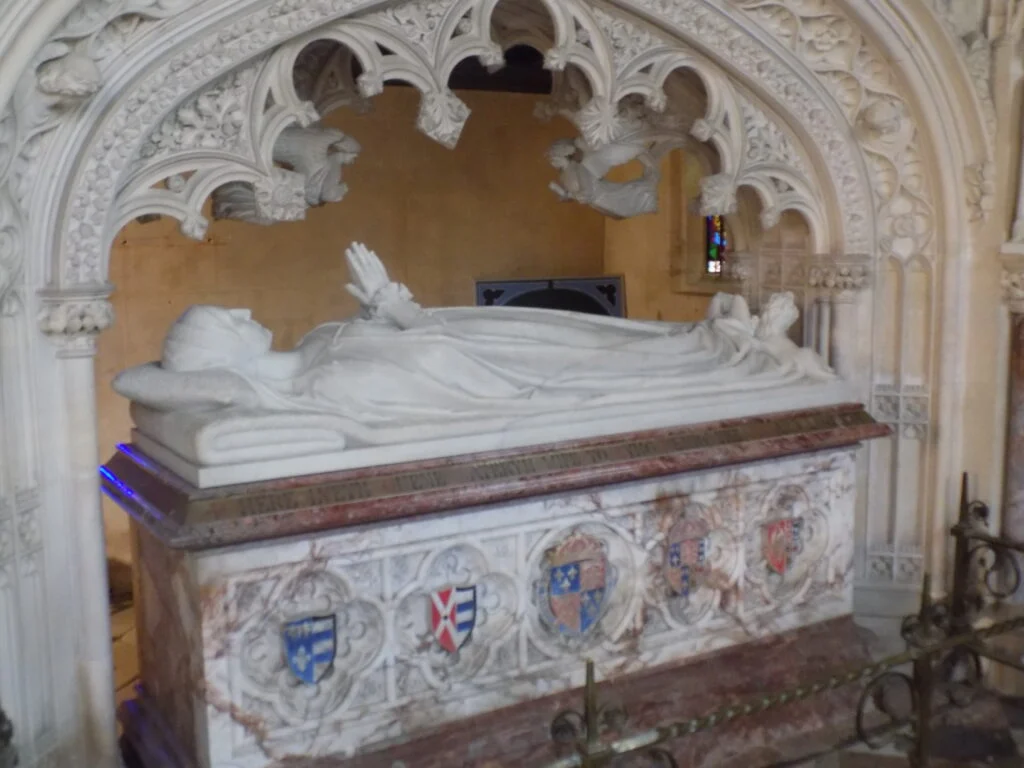
It was not until the Victorian era that authorities intervened to halt the desecration. The queen’s remains were gathered and afforded a dignified reinterment within the restored chapel at Sudeley Castle, culminating in the construction of the magnificent marble tomb that marks her resting place today.
Broader Implications and Ongoing Historical Debate
The death of Katherine Parr remains a microcosm of the lethal political and religious turbulence that defined the mid-16th century in England. As the first woman to publish a book under her own name in English and a quiet patron of religious reform, her influence extended far beyond the bedchambers of Whitehall.
The conflicting narratives of her demise—balancing the medical probability of puerperal fever against the darker political theories of poisoning or neglect—highlight the challenges historians face when interpreting historical sources written through the lens of state trials and factional survival. Whether she fell victim to the tragic biological realities of 16th-century childbirth, the machinations of an ambitious husband, or an unrecorded outbreak of disease, the final chapter of Katherine Parr’s life underscores the profound vulnerability of women, even queens, in the shadow of the Tudor crown.