
The Evolution of the Garden Cemetery Movement
The concept of the "garden cemetery" emerged in the early 19th century as a response to the overcrowded and unsanitary churchyards of rapidly industrializing cities. In London, Paris, and eventually the United States, burial grounds were relocated to the urban periphery and designed as sprawling, park-like landscapes. This shift transformed the burial site from a grim reminder of mortality into a place of contemplation and leisure.

The Mount Auburn Cemetery in Cambridge, Massachusetts, serves as a prime example of this transition. Founded in 1831, it is widely considered the first garden cemetery in the United States. Spanning 175 acres, it was designed to harmonize human engineering with the natural landscape. Today, it functions as a vital arboretum and a critical stopover on the Atlantic Flyway. Ornithologists and bird-watchers flock to the site, noting that the diverse flora provides a necessary sanctuary for migratory species, illustrating how cemeteries have become unintended wildlife preserves in increasingly urbanized environments.

Architectural Significance: The Case of Casabermeja
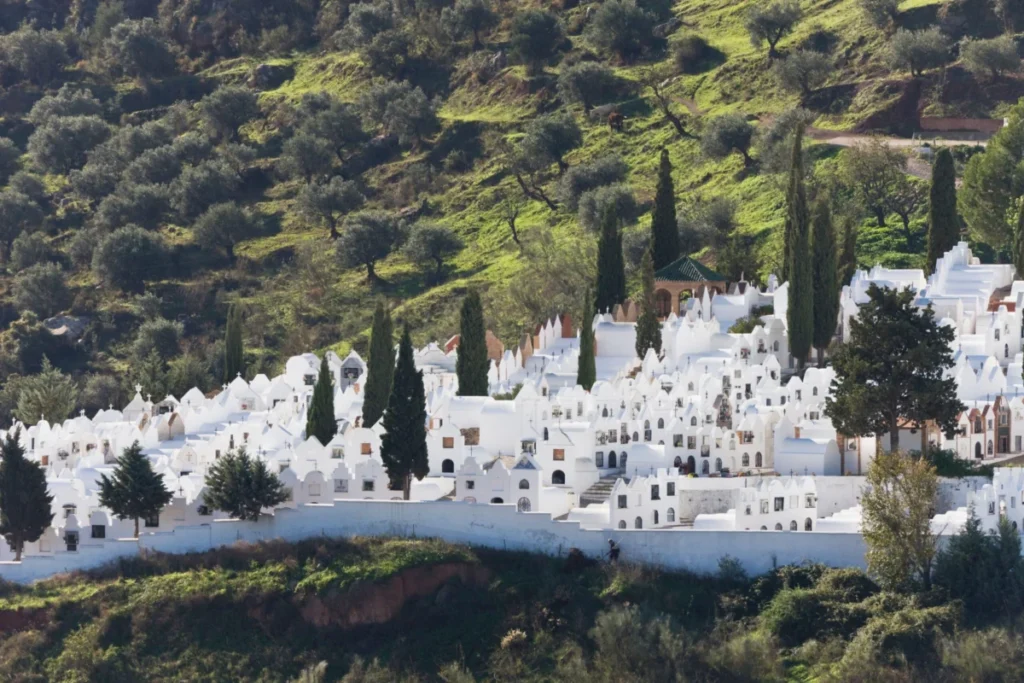
In the rolling hills of the Málaga province in Spain, the Monumental Cemetery of San Sebastian in Casabermeja offers a starkly different, yet equally compelling, architectural narrative. Unlike the sprawling lawns of North American garden cemeteries, the San Sebastian site is characterized by its compact, village-like structure. The white-washed, above-ground niches—often referred to as nichos—are stacked in rows that mimic the urban layout of the living town below.

The aesthetic of Casabermeja reflects the cultural history of Andalusia, where burial traditions are deeply intertwined with the landscape. The site is a registered landmark, recognized for its cultural and historical significance. Experts in Spanish architectural history note that these cemeteries are essential for understanding regional social structures, as the location and decoration of the burial niches frequently signaled the status of families within the local community.

Chronology of Cemetery Preservation
The preservation of these sites is not merely a matter of historical sentiment but a complex task of heritage management. The following timeline outlines the shift in how society views these sites:

- 1804: The opening of Père Lachaise Cemetery in Paris marks the birth of the modern municipal cemetery, introducing the concept of burial as a civic monument.
- 1831: The founding of Mount Auburn Cemetery in Massachusetts initiates the "rural cemetery" movement in the United States, emphasizing horticulture and landscape design.
- 1980s–1990s: A global surge in interest regarding genealogy and local history leads to the creation of the Association of Significant Cemeteries in Europe (ASCE), which seeks to protect sites of artistic and historical value.
- 2010–Present: Digital archival efforts and increased tourism initiatives transform cemeteries into educational hubs, with many sites hosting guided architectural tours and environmental workshops.
Supporting Data and Environmental Impact
The role of cemeteries in modern urban planning is increasingly being quantified. According to urban ecology studies, large, protected green spaces—such as cemeteries—can significantly mitigate the "urban heat island" effect. Research from the University of Massachusetts indicates that cemeteries often maintain higher biodiversity indices than public parks of similar size due to lower levels of human traffic and chemical intervention.

Furthermore, the economic impact of "cemetery tourism" is substantial. Cultural heritage sites, such as the Recoleta Cemetery in Buenos Aires or the Highgate Cemetery in London, contribute millions of dollars to local economies annually through ticketed entry, guided tour operations, and secondary spending in surrounding hospitality businesses. This revenue is frequently reinvested into the structural maintenance of the monuments, creating a sustainable model for the preservation of fragile, centuries-old stonework.

Official Responses and Preservation Challenges
Preservationists and local municipal authorities are currently navigating the tension between heritage conservation and the realities of modern burial space shortages. In many European cities, the practice of "reclaiming" burial plots after a set period of time—often 50 to 100 years—has become necessary due to lack of land. This has sparked intense debate among historians who argue that the loss of historic monuments destroys the visual record of a community.

"The cemetery is a mirror of the society that creates it," says Dr. Elena Rossi, a historian specializing in European sepulchral architecture. "When we lose a burial site, we are not just losing a place of rest; we are losing a chapter of our collective biography. The challenge for modern planners is to balance the need for space with the duty to honor the historical narrative inscribed in stone."

The Implications for Future Urban Design
As global urbanization continues to accelerate, the future of the cemetery is shifting toward multifunctionality. Forward-thinking urban planners are now advocating for "integrated burial spaces," where cemeteries are designed to function simultaneously as public parks, educational centers, and memorial sites.

The integration of sustainable burial practices—such as natural burials that avoid embalming chemicals and non-biodegradable caskets—is also gaining traction. These practices reflect a broader societal shift toward environmental consciousness, even in death. By transforming these sites into functional ecosystems, they ensure that the "breathtaking" nature of these grounds is preserved for future generations, not as stagnant relics of the past, but as dynamic, living components of the urban landscape.

Cultural and Philosophical Perspectives
Beyond the architecture and the ecology lies the philosophical importance of the cemetery. In a digital age, where information is ephemeral and virtual, the physical, stone-carved reality of the cemetery provides a grounding experience for visitors. Whether it is the elaborate mausoleums of the Victorian era or the humble, white-washed niches of rural Spain, these sites compel the visitor to confront the continuity of the human experience.

For the art enthusiast, the cemetery is a gallery of sculpture and iconography, where the progression of artistic movements—from Neoclassicism to Art Nouveau—can be observed in real-time. For the historian, it is a primary source document, a text written in marble and granite. And for the casual observer, it offers a rare space of profound silence and aesthetic beauty.

In conclusion, the movement to recognize and visit these sites is a testament to the enduring human need for connection—to the past, to the landscape, and to the shared destiny of all people. By fostering an appreciation for the artistic, historical, and environmental value of cemeteries, society ensures that these "breathtaking" sites continue to serve their purpose, not just as final resting places, but as vital landmarks that define the character and memory of our world. As we look toward the future, the continued stewardship of these sites remains a critical responsibility, ensuring that the stories they hold are never lost to the passage of time.