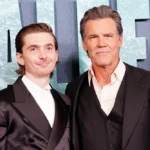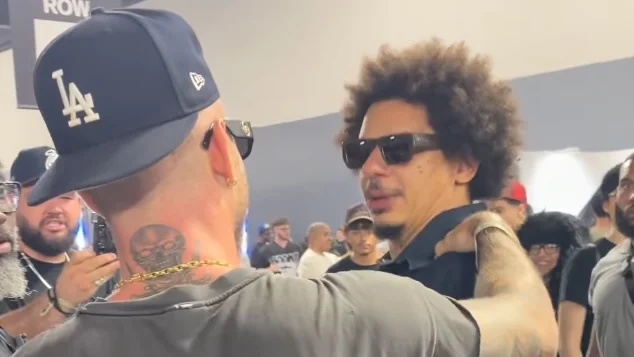

The long-simmering public animosity between internet personality Chet Hanks and comedian Eric Andre reached a physical flashpoint this past weekend at ComplexCon in Los Angeles. The confrontation, captured on video and circulated widely across social media, served as the latest installment in a multi-year conflict that has evolved from television set antics to public insults and, ultimately, a direct physical encounter on the convention floor.
The incident occurred at the Los Angeles Convention Center, where attendees witnessed a tense exchange between the two figures. According to video footage provided by Hanks, the confrontation began when he approached the comedian from behind and placed a hand on his shoulder. The interaction quickly devolved into a verbal dispute, requiring the intervention of security personnel to prevent further escalation. The event marks the first time the two have faced one another since their polarizing collaboration on The Eric Andre Show in 2023.
A Chronology of the Conflict
The friction between the pair originated during the production of the sixth season of The Eric Andre Show. The program, known for its surrealist, anarchic, and often uncomfortable interview segments, thrives on putting guests in situations that test their patience and social composure.
In early 2023, Hanks appeared as a guest on the show. At the time, the episode was marketed as a high-energy encounter, with both parties seemingly engaging in the show’s trademark absurdity. However, the narrative shifted shortly after filming concluded. Eric Andre, in a subsequent profile with Rolling Stone, characterized the interaction as far more problematic than the final edit suggested. Andre alleged that Hanks exhibited erratic behavior, including the unauthorized and reckless operation of a motorcycle on the production set, which Andre claimed put crew members at physical risk.
Andre’s critique was sharp, describing Hanks as "emotionally disturbed" and expressing public bewilderment regarding the character contrast between Chet and his brother, actor Colin Hanks. This prompted a swift, public rebuttal from Chet Hanks, who accused the comedian of manufacturing a narrative for publicity. Hanks claimed that his behavior on set was merely a reflection of the show’s established energy and that he was being unfairly maligned by a host who, in his view, felt threatened by his guest’s performance.
The feud escalated throughout 2023 and 2024, characterized by social media exchanges. Andre famously challenged the authenticity of Hanks’ lineage, and at one point, during a promotional interview for his own projects, Andre issued an open challenge to his rival, stating, "Tell him to say that shit to my fucking face." The recent ComplexCon encounter suggests that the invitation was finally accepted.
Analyzing the ComplexCon Confrontation
The events at ComplexCon were framed by the two men in vastly different ways. In his social media commentary following the event, Hanks asserted that Andre’s reliance on a four-person security detail was indicative of a lack of confidence, suggesting that the comedian felt "uneasy" in a public environment.
Hanks further claimed that the dialogue between them—which was largely inaudible in the provided footage—touched on a deeper grievance. According to the caption accompanying his social media post, Hanks alleged that Andre cited his past controversial use of a Jamaican accent—a viral moment from 2021—as a primary reason for his disdain. Hanks mocked this justification, labeling the comedian a "passionate cultural activist" in a sarcastic critique of Andre’s professional history of utilizing shock humor.
Andre, conversely, appeared visibly confused during the initial seconds of the encounter. Eyewitness reports and the footage suggest that while Andre was initially caught off guard by the physical contact, his demeanor shifted to dismissive irritation. As security moved to separate the two, Andre was overheard directing a final remark toward Tom Hanks, the father of the younger celebrity, signaling that the personal nature of their conflict remained intact.
Cultural Context and the Evolution of the "Public Feud"
The conflict between Hanks and Andre represents a specific intersection of modern celebrity culture, where the lines between performance, personal brand, and reality are intentionally blurred. The Eric Andre Show is built upon the premise of "cringe comedy," where the target of the humor is often the guest’s inability to maintain composure.
Media analysts point out that this specific feud follows a pattern observed in late-night and alternative comedy. When a guest—such as Hanks, who has cultivated an online persona defined by controversy and intentional provocation—engages with a host whose entire career is built on disruption, the potential for genuine friction is high.
However, the question of whether this ongoing hostility is a legitimate personal dislike or a collaborative marketing effort remains a subject of debate. While Andre insisted in multiple interviews during the 2023–2024 cycle that the contention was genuine and not a bit, the persistence of the conflict over three years suggests a level of dedication that is rare in the entertainment industry.
Implications for Future Public Appearances
The incident at ComplexCon raises questions regarding the security protocols at large-scale pop culture conventions. While these events are designed to be accessible to fans and celebrities alike, the presence of high-profile figures with established, public grievances creates a volatile environment.
Representatives for both parties have not released formal statements regarding the incident, though the viral nature of the confrontation has already sparked widespread debate on social media platforms. For fans of The Eric Andre Show, the incident is being viewed through the lens of the show’s chaotic ethos. For others, it serves as a cautionary example of how digital-age provocations can manifest into real-world physical confrontations.
The longevity of the feud—spanning over three years—is statistically anomalous. In the fast-paced cycle of celebrity news, most public disputes are resolved or discarded within weeks. The refusal of either party to move past the 2023 interview suggests that the underlying issues—whether they pertain to creative differences on set, ideological disagreements over cultural performance, or simple personality clashes—remain unresolved.
The Role of Social Media in Modern Conflict
A significant factor in the duration of this feud is the role of social media platforms. Both Hanks and Andre utilized Instagram and other digital outlets to "broadcast" their grievances to their respective fanbases. By turning the conflict into content, both parties maintained the relevance of the dispute long after the original television appearance had faded from the public consciousness.
The use of video footage to document the ComplexCon interaction is a testament to this strategy. By capturing the moment and framing the narrative via a caption, Hanks successfully controlled the first wave of public perception following the encounter. This "he-said-she-said" dynamic, played out in real-time, has ensured that their conflict remains a persistent, if peripheral, fixture in pop culture news.
Final Outlook
As of the latest reports, there is no indication of a reconciliation or an attempt at mediation between the two. The confrontation at the Los Angeles Convention Center serves as a bookend to a three-year cycle of tension. Whether the incident will trigger a legal response or simply add another chapter to the ongoing saga of the two figures remains to be seen.
For now, the event serves as a reminder of the unpredictable nature of celebrity interactions in the digital era. With both parties remaining active in their respective fields, the possibility of future intersections remains high. However, the events of the weekend suggest that the boundary between performance and personal reality has become increasingly difficult for the public—and the participants—to define.