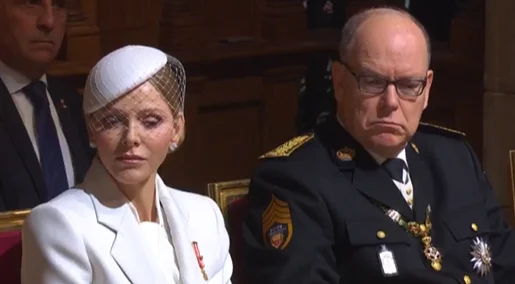

Princess Charlene of Monaco made a striking diplomatic and sartorial statement on Monday by exercising the centuries-old privilège du blanc—the privilege of white—during a high-profile encounter with Pope Leo XIV in Metz, France. Dressed in a sophisticated, all-white Dior trousersuit complemented by a matching Lady D-Joy handbag, the Monegasque royal stood out among a gathering of European leaders, heads of state, and high-ranking dignitaries.
The meeting took place at the Robert Schuman Conference Centre during the prominent regional gathering titled “At the Roots of Europe: For Peace and Unity.” This significant assembly formed the culminating event of Pope Leo’s intensive four-day pastoral visit to France. Princess Charlene was accompanied by her husband, Prince Albert II of Monaco, as they joined a select group of European leaders to engage in vital discussions concerning the continent’s socio-political future, humanitarian responsibilities, and enduring pursuit of peace.
The royal couple’s presence underscored the Principality of Monaco’s active diplomatic engagement on the European stage, particularly regarding matters of cross-border cooperation and humanitarian concern. Welcomed warmly upon their arrival by French President Emmanuel Macron and First Lady Brigitte Macron, Prince Albert and Princess Charlene participated in a day marked by solemn reflection, high-level political discourse, and traditional ecclesiastical protocol. Also in attendance was Grand Duke Guillaume of Luxembourg, adding further sovereign representation to the distinguished assembly.
The Significance of the Papal Gathering and European Unity
The conference “At the Roots of Europe: For Peace and Unity” served as a major intellectual and diplomatic platform during Pope Leo XIV’s apostolic journey through France. Set against the backdrop of Metz—a city rich in European history and located near the borders of Germany and Luxembourg—the summit brought together leaders to deliberate on the pressing challenges confronting contemporary Europe.
During his keynote address to the assembled dignitaries, religious figures, and civil leaders, Pope Leo XIV delivered a comprehensive speech touching upon some of the most sensitive and divisive issues currently facing the continent. The Pontiff addressed the interconnected crises of migration, geopolitical conflict, and the imperative of maintaining European unity in an increasingly fractured global landscape.
Pope Leo explicitly noted that Europe was “entering a new stage in its long history,” catalyzed in large part by the arrival of unprecedented numbers of people fleeing war, persecution, and extreme poverty in their home countries. The Pope urged European nations to adopt humanitarian frameworks rooted in solidarity, compassion, and shared responsibility rather than isolationism and division.
For leaders such as Prince Albert II and Princess Charlene, whose Mediterranean principality navigates its own unique demographic and geopolitical landscape, the papal address resonated deeply. The conference provided an invaluable forum for reinforcing bilateral ties between Monaco and France, as well as fostering broader regional cooperation among European microstates and neighboring nations.
Unpacking the Privilège du Blanc: Protocol and Tradition
While the geopolitical discussions at the Robert Schuman Conference Centre were of paramount importance, Princess Charlene’s wardrobe choice instantly captured the attention of international royal watchers and etiquette experts alike. By donning a pristine white Dior trousersuit, the Princess exercised the privilège du blanc (known in Italian as the privilegio del bianco), a historic and exceptionally rare papal protocol.
Under traditional Vatican etiquette, standard protocol dictates that women attending an official audience with the Pope must wear formal black attire, accompanied by a traditional black mantilla—a lace veil worn over the head—as a sign of solemnity, modesty, and respect for the Holy See. However, the privilège du blanc functions as a historic concession granted exclusively to a very select group of Catholic queens and princesses.
This centuries-old custom originated as a privilege extended to Catholic sovereigns who maintained special historical ties to the Papacy or ruled over predominantly Catholic realms with historic crowns. Today, the exclusive right is held by fewer than ten royal women globally. The current roster of individuals entitled to exercise the privilege includes:
- Queen Letizia of Spain
- Queen Sofia of Spain
- Queen Mathilde of the Belgians
- Grand Duchess Maria Teresa of Luxembourg
- Princess Charlene of Monaco
- Princess Camilla of Bourbon-Two Sicilies (under specific traditional dynastic claims)
It is worth noting that while the privilege is formally recognized for official audiences held within the Vatican City State, royal women entitled to it have occasionally exercised the custom when meeting the pontiff during pastoral visits or international journeys outside Rome. Princess Charlene herself first exercised this historic prerogative during an official audience with Pope Benedict XVI in 2013, opting for a white dress and traditional lace head covering. Her recent appearance in Metz demonstrates a modern adaptation of the tradition, as she paired the symbolic white color with a contemporary, tailored trousersuit rather than a traditional gown.
By contrast, other high-ranking female attendees who do not possess the privilège du blanc must adhere to standard ecclesiastical dress codes. Notably, French First Lady Brigitte Macron—who attended the event alongside her husband, President Emmanuel Macron—wore a classic black ensemble, fully respecting traditional papal etiquette for those without the privilege.
Chronology of Pope Leo XIV’s French Pastoral Journey
The encounter in Metz marked the culmination of a rigorous four-day pastoral itinerary that took Pope Leo XIV across various regions of France. The journey was designed to foster dialogue between the Catholic Church and secular French society, address contemporary social issues, and engage with political and religious leaders.
Day One: The pontiff arrived in France, greeted by national authorities, and immediately initiated discussions regarding the spiritual and cultural identity of modern Europe. His initial engagements focused on urban ministry and the challenges facing contemporary French parishes.
Day Two: Pope Leo traveled to historic regional centers, holding private meetings with local clergy and civil leaders. He emphasized the importance of interfaith dialogue and the preservation of Europe’s Christian heritage amid rapid secularization.
Day Three: The focus shifted toward international solidarity, economic justice, and ecological stewardship. The Pope addressed youth groups and community organizers, encouraging grassroots initiatives aimed at combating poverty and social alienation.
Day Four: The pastoral visit concluded in Metz with the high-profile conference “At the Roots of Europe: For Peace and Unity.” It was during this final leg that Pope Leo delivered his landmark speech on migration and geopolitical stability, culminating in the historic gathering with Prince Albert II, Princess Charlene, President Emmanuel Macron, and Grand Duke Guillaume of Luxembourg.
Diplomatic Implications and Broader Impact
The convergence of European royalty, heads of state, and the head of the Catholic Church in Metz carries notable diplomatic and symbolic weight. As Europe navigates complex geopolitical shifts, economic uncertainties, and ongoing humanitarian crises stemming from international conflicts, the alignment between state leaders and moral authorities remains a significant tool for public diplomacy.
For Monaco, participation at this level reinforces the principality’s commitment to multilateralism and peacebuilding initiatives. Prince Albert II has consistently used his platform as sovereign to advocate for environmental sustainability, international cooperation, and humanitarian aid. Meanwhile, Princess Charlene’s active involvement in high-level engagements highlights her evolving diplomatic profile and her ability to navigate complex international protocols with poise and sartorial precision.
Furthermore, the public nature of the event allowed leaders to project a unified front regarding the integration of displaced persons and the preservation of democratic and humanitarian values across Europe. While papal addresses do not possess binding legislative power, they frequently serve as moral catalysts, influencing policy debates within the European Union and member states.
As Pope Leo XIV concluded his French pastoral journey and returned to Rome, the echoes of the Metz conference continued to resonate across diplomatic circles. Princess Charlene’s adherence to and celebration of historic ecclesiastical traditions—blended seamlessly with contemporary fashion choices—ensured that the event will be remembered not only as a milestone in European diplomacy but also as a fascinating demonstration of living history within modern royal protocol.