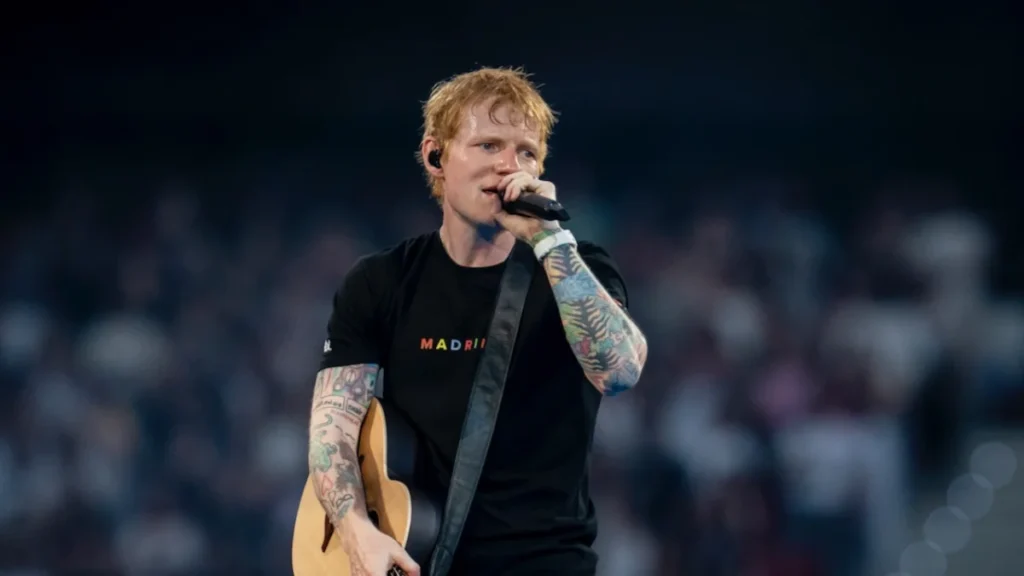

Ed Sheeran took the stage at Philadelphia’s Lincoln Financial Field this past Saturday, delivering a performance defined as much by its raw, emotional candor as by its musical setlist. The concert served as the singer-songwriter’s first public appearance following a week of intense industry turmoil, sparked by the forced removal of rapper Macklemore from his tour roster. The situation, which has ignited a broader debate regarding artistic autonomy, venue censorship, and the responsibility of public figures in the face of geopolitical crises, placed Sheeran at the epicenter of a polarizing cultural storm.
The Chronology of a Tour in Crisis
The controversy began when stadium operators, spearheaded by New England Patriots owner Robert Kraft, signaled their opposition to Macklemore’s continued participation in the tour. The objection stemmed from the rapper’s vocal and public support for Palestine and his criticisms of Israeli policy. The pressure exerted by these venue owners created a logistical and ethical impasse for Sheeran, who found himself caught between contractual obligations, venue-mandated restrictions on his supporting acts, and his own desire to maintain a neutral, inclusive platform.
Following Macklemore’s removal, the tour faced a domino effect of professional departures. Support acts including FINNEAS, Lukas Graham, and Aaron Rowe, as well as Sheeran’s long-standing backing band, Beoga, withdrew from the production. The collective exodus was framed as an act of solidarity with both Macklemore and the humanitarian cause in Palestine. For several days leading up to the Philadelphia performance, industry insiders and fans speculated that the entire tour might be canceled, as Sheeran grappled with the loss of his collaborators and the potential for public backlash.
The Philadelphia Address: A Departure from Routine
Breaking from his tradition of keeping his concerts focused exclusively on music, Sheeran opened the Philadelphia show with a prepared statement that acknowledged the internal and external pressures of the past week. Standing alone on stage, he addressed the audience with a tone of humility and vulnerability, acknowledging that he had made mistakes in navigating the delicate situation.
“I’m used to my music being criticized, and I’m always happy to take that,” Sheeran told the crowd of 50,000. “But this week, the criticism was about something much more important, and I’ve had to take and make difficult decisions.”
Sheeran explicitly addressed the issue of venue pre-approval of content, a practice he described as a threat to the “free world.” His comments highlighted a growing concern among touring artists: that the corporatization of concert venues now allows private entities to exert ideological control over the performances they host. This precedent, Sheeran suggested, undermines the role of live music as a bastion of free expression.
Geopolitical Stance and Humanitarian Pledges
Perhaps the most significant aspect of the evening was Sheeran’s attempt to articulate his perspective on the ongoing conflict between Israel and Gaza. Having previously maintained a position of neutrality to keep his music as a “space for unity,” the artist admitted that the scale of the crisis had made such a stance untenable.
Sheeran condemned the October 7th attack on the Nova music festival, labeling it “horrific” and an event that “compounded centuries of Jewish pain.” Simultaneously, he categorized the ongoing military actions in Gaza as “catastrophic, unjustifiable, and disproportionate.” By explicitly referencing the “systemic injustice” in the West Bank, Sheeran aligned himself with a humanitarian call for awareness that has resonated across the global stage.
In a move to move beyond rhetoric, Sheeran announced a concrete financial commitment. Alongside a $2 million contribution from Robert Kraft for humanitarian aid in the region, Sheeran pledged an additional $2 million of his own. The move suggests a strategic effort to balance the demands of powerful industry stakeholders with a commitment to addressing the human cost of the conflict.
Fact-Based Analysis: The Implications of Venue Censorship
The incident involving Macklemore and Sheeran raises critical questions regarding the intersection of private property rights and public speech. Stadiums and large-scale venues are often owned by corporations or individuals with significant political and financial ties. When these entities move from being passive providers of space to active gatekeepers of the content performed within their walls, they alter the landscape of the music industry.
Legal analysts note that while private venues generally have the right to curate their own bookings, the use of “morality clauses” or threats of cancellation based on the political speech of an artist creates a chilling effect on the industry. If artists are discouraged from touring due to their political views, the diversity of voices in public discourse is inevitably diminished. Sheeran’s decision to remain on tour, despite the departures of his team, highlights the tension between the artist’s desire to fulfill their contract and the pressure to uphold personal principles.
The Burden of Leadership and Mental Toll
Toward the end of the Philadelphia concert, Sheeran provided further insight into the personal toll the week had taken on him. He spoke candidly about feeling “abandoned” by friends and colleagues who had advised him to shut down the tour entirely. The emotional weight of these decisions was clearly visible, as he noted that the sight of thousands of fans still holding their tickets provided the necessary motivation to continue.
“I didn’t see cancellations—I saw people buying tickets,” he remarked, noting the resilience of his fan base as a primary factor in his decision-making process. The singer expressed profound gratitude to the audience for choosing to attend, emphasizing that the concert remained a space where individuals with fundamentally opposing political views could coexist in a shared experience of music.
Broader Impact on the Live Music Industry
As the tour continues, the events of the past week have set a new precedent for how artists address political controversy. Sheeran’s strategy—to provide a clear, albeit apologetic, statement before returning to his musical set—represents a attempt to bridge the gap between his role as an entertainer and the expectations of a socially conscious audience.
However, the departure of his support acts and the internal discord within his team suggest that the industry is still struggling to find a unified approach to the Israel-Palestine conflict. The pressure on artists to take definitive public stands is higher than ever, and the backlash for either speaking out or remaining silent is increasingly severe.
Ultimately, Sheeran’s Philadelphia performance underscored the fragility of the concert experience in an era of extreme political polarization. By acknowledging the difficulty of his position and committing to humanitarian efforts, he attempted to restore the “safe space” he claims his music provides. Whether this approach will satisfy his critics or simply invite further scrutiny remains to be seen, but the events of this week have undeniably marked a turning point in his career and in the ongoing discourse surrounding the responsibilities of global pop icons.
As the concert concluded, Sheeran reaffirmed his commitment to his craft, stating, “My shows are about this: they’re about unity, they’re about love, they’re about family.” While the atmosphere in the stadium was undoubtedly heavy with the weight of the week’s events, the performance served as a test case for whether the arts can truly function as a unifying force in a deeply divided political landscape. For now, the tour moves forward, but the questions raised in Philadelphia about censorship, solidarity, and the moral responsibilities of the global elite remain at the forefront of the music industry’s agenda.