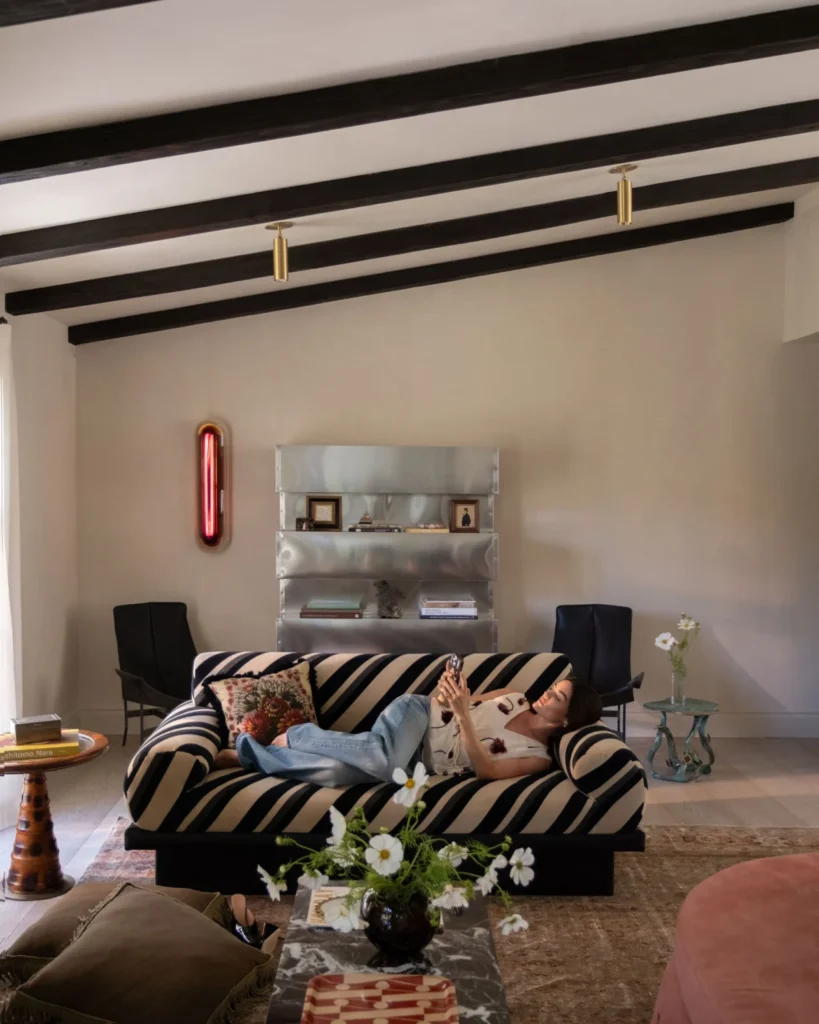

The residence of actor Lucy Hale in Los Angeles serves as a masterclass in the intersection of personal narrative and interior architecture. While the home is characterized by its structural elements—notably the sloped ceilings and exposed dark-wood beams—it is the meticulous curation of soft furnishings that defines the character of the space. In a collaboration with design firm Proem, led by Ashley Drost and Marie Trohman, Hale has cultivated an environment that favors instinctual, eclectic layering over rigid stylistic adherence. The living room, which serves as the primary focal point of this design philosophy, features a striking juxtaposition: a dusty-rose pink couch paired with a graphic, black-and-white striped sofa designed by Kelly Wearstler. Resting atop the latter is a fringed, floral Gucci pillow, a choice that defies traditional design rules yet harmonizes through a shared commitment to bold, irreverent aesthetics.
The Evolution of the Designer-Client Partnership
The process of designing Hale’s home began with a commitment to authenticity. Proem’s Drost and Trohman emphasize that the project was not an attempt to force a pre-existing design trend into the home, but rather a methodical extraction of Hale’s personal taste, which the team describes as both “fun” and “witchy.” This collaborative phase spanned several months, beginning with a deep dive into the actor’s lifestyle needs and aesthetic preferences.

The inclusion of high-concept, whimsical objects—such as a two-foot-tall sheep statue and an Elvis-inspired lamp—serves as a testament to the client’s desire for conversation-starting interiors. However, the most nuanced element of the project remains the selection of textiles. The design team notes that the “unexpected” pairing of patterns, such as the Gucci floral pillow against the Wearstler stripe, was not a result of calculated planning but of organic discovery during the move-in process. This accidental placement, which the team ultimately chose to retain, highlights a growing trend in luxury interior design: the move away from monochromatic, showroom-style staging toward lived-in, layered spaces that prioritize personal expression.
Chronology of Design Decisions
The development of the home’s interior followed a structured progression, beginning with the foundational structural updates and moving toward the fine-tuning of soft furnishings. Following the initial architectural renovation, which prioritized the preservation of the home’s original wooden beams, the team focused on the "living room narrative." By mid-project, the team faced a conflict regarding the entertainment room, where Hale insisted on the inclusion of round, leopard-print pillows.
Designers Trohman and Drost admit to initial hesitation, attempting to steer the project toward more traditional, muted patterns. However, the decision to incorporate the leopard print proved to be a pivotal moment in the home’s aesthetic evolution. When balanced against the watercolor-print accents, the leopard print transformed from a potential clash into a playful, grounding element. This sequence of decisions—from initial resistance to eventual acceptance—underscores the importance of client intuition in high-end design, a principle that has seen increased recognition in the professional design community over the past decade.

Market Context and the Rise of "Curated Maximalism"
The interior design industry is currently witnessing a transition from the minimalist "Scandi" aesthetic that dominated the 2010s toward a more complex, expressive style often termed "curated maximalism." According to market data from interior design associations, demand for bespoke, high-texture textiles has increased by approximately 22% since 2021. Consumers are increasingly seeking out items that offer a sense of history or personality, such as the pastoral-landscape-embroidered pillows found in Hale’s bedroom.
These pieces, which were initially conceived as a traditional Aubusson wall tapestry, were adapted into pillows to create a more intimate, tactile environment. The shift from wall-hanging to functional textile reflects a broader market trend where homeowners prioritize comfort and utility alongside visual impact. In the meditation room, the use of golden, ornate pillows against a deep gray tufted daybed further demonstrates this strategy. By introducing reflective, silken fabrics into a space designed for tranquility, the designers successfully diffused light and added depth to a room that could have otherwise felt monochromatic or cold.
Implications for Modern Home Styling

The design of the Hale residence offers significant implications for both professional designers and the general public. The primary lesson is the necessity of "intentional friction." In professional interior design, this refers to the deliberate placement of contrasting elements—such as geometric stripes against organic florals—to create visual energy. The effectiveness of this approach in Hale’s home suggests that the value of a luxury space is no longer measured by the uniformity of its pieces, but by the thoughtful, often surprising, relationships between them.
Furthermore, the integration of high-fashion accessories, such as the Gucci and Scalamandrè textiles, indicates a growing crossover between fashion and interior design. As luxury brands continue to expand their home collections, consumers are treating their living spaces as extensions of their personal style, utilizing pillows, throws, and tapestries as "accessories" that can be rotated or updated with greater frequency than major furniture items. This modular approach to luxury design allows for a dynamic home environment that can evolve alongside the resident.
Official Responses and Design Philosophy
In their commentary on the project, Drost and Trohman emphasize that the "irreverent" nature of the home is its greatest strength. By moving away from the "too-perfect" look that has defined social media interior design for years, the team has created a space that feels grounded in reality. The designers have noted that the inclusion of historical references, such as the pastoral landscapes in the bedroom, provides a necessary counterpoint to the more modern, graphic elements of the home. This balance between the antique and the avant-garde is a hallmark of contemporary high-end residential design.

For those looking to replicate the look, the designers point to the importance of sourcing from diverse channels—combining luxury heritage brands like Scalamandrè with accessible, contemporary options like those from Anthropologie or Arhaus. This accessibility ensures that the "curated maximalism" look remains achievable for a broader range of consumers. The ultimate goal, as evidenced by the success of the Hale residence, is not to adhere to a specific rulebook, but to ensure that every object within the home serves a purpose—whether that purpose is to provide comfort, spark conversation, or simply offer a moment of visual delight.
Conclusion: The Future of the "Interior Monologue"
The "Interior Monologue" of a space—the story it tells about its occupant—is perhaps the most vital component of successful home design. Lucy Hale’s Los Angeles home is not merely a collection of high-end furniture; it is a carefully assembled narrative of her personal taste. By embracing the unexpected, the designers have proven that the most compelling interiors are those that allow for a degree of "happy accidents." As the industry moves forward, the focus will likely remain on this type of personal, multi-layered storytelling, where the throw pillow becomes more than a comfort object—it becomes a central character in the architecture of the home. Through this project, the collaboration between actor and design firm serves as a benchmark for how modern homeowners can successfully balance the demands of luxury with the necessity of personal expression.