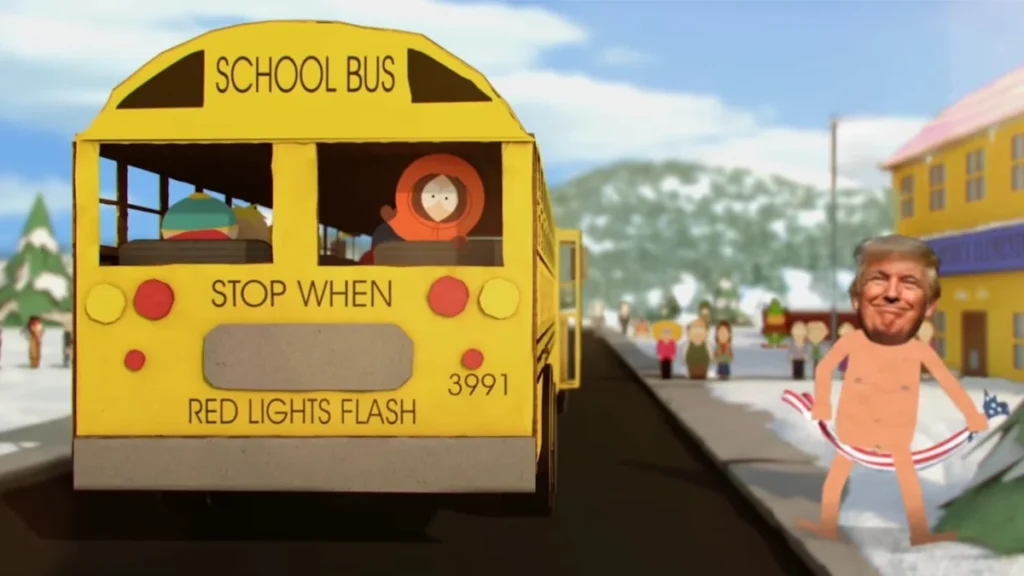

As the long-running animated satire South Park enters its 29th season, the production team has executed a bold and unexpected creative pivot, rebranding the series as South America. This transition, which has sent shockwaves through the fan base and industry analysts alike, was officially inaugurated with a retooled version of the show’s legendary theme song. The updated sequence features fresh, gritty vocal contributions from Primus frontman Les Claypool—a longtime collaborator with the series—and, in a move that signals the show’s enduring commitment to its provocative brand of political satire, a high-profile cameo from Donald Trump.
The debut of this revamped opening sequence during the Season 29 premiere marks a significant departure from the established aesthetic that has defined the series since its inception in 1997. While the core visual identity remains anchored in the show’s signature construction-paper cut-out animation style, the inclusion of new audio elements and the explicit change to the show’s title card serve as a deliberate disruption of nearly three decades of television continuity.
A Legacy of Musical Collaboration
The involvement of Les Claypool in the South Park theme is not a novel development, but rather a deepening of a historic partnership. Claypool, the virtuosic bassist and vocalist behind the alternative rock band Primus, has been the voice behind the show’s opening theme since the pilot episode, "Cartman Gets an Anal Probe." His distinct, funk-infused bass lines and idiosyncratic vocal delivery have become as synonymous with the show as the characters of Stan, Kyle, Cartman, and Kenny themselves.
By returning to the studio to record fresh vocals for this "South America" iteration, Claypool underscores the show’s ability to evolve while maintaining its musical DNA. Industry observers note that having an artist of Claypool’s stature re-record such a recognizable piece of pop culture history is a rarity in television. It signifies that creators Trey Parker and Matt Stone are approaching this rebrand with a high level of intentionality, ensuring that the transition does not feel like a mere gimmick, but rather a curated evolution of the show’s identity.
The Political Context of the Trump Cameo
The inclusion of a Donald Trump cameo in the new opening sequence arrives at a time when the show’s relationship with American politics is under intense scrutiny. Throughout the late 2010s and early 2020s, South Park famously struggled to lampoon a political landscape that often seemed to defy traditional satire. In previous seasons, the writers openly discussed the difficulties of keeping pace with the rapid-fire absurdity of modern political discourse.
By placing a cameo of the former president directly into the title sequence, the creators are effectively centering the show’s new "South America" era within the current political zeitgeist. This move suggests that despite the radical name change, the series remains firmly committed to its roots as a mirror for the nation’s socio-political dysfunction. The cameo functions as a statement of intent: the show is not retreating from the political arena, but rather re-contextualizing its approach to how it handles real-world figures.
The Season 29 Premiere: A Return to Form
Despite the fanfare surrounding the rebrand and the new theme music, the Season 29 premiere offered a surprising contrast. Following the unveiling of the updated opening, the episode itself largely eschewed heavy-handed political commentary in favor of a narrative structure reminiscent of the show’s "golden era."

For many long-term viewers, this was a welcomed development. Over the past several years, South Park had moved toward serialized storytelling, often dedicating entire seasons to a single overarching plot thread. The premiere’s return to a standalone, character-driven story—one that focuses on the dynamics of the core group of children rather than the national news cycle—suggests that the "South America" rebrand may be more of a structural reset than a thematic departure. By balancing the "big" changes in the production design with a return to the classic episodic format, Parker and Stone appear to be attempting to recapture the anarchic, unpredictable spirit that made the show a cultural juggernaut in the late 90s and early 2000s.
The Evolution of South Park: A Chronology
The transformation of South Park into South America is the latest chapter in a storied history of reinvention. To understand the gravity of this change, one must look at the show’s trajectory:
- 1997: South Park debuts on Comedy Central. The theme song by Primus is established as the standard.
- 2005: The show begins to lean into more topical, "ripped from the headlines" storytelling, leading to the development of the "six-day production cycle" that allows the show to react to current events in real-time.
- 2015-2016: The series shifts toward heavily serialized arcs, with Season 19 and 20 focusing on continuous narratives surrounding political correctness and the 2016 presidential election.
- 2021: The release of the "Post Covid" specials on Paramount+ demonstrates the show’s ability to experiment with long-form storytelling and alternate timelines.
- 2026: The Season 29 premiere marks the formal "South America" rebrand, featuring a retooled theme song and a renewed focus on episodic, character-based humor.
Implications for the Industry
The decision to rebrand a show of this magnitude is a high-stakes gamble. In the television industry, brand recognition is the primary currency. By altering a title that has been etched into the public consciousness for 29 years, the production team risks alienating casual viewers while simultaneously generating immense curiosity.
From a marketing perspective, the move is brilliant. It forces a conversation about the show’s future, dominates social media discourse, and provides a clear "entry point" for new viewers who may have felt intimidated by the weight of nearly three decades of canon. Analysts suggest that this could serve as a model for other long-running franchises that struggle with "creative fatigue." By shifting the framing—even if the content remains familiar—the show effectively resets the clock, allowing the creators to experiment without the burden of excessive audience expectations.
The Future of South America
As the season progresses, fans are left to speculate on the implications of the name change. Does "South America" suggest a shift in the setting? Will the characters be traveling, or is the title merely a symbolic rejection of the "South Park" brand?
Historically, Parker and Stone have utilized confusion as a tool for satire. Whether the name change is a commentary on the shrinking of the American dream, a jab at global politics, or simply an elaborate prank on their own audience remains to be seen. What is clear, however, is that the show’s production values remain as sharp as ever. The collaboration with Les Claypool and the deliberate, calculated nature of the title sequence update prove that after 29 years, South Park—or rather, South America—has no intention of fading into the background.
The premiere has set a tone of renewed vigor. By grounding the show in the familiar voices and faces that fans have loved for generations while wrapping them in a brand-new, provocative package, the creators have managed to keep the series relevant. As the season continues to unfold, the industry will be watching closely to see if this "rebranding" proves to be a momentary aesthetic shift or the beginning of a profound transformation for one of television’s most enduring and controversial properties. For now, the takeaway is clear: the show has not changed its core, but it has certainly changed the rules of the game.