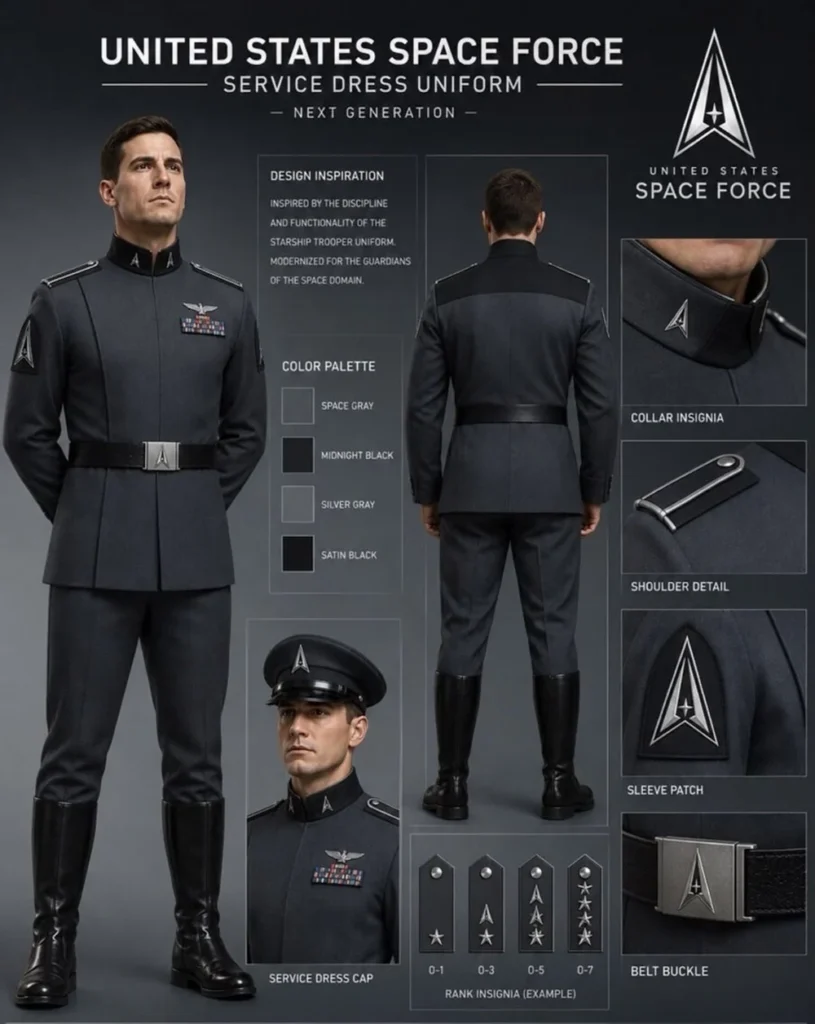

The intersection of science fiction cinema and American military aesthetics entered a novel phase when a design mockup for the United States Space Force uniform was publicly released, drawing immediate comparisons to dystopian cinematic satire. On September 6, Donald Trump utilized social media platform Truth Social to unveil a design concept for the Space Force’s "next-generation" military service dress. Featuring a severe black-and-gray color palette, the uniform proposal was accompanied by explicit commentary from the administration noting that the aesthetic was directly "inspired by the discipline and functionality of the Starship Trooper uniform."
This unexpected reference point immediately reignited cultural conversations regarding Paul Verhoeven’s 1997 satirical action feature film Starship Troopers. While the movie initially suffered a critical and commercial rejection upon its theatrical debut, subsequent decades have witnessed a dramatic critical reappraisal. Contemporary film criticism frequently hails the project as a misunderstood masterpiece that deployed heavy-handed futuristic militarism to deliver a cautionary narrative concerning fascism and propaganda. The utilization of a cinematic fascist aesthetic as an explicit blueprint for an actual branch of the United States armed forces has since generated significant discourse among cultural historians, political analysts, and the original creators of the film.
Evolution of the U.S. Space Force and Military Aesthetics
Established on December 20, 2019, through the enactment of the National Defense Authorization Act, the United States Space Force represents the first new branch of the United States Armed Forces since the establishment of the U.S. Air Force in 1947. Operating as a component of the Department of the Air Force, the nascent military branch has faced the ongoing challenge of defining its own unique institutional culture, traditions, and visual identity.
Historically, military service dress uniforms undergo rigorous design phases, balancing historical heritage, functional utility, and public perception. The introduction of conceptual mockups on digital platforms bypasses traditional military sartorial boards, presenting a distinct public relations strategy. The proposed black-and-gray color scheme deviates sharply from the traditional navy blues, olives, and khakis historically favored by the U.S. military, leaning instead into futuristic tropes common within dystopian science fiction.
The decision to model a branch’s service dress on a fictional military from a satirical film has few historical parallels. Military uniforms typically draw from past domestic service dress or historical alliances, designed to evoke trust, authority, and democratic continuity. Opting for an aesthetic explicitly engineered to mock totalitarianism highlights a growing intersection between pop-culture iconography and contemporary political signaling.
The Cultural Reassessment of Starship Troopers
Based loosely on Robert A. Heinlein’s 1959 science fiction novel, Paul Verhoeven’s 1997 film adaptation deliberately subverted the source material’s perceived militaristic sincerity. Set in a future global federation ruled by a military-centric government where citizenship is earned solely through federal service, the film follows enthusiastic young recruits—portrayed by an ensemble cast featuring Casper Van Dien, Denise Richards, and Neil Patrick Harris—as they are thrust into a brutal interstellar war against an alien arachnid species.

Upon release, mainstream reviewers frequently misconstrued the film’s satirical intent, reading the project as a straight-faced, jingoistic action vehicle. Consequently, the movie underperformed at the box office and divided critics. However, late-stage cultural analysis has completely transformed its legacy. Modern retrospectives published by prominent outlets have categorized the feature as an astute cautionary tale against reckless militarism and the seductive nature of fascist propaganda.
Central to the film’s visual language was the costume design crafted by Oscar-nominee Ellen Mirojnick. Renowned for her extensive portfolio—which includes cinematic milestones such as Basic Instinct, Wall Street, Speed, Twister, and Oppenheimer—Mirojnick engineered costumes that consciously mirrored the sleek, authoritarian styling historically associated with mid-20th-century totalitarian regimes.
Filmmaker Response and Historical Influences
Upon learning that the Trump administration utilized his cinematic creation as a stylistic foundation for an actual military branch, director Paul Verhoeven offered a candid and historically grounded critique. Reacting to the development, Verhoeven remarked with amusement before pointing out the direct historical lineage embedded within his artistic choices.
"It’s an honor, isn’t it?" Verhoeven said, before expanding on the foundational design philosophy of the movie. "When [the administration] talks about Starship Troopers, they should be aware that it’s based on the style of Leni Riefenstahl."
Leni Riefenstahl was a prominent German filmmaker whose pioneering documentaries, most notably the 1935 Nazi propaganda film Triumph of the Will, famously glorified Adolf Hitler and the National Socialist German Workers’ Party. Verhoeven explained that the intentional irony of his film has consistently eluded casual viewers and public figures alike.
"I don’t know if this president is aware that the movie says these [characters] are fascists without knowing that they’re fascists. That’s the point," Verhoeven stated. He noted that this misinterpretation has been a persistent hurdle since production wrapped in the late 1990s. "Many of the people who were working on the movie were disappointed when they saw the result. I knew what I was doing, but I don’t know if many of the actors and actresses realized."
Verhoeven elaborated on the ongoing challenge audiences face when processing the film’s underlying thesis. "The film has been challenging for audiences because its heroes are, without knowing, Nazis. That’s been a problem. I thought people would understand and laugh about it. But that was not the case."

As a Dutch citizen residing in the United States for decades, Verhoeven concluded by reflecting on the complexities of American political symbolism. "I’m a Dutch citizen, and I cannot vote. I’ve been here in this country for 40 years and it’s still difficult for me to understand the political culture here in America."
Fact-Based Analysis of Implications
The public unveiling of the Space Force uniform mockup and its cinematic inspiration carries several notable implications for civil-military relations, political communication, and public diplomacy.
First, the integration of pop-culture references into official or quasi-official military proposals reflects the modern erosion of boundaries between entertainment media and statecraft. In an era dominated by digital communication channels like Truth Social and X, policy ideas and aesthetic concepts are frequently tested in real-time public forums rather than through traditional bureaucratic channels. This shift allows political figures to bypass conventional institutional reviews and directly gauge base reactions.
Second, the invocation of an explicitly satirical, anti-fascist text to model a real-world military uniform underscores a broader cultural phenomenon wherein ideological irony is frequently lost in translation. Critics note that utilizing totalitarian-inspired aesthetics—even under the guise of futuristic science fiction—risks normalizing symbols historically associated with oppression. While supporters may view the design merely as a nod to sleek, high-tech science fiction tropes, historians and media analysts argue that visual symbology carries inherent political weight that extends far beyond fictional contexts.
Ultimately, whether the proposed black-and-gray service dress transitions from a digital concept art phase into an officially authorized uniform remains uncertain. Standard military uniform development requires rigorous testing, adherence to branch regulations, and formal approval from military leadership. Nevertheless, the episode highlights the enduring cultural footprint of Verhoeven’s cinematic satire and the unpredictable ways in which art, politics, and military identity intersect in the contemporary public sphere.