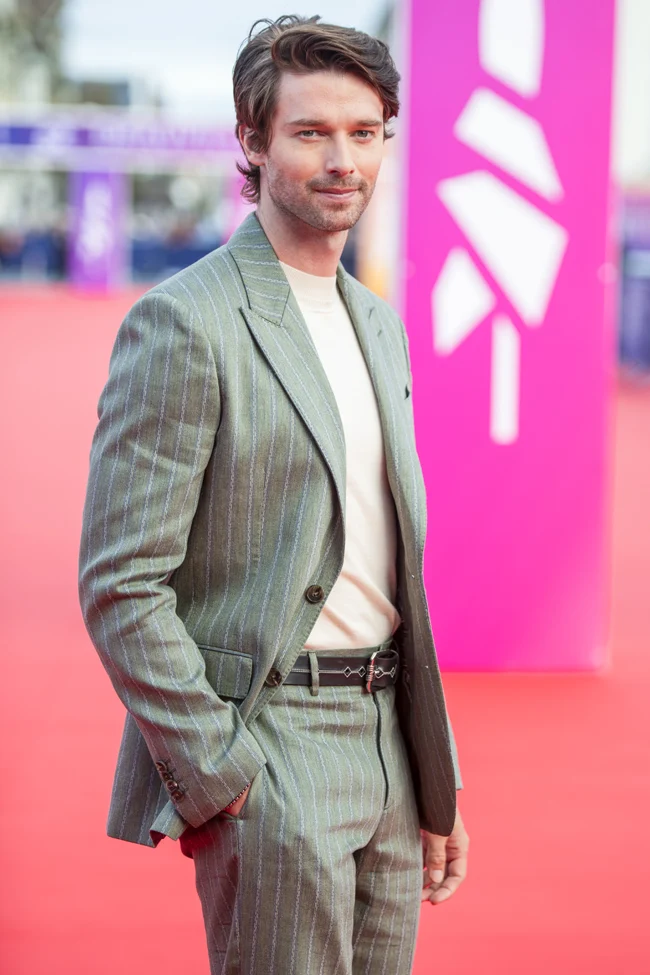

Patrick Schwarzenegger arrived at the prestigious Deauville American Film Festival in Normandy, France, to accept the distinguished Rising Star Award, marking another significant milestone in his steadily developing cinematic career. The actor, recognized for balancing high-profile streaming television roles with independent feature films, stepped onto the red carpet in a meticulously tailored ensemble by luxury Italian fashion house Etro, styled by Avo Yermagyan. The appearance highlighted not only his rising stature within the international film community but also a deliberate engagement with contemporary menswear aesthetics that frequently distinguish him from traditional Hollywood styling norms.
The event, held against the backdrop of the historic Normandy coastline, brought together international cinephiles, industry executives, and prominent filmmakers to celebrate both established auteurs and emerging talent. Schwarzenegger’s receipt of the Rising Star Award places him in a lineage of performers who have successfully transitioned from early supporting roles to more complex, leading characters across diverse genres.

Main Facts of the Appearance and Recognition
The Deauville American Film Festival, established in 1975, has long served as a premier European showcase for American cinema, providing a vital transatlantic bridge for Hollywood studios and independent filmmakers alike. The Rising Star Award specifically honors performers who have demonstrated exceptional versatility and promise in recent cinematic and television projects. Schwarzenegger’s recognition at the 2026 edition reflects a broader industry acknowledgment of his recent performances, which have steered clear of the action-hero archetypes often associated with his familial background.
For the award ceremony, Schwarzenegger wore an Etro single-breasted blazer in a distinctive muted green hue, paired with matching straight-leg trousers. The suit departed from traditional black-tie conventions through intricate detailing: the pinstripes on the fabric were intricately designed to resemble delicate chains, adding a subtle textural complexity to the garment. The look was layered with a complementary fine-knit sweater, replacing the standard dress shirt and tie to project a modern, relaxed elegance appropriate for an afternoon-to-evening European festival setting. The ensemble was completed with a dark brown leather belt featuring geometric thread embroidery. While critics noted the footwear—a pair of dark leather shoes—as a slightly conventional choice that lacked the inventive flair of the suiting and accessories, the overall presentation was widely praised for its sophistication and adherence to modern tailoring trends.
Chronology and Professional Trajectory
Schwarzenegger’s path to the Deauville stage represents a measured and deliberate progression within the entertainment industry. Eschewing the immediate pressure to capitalize on marquee action franchises in the direct wake of his early adult years, the actor pursued a combination of higher education at the University of Southern California and targeted acting training before committing fully to the profession.

His early film credits included minor roles in comedies such as Grown Ups 2 (2013) and Scouts Guide to the Zombie Apocalypse (2015), followed by a more dramatic turn in the romantic drama Midnight Sun (2018). However, it was his transition into serialized television that significantly altered his professional trajectory. His performance in the critically acclaimed HBO true-crime miniseries The Staircase (2022) demonstrated a capacity for nuanced, emotionally demanding character work. This momentum accelerated with his prominent role in Gen V (2023), the superhero satirical spin-off of the hit series The Boys, where his portrayal of Luke Riordan / Golden Boy earned widespread critical notice for its physical and psychological depth.
By 2026, Schwarzenegger had cultivated a diverse portfolio spanning psychological thrillers, dark satires, and character-driven dramas. The Rising Star Award at Deauville serves as a formal European stamp of approval, validating his efforts to build a credible, multifaceted resume independent of external expectations.
Supporting Data and Festival Context
The Deauville American Film Festival traditionally attracts tens of thousands of visitors over its ten-day run, screening dozens of feature films in competition and out-of-competition formats. Alongside competition winners, the festival regularly highlights American actors whose body of work suggests a lasting impact on the medium.

Stylistically, the festival’s red carpet acts as a barometer for transatlantic fashion exchanges, where American actors frequently adopt European tailoring houses to project a more refined, editorial image. Etro, known for its bohemian-inflected luxury, rich textiles, and historical Italian craftsmanship, proved to be an apt choice for Schwarzenegger. Under the creative direction of Marco De Vincenzo, the Milan-based house has increasingly focused on deconstructing traditional menswear silhouettes while retaining artisanal integrity. The collaboration with stylist Avo Yermagyan—who has built a reputation for outfitting actors in distinctive, non-formulaic red carpet attire—underscores a strategic approach to image-building that prioritizes sartorial risk-taking over safe, corporate styling.
Official Responses and Industry Reactions
While formal press statements from talent agencies and festival organizers typically emphasize artistic merit and professional achievement, industry analysts have noted the cultural significance of Schwarzenegger’s trajectory. Observers within the fashion and film sectors frequently analyze the phenomenon of generational actors—colloquially termed "nepo babies"—and the distinct scrutiny they face upon entering the public eye.
Public relations and brand strategy experts point out that Schwarzenegger has successfully navigated this scrutiny by letting his choice of projects and public appearances speak for themselves. By selecting complex, morally ambiguous roles in genre-bending television and independent cinema, alongside thoughtful fashion partnerships with houses like Etro, he has constructed a distinct professional identity. Industry commentators have observed that his willingness to embrace unusual color palettes and textured garments on the red carpet reflects a broader shift among contemporary male actors toward self-expression through fashion, moving away from the uniform navy and black tuxedos that dominated red carpets in previous decades.

Broader Impact and Implications
The recognition of Patrick Schwarzenegger at the Deauville American Film Festival carries broader implications for the current landscape of celebrity branding and international film promotion. As film festivals increasingly rely on crossover stars who bridge traditional cinematic prestige with streaming-era visibility, events like Deauville must balance historical prestige with contemporary relevance.
Schwarzenegger’s presence in Normandy exemplifies the modern multi-hyphenate young actor: commercially viable through major streaming platforms, critically validated through selective independent and dramatic work, and culturally engaged through high-fashion partnerships. The careful curation of his public image—exemplified by the Etro ensemble in Deauville—demonstrates how contemporary talent utilizes red carpet appearances not merely as promotional obligations, but as extensions of their artistic identity.
As the actor continues to expand his slate of upcoming film and television projects, accolades such as the Rising Star Award signal to international distributors and casting directors that his transition from a recognizable surname to a self-sustaining, bankable cinematic presence is complete. The combination of disciplined career choices and elevated sartorial presentation ensures that his footprint within both the film and fashion industries will remain significant in the years ahead.