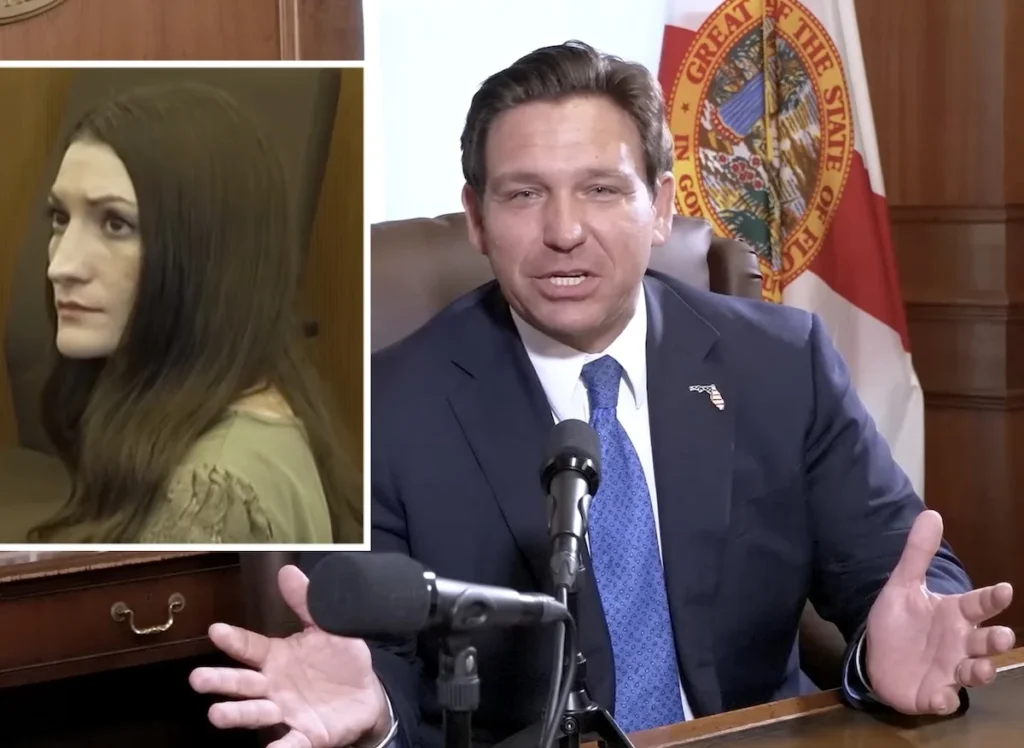

The legal proceedings surrounding the trial of Lindsay Clancy, the Massachusetts mother accused of strangling her three young children in January 2023, reached a volatile impasse last week. Following more than six days of intense deliberation, Judge William Sullivan declared a mistrial after the jury remained deadlocked at an 11-1 vote. The lone holdout juror, who refused to join the majority in finding the defendant not guilty by reason of insanity, has since become the focal point of a heated political and media firestorm, drawing the attention of Florida Governor Ron DeSantis.
The controversy deepened when NBC10 Boston published a report detailing the background of the holdout juror, specifically noting previous domestic violence allegations and an active restraining order against him. Governor DeSantis reacted sharply to this disclosure, accusing the media of attempting to intimidate a citizen who stood by his convictions. In a statement released on Friday, the governor offered a provocative solution for the juror: relocation to Florida.
"A man objected to allowing a woman to kill her three young kids and get away with it, so NBC is trying to smear that juror, whose identity should be protected," DeSantis stated. "Another low for legacy media. If the juror is being harassed, Florida will provide asylum—I’m sure he’d be welcomed and appreciated."
Chronology of the Tragedy and Legal Proceedings
The events that led to this impasse began on January 24, 2023, in Duxbury, Massachusetts. Authorities were called to the Clancy residence, where they discovered five-year-old Cora, three-year-old Dawson, and eight-month-old Callan unresponsive. All three children were later pronounced dead. Lindsay Clancy, who survived an attempt on her own life following the incident, was subsequently charged with three counts of murder and three counts of strangulation.
Throughout the trial, the defense team argued that Clancy was suffering from severe postpartum psychosis and that her mental state was exacerbated by a cocktail of prescribed psychiatric medications. The defense maintained that she lacked the criminal responsibility required to be held legally accountable for her actions. The prosecution, meanwhile, focused on the deliberate nature of the acts, suggesting that the defendant understood the gravity of her decisions.
The jury began deliberations on February 18, 2025. Over the course of the next six days, the court received multiple notes from the jurors indicating that they were unable to reach a unanimous verdict. Despite Judge Sullivan’s instructions to continue deliberating, the 11-1 split remained firm. On February 24, a mistrial was formally declared.
Scrutiny of the Holdout Juror
The focus on the lone holdout juror has brought to light significant questions regarding the jury selection process in Massachusetts. According to reports from NBC10 Boston, the juror had previously been charged in 2021 following an incident involving his teenage nephew, who alleged the man had assaulted his then-wife. While those charges were eventually dismissed, the same nephew later obtained a restraining order against the man in 2025, alleging that the juror had pushed him to the ground and engaged in repeated physical violence.
These disclosures have prompted legal experts to question why such history was not addressed during the voir dire process. Massachusetts juror questionnaires typically require prospective jurors to disclose information regarding prior arrests, criminal charges, and active court orders. The failure to surface this information, or the potential for a juror to withhold it, highlights the complexities inherent in selecting an impartial jury in high-profile criminal cases.
Implications for the Justice System
The intervention of Governor DeSantis into a Massachusetts judicial matter has raised broader questions about the role of political figures in local criminal proceedings. By framing the media’s reporting as a "smear campaign" and offering "asylum" to a private citizen serving on a jury, the governor has effectively politicized the sanctity of the deliberation room.
Legal analysts note that juror privacy is a pillar of the American justice system, designed to allow jurors to vote their conscience without fear of retribution. However, when a juror’s past conduct is a matter of public record, the boundary between "harassment" and "investigative journalism" becomes blurred.
"The integrity of the jury system relies on the assumption that jurors are screened for impartiality," said one constitutional scholar. "When a trial ends in a deadlock, the spotlight inevitably turns to the jury. However, the involvement of high-ranking state officials in the personal affairs of a juror is highly irregular and sets a precedent that could undermine the independence of the judicial process."
The Debate Over Postpartum Psychosis
Beyond the political fallout, the Clancy trial has reignited a national conversation regarding the legal treatment of postpartum mental health issues. Postpartum psychosis is a rare but severe condition characterized by delusions, hallucinations, and paranoia. The defense’s reliance on this diagnosis as a primary argument for lack of criminal responsibility forced the jury to weigh complex medical testimony against the objective reality of the children’s deaths.
Public reaction has been deeply divided. Some advocacy groups argue that the justice system is ill-equipped to handle cases where mental health crises result in extreme violence, suggesting that the focus should be on treatment and systemic reform rather than incarceration. Conversely, many citizens and victim advocates maintain that a verdict of "not guilty by reason of insanity" in cases involving multiple fatalities fails to provide justice for the victims and ignores the element of personal accountability.
Future Legal Steps
As it stands, the case is in a state of legal limbo. The Suffolk County District Attorney’s office has not yet issued a definitive statement regarding whether the Commonwealth will pursue a retrial. A hearing is currently scheduled for later this month to discuss the next steps in the litigation.
Should the state choose to retry the case, the process of selecting a new jury will likely face heightened scrutiny. The court will need to determine whether the media coverage of the first trial, combined with the subsequent political commentary from external figures like Governor DeSantis, has tainted the jury pool to a degree that a fair trial in the same jurisdiction is no longer possible.
Data and Contextual Analysis
Statistical data on jury deadlocks indicate that while they are relatively rare, they are more frequent in cases involving complex psychiatric defenses. According to the National Center for State Courts (NCSC), approximately 5-6% of criminal trials result in a hung jury. The primary reasons for these deadlocks often include disagreements over the interpretation of evidence, differing perspectives on the threshold of "reasonable doubt," and the influence of dominant personalities within the jury room.
The Clancy case, however, represents an outlier due to the intensity of the public interest and the subsequent public outing of a juror’s personal history. The intersection of domestic violence allegations against a juror and a trial involving the death of children has created a uniquely combustible environment for public discourse.
Conclusion
The aftermath of the Lindsay Clancy trial serves as a reminder of the fragility of the judicial process when placed under the pressure of public opinion and political rhetoric. As the legal system prepares for the upcoming hearing, the focus will remain on whether the Commonwealth of Massachusetts can secure a path to resolution that respects the rights of the defendant while addressing the profound loss of the victims.
For the juror at the center of the storm, the offer of "asylum" from a sitting governor underscores the extent to which this case has transcended the courtroom. As the legal proceedings move forward, the broader implications for jury integrity, media ethics, and the treatment of postpartum mental health in the eyes of the law will continue to be debated in academic and public spheres. The final determination of whether a retrial will occur rests with the prosecution, who must weigh the costs of a second trial against the public interest in reaching a definitive legal conclusion to one of the most tragic cases in recent Massachusetts history.