
In November 1943, at the height of the brutal Nazi occupation of Belgium, a clandestine coalition of journalists, printers, and resistance operatives executed one of the most audacious psychological operations of the Second World War. Rather than relying on traditional guerrilla tactics such as planting explosives or ambushing occupying forces, these underground operatives weaponized humor, wit, and typography. They successfully intercepted the distribution network of Le Soir—the premier French-language daily newspaper in Belgium, which had been commandeered and converted into a fascist propaganda rag by the Third Reich—and replaced it with a brilliant, satirical counterfeit edition known as Le Faux Soir (The Fake Evening).
This historic subversive operation, widely acknowledged by historians as the world’s first major media hack, has now been transformed into a cinematic feature film directed by acclaimed Belgian filmmaker Michaël R. Roskam. Premiering internationally at the prestigious Toronto International Film Festival (TIFF) and distributed globally by Goodfellas, Le Faux Soir reinterprets the harrowing wartime resistance effort through the lens of a high-stakes, gripping caper. Blending the tension of a tactical heist with the sharp comedic timing of an ensemble cast featuring some of France and Belgium’s finest comedic talents, Roskam’s film explores the immense power and perilous consequences of fighting totalitarianism with laughter.
Background Context and Historical Origins
To fully understand the gravity of Le Faux Soir, one must examine the oppressive media landscape of occupied Europe during World War II. Following the lightning-fast invasion of Belgium in May 1940, the Nazi regime systematically dismantled or co-opted all independent media outlets. Le Soir, a respected pre-war publication, was placed under strict German military censorship and transformed into a mouthpiece for Nazi ideology, anti-Semitic rhetoric, and Axis war updates. For the Belgian populace suffering under food rationing, curfews, and the constant threat of deportation or execution, reading Le Soir was a daily exercise in demoralization.
Enter the Front de l’Indépendance (Independence Front), a broad-based resistance movement that recognized the psychological toll of relentless propaganda. The idea to counterfeit the occupier’s most prominent propaganda instrument was hatched not as a mere schoolboy prank, but as a calculated psychological strike. The conspirators understood that authoritarian regimes, which rely entirely on an aura of absolute authority and infallibility, possess a profound vulnerability: they cannot tolerate being mocked. By subverting the official layout, typography, and editorial voice of Le Soir, the resistance sought to shatter the illusion of Nazi omnipotence and remind the occupied citizenry that their oppressors were fundamentally ridiculous.
Chronology of the Caper: November 9, 1943
The execution of Le Faux Soir required military-grade precision, split-second timing, and absolute secrecy. The operation unfolded over several months of meticulous planning, culminating on the night of November 9, 1943.

- The Planning Phase (Mid-1943): Resistance printers and journalists secretly drafted satirical articles, fabricated war reports announcing the imminent collapse of the Third Reich, and composed absurd advertisements mocking both Adolf Hitler and the collaborationist Belgian authorities.
- The Infiltration (November 9, 1943): A specialized team of resistance members, maintaining deep cover within the legitimate printing facilities of Le Soir, managed to gain access to the press floor after hours. Utilizing authentic printing plates, specialized inks, and vintage linotype machinery, they integrated the counterfeit pages into the standard print run.
- The Distribution (November 10, 1943): Roughly 50,000 copies of Le Faux Soir were successfully loaded onto delivery trucks alongside genuine editions. Unwitting news vendors across Brussels distributed the counterfeit papers to unsuspecting commuters and German officials alike.
- The Immediate Aftermath: For several hours, readers perused headlines announcing ridiculous victories and satirizing Nazi generals before the deception was uncovered. The Gestapo launched a frantic, immediate manhunt. While many of the printers and journalists managed to evade capture through clever underground networks, several key members of the operation were eventually hunted down, arrested, and executed by the occupying regime.
Directorial Vision and Adaptation Challenges
For director Michaël R. Roskam—renowned for gritty, grounded crime dramas such as Bullhead, The Drop, and Racer and the Jailbird—the journey to bringing Le Faux Soir to the screen began with his co-writer, Bernard Falaise. While studying media piracy and satire at a Belgian university, Falaise attended a lecture on the 1943 event. Eerily, during the lecture, the students’ phones began buzzing with breaking news alerts regarding the tragic terrorist attack on the offices of the French satirical magazine Charlie Hebdo in Paris.
This modern parallel between historical anti-fascist satire and contemporary violence against free expression cemented the project’s urgency. When Falaise approached Roskam with the initial concept, Roskam immediately recognized its cinematic potential, describing the project as an Ocean’s Eleven style heist movie centered entirely around a newspaper printing press.
However, translating a 1940s satirical broadsheet into a modern cinematic narrative presented significant technical hurdles. Roskam noted that while the original text of Le Faux Soir was undeniably clever for its time, many of the jokes relied heavily on context, slang, and political figures of the era that modern audiences would fail to recognize. Consequently, the filmmakers chose to focus less on recreating every historical punchline and more on the harrowing mechanics of how the resistance pulled off the infiltration under the watchful eyes of the Gestapo.
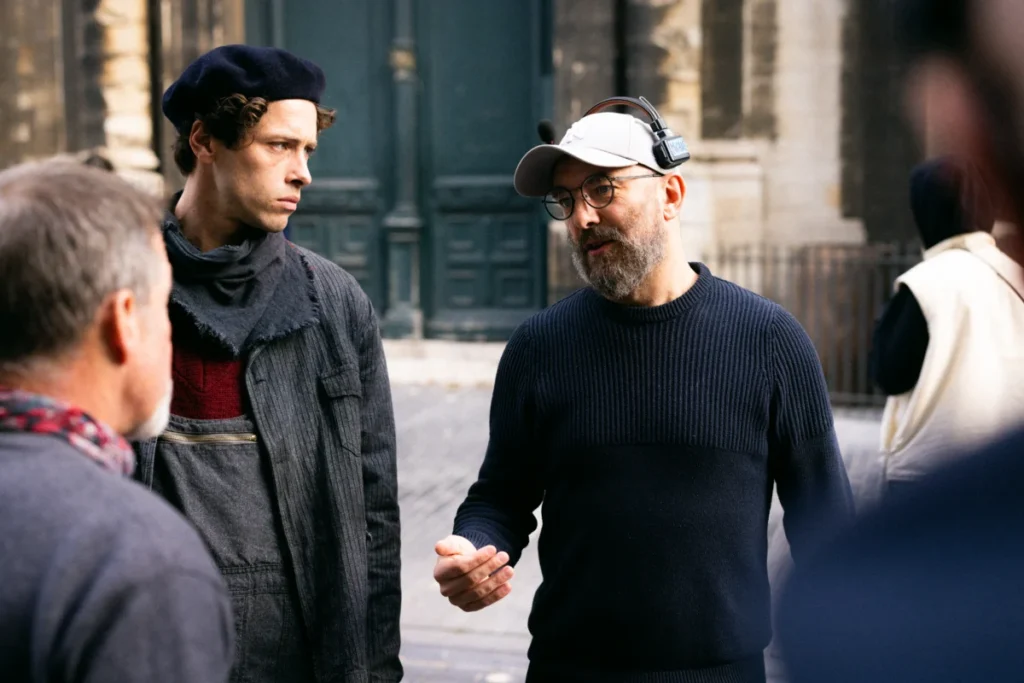
To maintain historical authenticity, Roskam immersed himself deeply in the technological mechanics of 1940s print journalism. Much like his rigorous preparation for Bullhead, where he learned the nuances of cattle farming and meat markets, Roskam studied vintage printing presses and linotype machines—automatic mechanical devices that cast entire lines of text from molten lead. Visiting specialized museums and interviewing elderly printers who preserved these obsolete skills, Roskam captured the tactile, physical reality of a bygone era of journalism, a stark contrast to the frictionless, digital nature of modern media hacks.
Strategic Casting and Ensemble Dynamics
To balance tension and humor without descending into overt farce or parody—a trap Roskam sought to avoid, consciously distinguishing his film from works like Life is Beautiful or Jojo Rabbit—the director assembled a stellar ensemble of French and Belgian acting talent. The cast features prominent performers renowned for their comedic timing and emotional depth, including François Damiens, Arieh Worthalter, Bouli Lanners, and Mélanie Thierry.
Roskam deliberately cast actors with "funny bones" to portray ordinary citizens pushed to extraordinary acts of bravery. Yet, his primary directorial challenge on set was reigning in their natural comedic impulses to ensure the film maintained its realistic, high-stakes dramatic tension. By anchoring the performances in the genuine terror of resisting fascism, the cast portrays individuals who use puns, poetry, and pranks not out of detached irony, but as a vital psychological defense mechanism against systemic brutality.

Broader Impact, Modern Implications, and the Paradox of Satire
As Le Faux Soir makes its global debut, its thematic resonance extends far beyond the historical boundaries of World War II Brussels. In an era dominated by discussions of systemic disinformation, state-sponsored cyberattacks, and the weaponization of digital media, the film offers a timely meditation on the fragility of truth.
Ironically, modern digital authoritarianism has inverted the tactics of Le Faux Soir. Today, state actors and hostile foreign intelligence agencies—such as those operating Russian bot farms that meticulously replicate legitimate Western publications like Le Monde or Der Spiegel—utilize counterfeit digital infrastructure to propagate pro-regime disinformation and dismantle democratic trust from within.
This contemporary parallel raises profound questions regarding the efficacy and ultimate limits of satire against entrenched authoritarian power. Historically, satirists from Berlin cabaret performers to modern cartoonists have frequently faced exile, imprisonment, or execution without single-handedly toppling oppressive regimes. Yet, as Roskam argues, the true power of satire lies in its cumulative psychological impact. By stripping away the faux dignity and absolute authority claimed by tyrants, humor acts as the proverbial dismantling of the emperor’s clothes.
Ultimately, Le Faux Soir serves as a poignant reminder that while weapons and violence have historically dictated the outcomes of conflicts, the written word—and the courageous act of laughing in the face of tyranny—remains one of humanity’s most resilient instruments of resistance.