
Fifty years after the American bicentennial, a low-budget underdog film about a struggling club fighter who went the distance against a heavyweight champion defied all expectations to capture the cultural zeitgeist. That 1976 feature, John G. Avildsen’s Rocky, written by and starring an unknown actor named Sylvester Stallone, went on to vanquish formidable heavyweights like All the President’s Men, Network, and Taxi Driver to claim the Academy Award for Best Picture. Half a century later, the echoes of that unlikely triumph reverberated once again through the festival circuit, bridging the gap between Hollywood history and contemporary awards-season prognostication.
On Saturday evening, filmmaker Peter Farrelly returned to the Toronto International Film Festival (TIFF) for the world premiere of I Play Rocky, a biographical drama chronicling the arduous genesis and turbulent production of the original 1976 classic. The film’s trajectory immediately mirrored a past festival phenomenon. Eight years prior, Farrelly’s feel-good drama Green Book premiered at the same festival. It polarized professional film critics, played sensationally to public audiences, captured the coveted TIFF People’s Choice Award, and ultimately marched triumphantly to several Oscar nominations, securing the Academy Award for Best Picture.
Following its Saturday night screening, I Play Rocky appears poised to replicate that unique path. While early critical reviews have shown signs of polarization, general festivalgoers responded with unbridled enthusiasm, punctuating the screening with spontaneous mid-film applause and concluding with a prolonged, emotional standing ovation. Industry insiders are already forecasting a robust awards campaign, placing the Amazon MGM Studios release—slated for a theatrical rollout in the United States on November 6—firmly in the conversation for Best Picture nominations.
A Breakthrough Performance and the Complex Anatomy of an Oscar Race
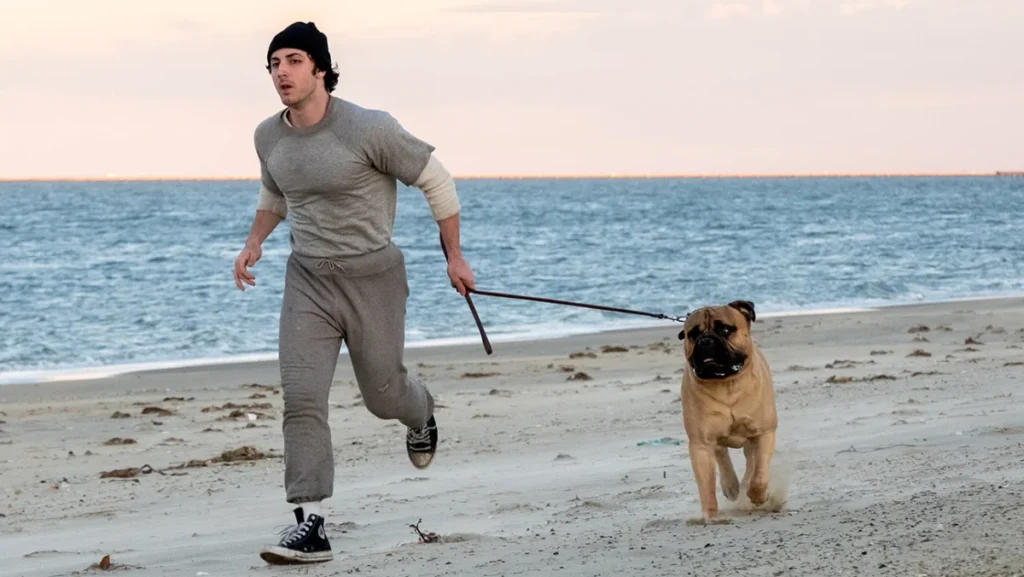
Beyond its prospects in major categories, I Play Rocky serves as a launching pad for its relatively obscure lead actor, Anthony Ippolito. Charged with portraying a young Sylvester Stallone during his most desperate pre-fame years, the 27-year-old actor delivers a performance that reportedly channels the iconic star’s distinct physical mannerisms, idiosyncratic vocal cadences, and relentless grit with eerie precision.
Much like the real-life narrative of Stallone refusing to sell his screenplay unless he was cast as the lead, the meta-narrative of Ippolito stepping into a career-defining role carries an authentic underdog charm. This parallel is expected to resonate deeply with both voters and audiences, positioning Ippolito securely within the crowded and highly competitive Best Actor Oscar race.
Supporting Ippolito’s central performance is a strong ensemble cast. AnnaSophia Robb portrays Stallone’s first wife, Saasha Czack; Tracy Letts steps into the shoes of United Artists executive Arthur Krim; and Jay Duplass takes on the role of director John G. Avildsen. The technical execution mirrors the craftsmanship of Green Book, bolstered by the contributions of cinematographer Sean Porter, production designer Anthony Gasparro, makeup artist Jackie Risotto, and hairstylist Nakoya Yancey.
The Underlying Tension: Sylvester Stallone, the Producers, and Franchise Ownership
Despite the celebratory tone of the premiere, I Play Rocky navigates a delicate minefield regarding its subject. The most significant variable facing the film’s commercial and critical campaign is Sylvester Stallone himself.
During the festival’s press engagements, including a stop at the Hollywood Reporter TIFF lounge, Ippolito noted that he had spoken with Stallone prior to filming. Similarly, Farrelly confirmed that he screened the completed film for Stallone, who reportedly expressed general satisfaction with the final product. Farrelly even offered a public acknowledgment of the action star from the stage just before the lights dimmed for the premiere.

However, the reality behind the production’s corporate structure reveals a notable absence: Stallone was not directly involved in the creation of I Play Rocky, nor is he slated to receive a direct financial stake or equity cut from its distribution. This dynamic touches upon a deeply sensitive nerve for the octogenarian actor.
In July 2022, Stallone made international headlines when he publicly lashed out at Irwin Winkler, one of the primary producers of the original Rocky franchise who originally helped launch his career. Stallone took to social media to denounce Winkler as a "parasitical producer," expressing lifelong frustration over his lack of an ownership stake or equity in a cinematic universe that has generated billions of dollars over the decades through sequels, merchandise, and the Creed spin-off series.
Interestingly, the historical figures at the center of that ownership dispute receive a surprisingly sympathetic treatment in Farrelly’s film. Irwin Winkler, now 95 years old, is portrayed by P.J. Byrne and even makes a brief cameo appearance. The late Robert Chartoff, Winkler’s longtime co-producer who passed away in 2015, is played by Toby Kebbell, and Chartoff’s widow was in attendance at the Toronto premiere. The presence of these key stakeholders suggests that the producing camp behind the original film views Farrelly’s cinematic retelling favorably.
Implications for the Awards Season and Historical Mythmaking
As the film approaches its November theatrical release, industry analysts are closely monitoring how Stallone—who celebrated his 80th birthday in July—will publicly react. The implications of his stance are stark and twofold. A public denunciation from the franchise creator could severely hamper the film’s momentum with Academy voters, introducing unnecessary controversy into an otherwise crowd-pleasing campaign. Conversely, a public endorsement could galvanize support and validate the project as an authorized celebration of his legacy.
Ironically, Stallone has compelling reasons to embrace the film. Written by Peter Gamble, the screenplay functions essentially as an hagiography celebrating his tenacity, ingenuity, and raw talent. Furthermore, the film institutionalizes the popular origin myth of Rocky that Stallone has cultivated in interviews over the past half-century—a narrative of bootstrap determination that, while occasionally smoothing over the messy bureaucratic realities of 1970s Hollywood development, has firmly cemented itself in cinematic folklore.
Broader Industry Context and Distribution Strategy
Amazon MGM Studios has positioned I Play Rocky as a cornerstone of its late-year prestige slate. By timing the release for early November, the studio is executing a classic platform strategy designed to build word-of-mouth momentum through the autumn festival circuit before expanding into wider theatrical distribution ahead of the holiday corridor.
The strategy mirrors the playbook used by Universal Pictures for Green Book in 2018. That film overcame initial critical divisions by tapping directly into populist sentiment, ultimately gross over $320 million worldwide against a modest $23 million budget, while sweeping up three Academy Awards including Best Picture, Best Original Screenplay, and Best Supporting Actor for Mahershala Ali.
Whether I Play Rocky can scale those same commercial and critical heights remains to be seen. Yet, as audiences in Toronto stood to applaud the cinematic recreation of Hollywood’s ultimate underdog story, the parallels to 1976 and 2018 were difficult to ignore. In an industry increasingly driven by intellectual property and corporate calculation, a film about the sheer, stubborn will required to bring an original vision to the screen has once again captured the imagination of the festival crowd—proving that, at least in the realm of cinema, history is always ready for another round.