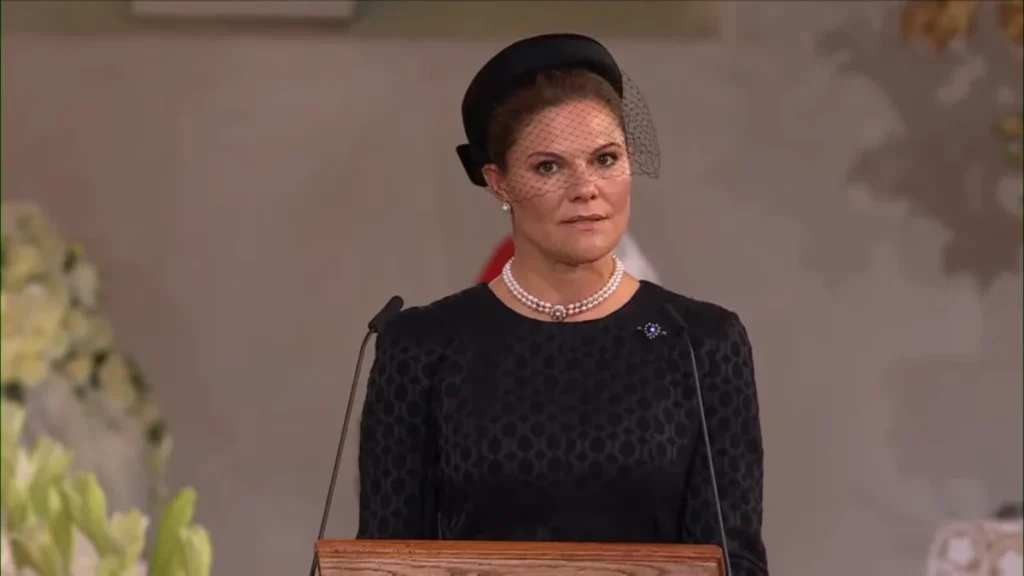

Crown Princess Victoria of Sweden played a deeply personal and prominent role during the state funeral of her godfather, the late King Harald, stepping forward to read the iconic Prayer of Saint Francis in Swedish within the hallowed walls of Oslo Cathedral. The solemn service marked a poignant farewell to a monarch who had deeply influenced regional stability, Nordic unity, and familial bonds across Scandinavia. As the heir to the Swedish throne, Crown Princess Victoria’s active participation in the service underscored not only her official status as a senior representative of the Bernadotte dynasty, but also the profound emotional attachment she held for the late Norwegian sovereign, whom she affectionately remembered as a warm, welcoming presence with an enduring twinkle in his eye.
The state funeral drew royalty, heads of state, and dignitaries from across Europe to Norway’s capital to pay their final respects to King Harald, whose passing on August 28 marked the end of an era for the Norwegian monarchy. While numerous foreign royals and international delegates looked on from the cathedral pews, Crown Princess Victoria stood out as the sole foreign royal actively participating in the liturgy of the funeral service itself. Her inclusion highlighted the unique, cross-border dynastic ties that weave together the royal houses of Sweden, Norway, and Denmark, lineages that frequently transcend mere diplomacy to encompass deep personal affection, shared ancestry, and lifelong mentorship.
A Solemn Procession Through the Streets of Oslo
Hours before the service commenced inside Oslo Cathedral, a solemn funeral procession wound its historic route through the heart of the Norwegian capital. The wider Swedish Royal Family turned out in force to honor the late king, marching alongside military guards, state officials, and members of the Norwegian royal household. Conspicuously absent from the procession was Queen Silvia of Sweden, who remained behind due to health precautions, leaving King Carl XVI Gustaf and other senior royals to represent the Swedish court alongside Crown Princess Victoria.
Thousands of mourners lined the processional route, braving the late summer chill to witness the horse-drawn gun carriage carrying the casket draped in the royal flag. The procession moved methodically from the Royal Palace down Karl Johans gate toward Oslo Cathedral, echoing similar historic farewells that have punctuated the twentieth and twenty-first centuries of Scandinavian monarchies. The synchronized step of the honor guard, the tolling cathedral bells, and the quiet dignity of the grieving royals created an atmosphere of collective national and international mourning.
The Liturgical Significance of the Prayer of Saint Francis
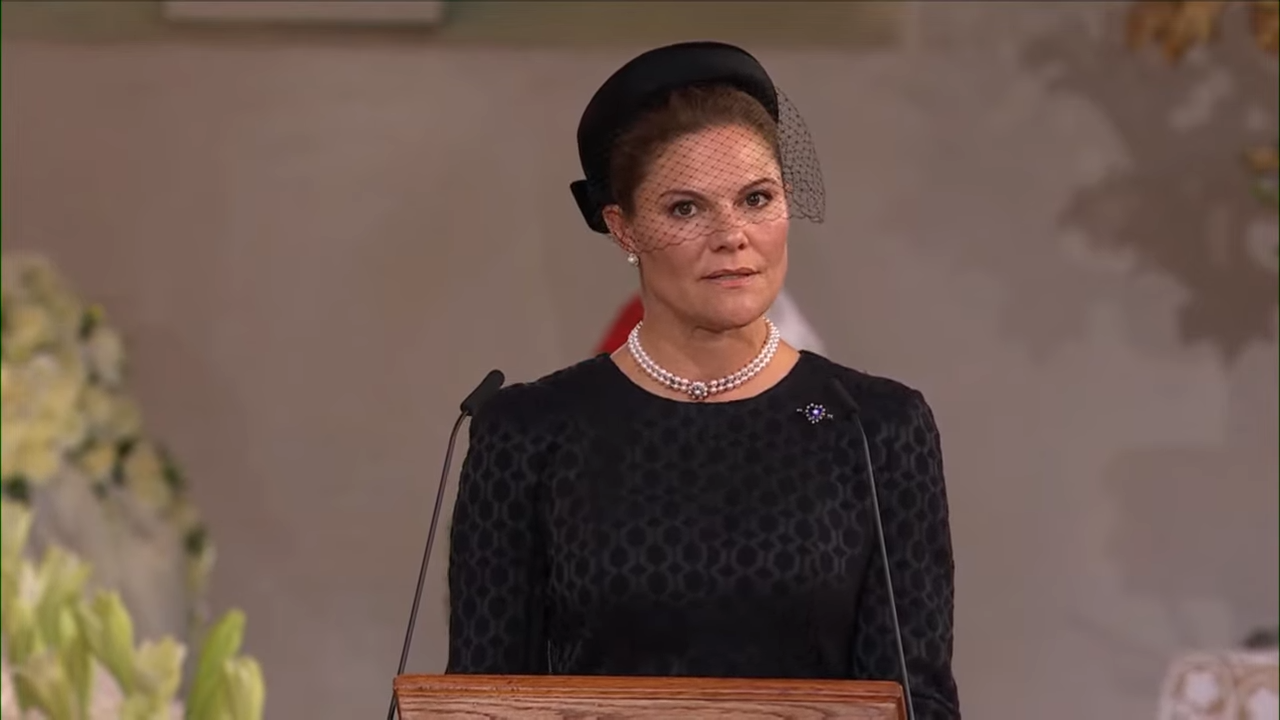
Inside the cathedral, the emotional high point of the service arrived when Crown Princess Victoria ascended the pulpit to deliver the reading. Choosing the Prayer of Saint Francis—a centuries-old meditation on peace, reconciliation, and divine grace—she read the text fluently in her native Swedish, her voice carrying clearly through the vaulted architecture of the cathedral.
Though historically associated with Saint Francis of Assisi, who lived between 1182 and 1226, modern historians note that the specific prayer text does not appear in the saint’s surviving authentic writings. Nevertheless, it has evolved into one of the most universally recognized Christian petitions for harmony and spiritual comfort.
Crown Princess Victoria’s delivery focused on key passages that resonated powerfully with the theme of loss and remembrance: "Make me an instrument of your peace; where there is hatred, let me sow love; where there is injury, pardon; where there is doubt, faith; where there is despair, hope; where there is darkness, light; where there is sadness, joy."
The reading concluded with the traditional theological affirmation: "For it is in giving that we receive, it is in pardoning that we pardoned, and it is in dying that we are born to eternal life. Amen."
Liturgical experts noted that the choice of text reflected both the personal theological preferences of the late king’s family and the universal grief felt by those mourning his passing, transforming a traditional state ritual into an intimate spiritual commendation.
A Lifelong Bond: From 1977 Christening to Modern Monarchy
The connection between Crown Princess Victoria and King Harald was forged decades prior to her landmark role at his funeral. King Harald was officially named a godfather to Victoria at her christening in 1977, a period when the Swedish succession laws were structured differently. At the time of her birth, Victoria was not yet the legal heir to the Swedish throne; that status belonged briefly to her younger brother, Prince Carl Philip, who was born the following year in 1979.
However, the political and constitutional landscape of Sweden shifted dramatically in 1980, when the Riksdag enacted sweeping constitutional reforms establishing absolute primogeniture. This reform mandated that the crown would pass to the monarch’s eldest child regardless of gender, and it was applied retroactively. Consequently, Crown Princess Victoria was officially designated as the Crown Princess of Sweden, placing her on a direct trajectory to become the nation’s first queen regnant from the House of Bernadotte. Throughout her upbringing, preparation for queenship, and ascension into active public life, King Harald remained a steady, affectionate figure, blending familial warmth with his vast experience as a reigning Scandinavian monarch.
Personal Tributes and Memories of Uncle Harald
In the immediate aftermath of King Harald’s death on August 28, Crown Princess Victoria released a deeply personal and moving written tribute that captured the essence of her relationship with her godfather. Her words painted a picture of a man who balanced the heavy burdens of statecraft with a genuine, approachable humanity.
"King Harald was a much-loved Godfather – always welcoming and warm," Victoria wrote in her statement. "He had a ready laugh and a twinkle in his eye… Some people leave an impression that time never erases. King Harald is one such person. With his warmth and presence, he had a rare ability to see people."
Concluding her tribute, she addressed him directly with the affectionate moniker used by his extended royal family: "Uncle Harald, you will forever remain in the hearts of all of us who loved you!"
This sentiment was echoed across the wider European royal community, where leaders and monarchs praised King Harald’s dedication to democratic values, environmental stewardship, and diplomatic stability throughout his reign. Palace observers noted that the outpouring of grief was not merely diplomatic protocol, but a reflection of the genuine personal affection the late king inspired among his peers.
Broader Implications for the Nordic Monarchies
The passing of King Harald and the subsequent state funeral serve as a stark reminder of the generational transition currently underway within European monarchies. As older patriarchal and transitional figures pass away, a new generation of royals—exemplified by leaders like Crown Princess Victoria—must navigate the modern realities of constitutional monarchy in the twenty-first century.
The prominent role assumed by Victoria at the funeral reinforces her growing stature as a senior statesman within European royal circles. As monarchies face increasing scrutiny regarding their utility, transparency, and public relevance, the ability of heirs like Victoria to seamlessly blend emotional authenticity with traditional pageantry remains vital for institutional survival and public affection.
Furthermore, the gathering of Nordic royals in Oslo underscored the enduring geopolitical and cultural solidarity of the Scandinavian countries. In an era marked by shifting European security landscapes and complex global challenges, the close familial and institutional ties between Sweden, Norway, and Denmark continue to serve as a soft-power anchor for regional cooperation.
As the state funeral concluded and the dignitaries departed Oslo Cathedral, the immediate grief of the Norwegian and wider Scandinavian royal families transitioned into a period of historical reflection. For Crown Princess Victoria, the journey from being held at the baptismal font by King Harald in 1977 to standing in his cathedral pulpit in 2026 marked the full circle of a remarkable mentorship—one defined by duty, affection, and an enduring legacy of peace.