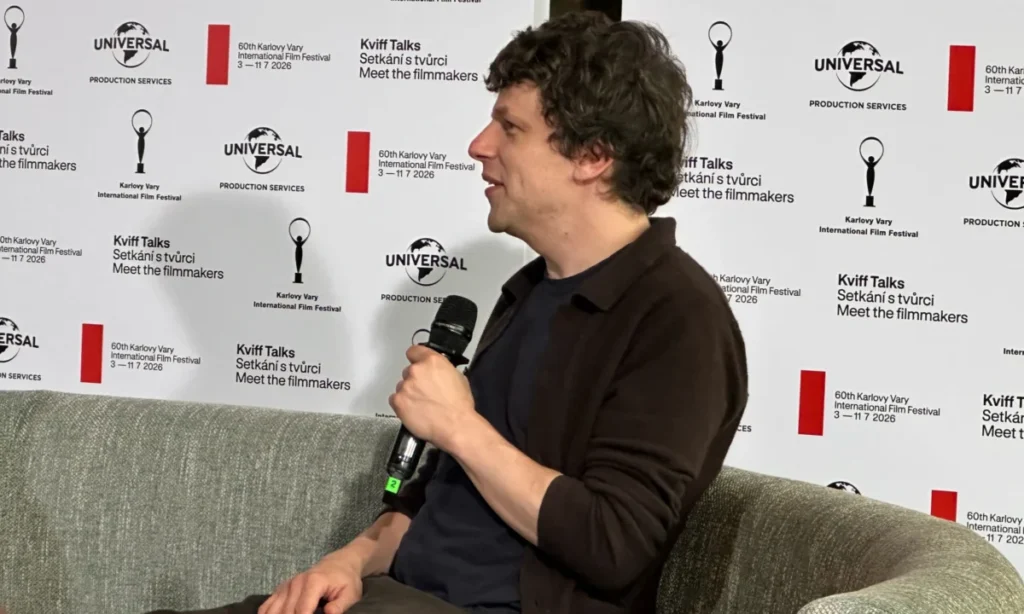

Karlovy Vary, Czech Republic – Renowned actor Jesse Eisenberg, celebrated for his roles in films such as A Real Pain, When You Finish Saving the World, and the critically acclaimed The Social Network, delivered a series of remarkably candid reflections on social media and its most prominent architect, Meta Platforms chairman and CEO Mark Zuckerberg, during a KVIFF Talk at the Karlovy Vary International Film Festival on Saturday. Eisenberg’s outspoken remarks, made during a busy day that also saw him receive a prestigious festival award, offered a stark contrast to the often-polished public personas of Hollywood figures, reaffirming his reputation for intellectual rigor and a distinct aversion to the digital age.
Karlovy Vary: A Historic Hub for Cinematic Dialogue
The Karlovy Vary International Film Festival (KVIFF), one of the oldest and most respected film festivals in the world, served as the backdrop for Eisenberg’s thought-provoking discussion. Celebrating its momentous 60th edition in the 80th year of the Czech festival, KVIFF has long been a significant platform for European and international cinema. Held annually in the picturesque spa town of Karlovy Vary, known for its thermal springs and historic architecture, the festival attracts filmmakers, industry professionals, and cinephiles from across the globe. It is one of only twelve festivals worldwide to hold a competitive status granted by the International Federation of Film Producers Associations (FIAPF), placing it in the same league as Cannes, Venice, and Berlin.
This year’s double anniversary edition, running from July 3-11, has been particularly vibrant, drawing a constellation of stars and honoring significant contributions to world cinema. The expanded red carpet of the festival, a testament to its growing stature, has welcomed luminaries such as Dustin Hoffman, who received the Crystal Globe for Outstanding Artistic Contributions to World Cinema, and Maggie Gyllenhaal, who, alongside Eisenberg, was honored with the President’s Award. Harvey Keitel also made an appearance, adding to the festival’s star power. KVIFF Talks, a popular feature of the festival, provide an intimate setting for attendees to engage with prominent figures, offering insights into their work, creative processes, and broader perspectives on contemporary issues. It was within this esteemed and intellectually stimulating environment that Eisenberg chose to articulate his profound disquiet with the digital landscape.
Eisenberg’s Evolution from Portraying to Publicly Criticizing Zuckerberg
Eisenberg’s portrayal of Mark Zuckerberg in David Fincher’s 2010 masterpiece, The Social Network, remains one of his most iconic and defining roles. The film, which chronicled the contentious founding of Facebook, garnered widespread critical acclaim, earning eight Academy Award nominations, including a Best Actor nod for Eisenberg. At the time of the film’s production, Zuckerberg, while a significant figure in the tech world, had not yet achieved the global omnipresence or generated the complex public scrutiny that defines his image today.
Recalling the period, Eisenberg stated, "He wasn’t very well-known at the time, so the movie seemed like such a strange thing to make because no one really knew who he was… He wasn’t in the public [eye] a lot, so it was more just an interesting character." This perspective highlights the transformative decade that followed the film’s release, during which Facebook (now Meta Platforms) ballooned into a colossal global entity, profoundly reshaping communication, politics, and daily life. Concurrently, Zuckerberg himself transitioned from a tech visionary to a figure of intense public debate, often associated with concerns ranging from data privacy and misinformation to societal polarization.
Eisenberg’s current sentiment starkly contrasts his initial artistic detachment. "I thought of it like an interesting character, and then he’s become famous, and now I don’t want to do the movie because they’re doing a new movie," he revealed, alluding to potential future cinematic explorations of Facebook’s ongoing narrative. His aversion goes deeper than mere creative fatigue: "But I don’t want to be associated with him anymore, because I don’t really like the comparison." This statement underscores a clear personal and ethical boundary Eisenberg now draws, indicating a discomfort with the enduring association between himself, the fictionalized portrayal, and the real-world figure whose company has sparked considerable controversy.
The actor’s most pointed critique came when he declared, "I see that the person who created this website is not a person who cares about people. If this guy is the creator of this world, I don’t want to live in that world." This powerful assertion transcends a simple professional distancing; it represents a moral judgment on the perceived ethos behind Meta’s creation and operation. Eisenberg’s words resonate with a growing global sentiment of disillusionment and skepticism towards large tech companies and their founders, particularly concerning their influence on societal well-being, democratic processes, and individual mental health. His statement implies a belief that the foundational principles or subsequent stewardship of Facebook have deviated from a path that prioritizes human welfare, echoing concerns raised by regulators, ethicists, and former employees alike.
A Personal Disconnect: Eisenberg’s Stance on Social Media
Eisenberg’s critical stance on Zuckerberg is deeply intertwined with his personal decision to abstain entirely from social media platforms. He articulated this aversion with characteristic self-deprecating humor and profound conviction. "I talk about myself so much, it’s not healthy," he explained, reflecting on the performative aspect of public life. "I’m not on any of that stuff. All that stuff scares me so much — Facebook or social media, Twitter, whatever. Already, I feel humiliated to be in public talking about myself. It’s disgusting, so I’m not going to say, ‘Hey, I drank this water.’ All that stuff terrifies me."
This statement provides a crucial insight into Eisenberg’s psychological makeup and his perception of the digital sphere. For an individual who finds public self-promotion inherently "humiliating" and "disgusting," the relentless self-documentation and curated performativity demanded by social media platforms represent an antithetical mode of existence. His fear is not merely a technophobic reaction but stems from a deeper ethical and psychological discomfort with the culture these platforms foster – one that he perceives as narcissistic, superficial, and ultimately detrimental to genuine human connection and self-worth.
His perspective aligns with a broader societal conversation about the mental health impacts of social media, particularly among younger generations. Studies consistently link excessive social media use to increased rates of anxiety, depression, and feelings of inadequacy, driven by constant comparison and the pressure to maintain an idealized online persona. Eisenberg’s choice to opt out can be seen as a conscious effort to protect his mental space and maintain a sense of authenticity in an increasingly digitalized world. It also highlights a growing divide between those who embrace the digital landscape as an essential tool for connection and expression, and those who view it with profound skepticism, perceiving it as a source of alienation and manufactured reality.
Moments of Magic: Acid and Fatherhood
Beyond his critical commentary, Eisenberg also offered a remarkably personal anecdote when asked by a fan about experiences that felt magical or defied logical explanation. His response, delivered with his characteristic blend of wit and vulnerability, offered a glimpse into his inner world and his search for profound meaning. "I took acid once," he began, recalling a vivid experience. "And I remember thinking, ‘I’m on the floor, and I can’t move.’ And I said to my friend, who was a more regular user of it: ‘Is this normal?’ And he said, ‘No, you should be able to move.’" This humorous recollection of an altered state provided a surprising counterpoint to his intellectual discourse.
He then transitioned to a more universally relatable, yet equally profound, experience: fatherhood. "And then also having a child," he concluded. "I guess between taking the Acid and bringing life into this world and nurturing it through happiness and hard times are the two most special experiences of my life." This juxtaposition is striking. On one hand, an intense, chemically induced alteration of perception, a transient departure from reality. On the other, the enduring, tangible, and deeply human act of bringing a child into the world and raising them.
This anecdote serves as a powerful testament to Eisenberg’s priorities. The "magic" he seeks is found not in fleeting digital connections or curated online identities, but in the raw, unvarnished experiences of life – whether an extreme sensory journey or the profound, enduring responsibility and joy of parenthood. It underscores a philosophy that values deep, authentic, and often challenging human experiences over the superficiality and detachment he perceives in the digital realm. His child, a tangible embodiment of life and future, represents the kind of "world" he genuinely wishes to live in and contribute to, starkly contrasting with the "world" created by Zuckerberg that he explicitly rejects.
Recognition and Future Endeavors at KVIFF
Eisenberg’s KVIFF Talk capped off a remarkably full day for the actor, writer, and director. Earlier in the late morning, he had been honored with the festival’s prestigious President’s Award. This accolade recognizes significant contributions to world cinema and highlights Eisenberg’s multifaceted career, which extends beyond acting into writing and directing. Following the award ceremony, a special screening of Richard Ayoade’s 2013 film The Double, in which Eisenberg plays the lead role, was held. The film, a dark comedy thriller where Eisenberg portrays two identical men, offered festival-goers an opportunity to appreciate his range and nuanced performances.
Looking ahead, Eisenberg’s creative energies are clearly focused on his burgeoning career as a writer and director. His upcoming film, The Debut, promises to be a significant artistic statement. The project boasts an impressive cast, starring veteran actors Julianne Moore and Paul Giamatti, signaling its potential for critical acclaim. Notably, Eisenberg not only directs and writes the film but also co-stars in it and has composed the music and lyrics for a musical-within-the-movie, showcasing his expansive artistic talents. The Debut is slated for a fall release by A24, a production company renowned for its distinctive and critically successful independent films, further cementing Eisenberg’s position as a formidable creative force in contemporary cinema.
Broader Implications: Artists, Ethics, and the Digital Age
Jesse Eisenberg’s pronouncements at KVIFF are more than just a celebrity’s personal opinion; they reflect a growing trend of public figures using their platforms to engage with pressing ethical questions surrounding technology and its impact on society. As the digital landscape continues to evolve at an unprecedented pace, the responsibilities of its architects and the consequences for its users become increasingly scrutinized. Eisenberg, having intimately portrayed one of the most influential figures of this era, offers a unique and compelling perspective.
His sharp criticisms of Mark Zuckerberg and Meta Platforms contribute to an ongoing global dialogue about corporate accountability, the ethics of algorithmic design, and the broader societal implications of platforms that mediate so much of human interaction. When an artist of his caliber, particularly one so closely associated with the very narrative of Facebook’s genesis, publicly disavows its creator and the "world" he built, it sends a powerful message. It underscores a prevailing public anxiety that the pursuit of technological innovation and corporate growth has, in some instances, overshadowed considerations for human well-being and societal cohesion.
The Karlovy Vary International Film Festival, through its commitment to fostering open dialogue and celebrating artistic expression, provided an ideal forum for such a discussion. Eisenberg’s unwavering stance against social media, his search for genuine "magic" in life’s most profound experiences, and his ongoing artistic pursuits as a multi-hyphenate creator, collectively paint a picture of an artist deeply engaged with the complexities of the modern world, striving to forge a path that prioritizes authenticity and human connection over digital ubiquity. His voice adds a significant, and perhaps increasingly common, layer to the evolving narrative of technology’s place in our lives, challenging both creators and consumers to critically examine the "worlds" they inhabit and contribute to.