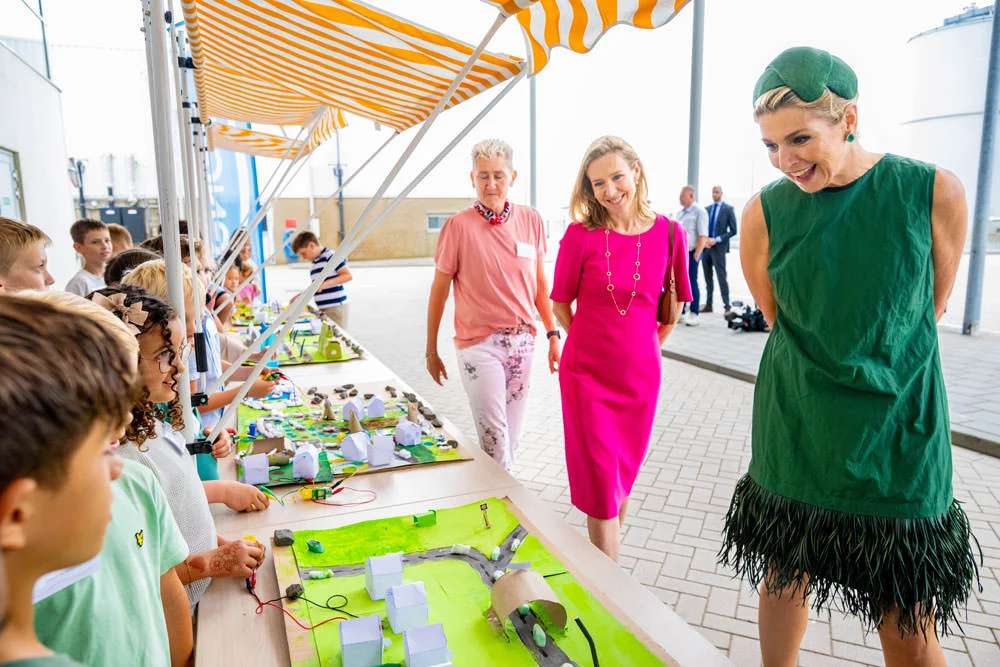

Queen Máxima of the Netherlands arrived in Lelystad this week to officially inaugurate a major new battery storage facility at the Máxima Power Station, an event that underscores the nation’s accelerating transition toward a sustainable energy infrastructure. The facility, operated by the international energy giant Engie, represents a significant milestone in the Dutch utility sector’s efforts to stabilize the national power grid through advanced storage technology. This engagement followed a formal morning session at the Council of State in The Hague, marking a day of diverse responsibilities for the Queen, ranging from constitutional advisory roles to the promotion of industrial innovation.
The opening of the battery park is not merely a local infrastructure project but a critical component of the Netherlands’ broader climate goals. As the country increases its reliance on intermittent renewable energy sources such as wind and solar, the ability to store excess power and release it during periods of low production has become a national priority. The choice of the Máxima Power Station for this installation is both symbolic and practical, as the site has long been a cornerstone of the Flevoland province’s energy production.
A Chronology of Royal Engagements
The Queen’s schedule for the day reflected the multifaceted nature of the Dutch monarchy’s modern role. The morning began in The Hague at the Kneuterdijk Palace, where Queen Máxima attended a meeting of the Council of State (Raad van State). As a member of the Council, the Queen holds a seat in the Advisory Division, although she does not possess voting rights. These meetings are essential to the Dutch legislative process, providing the government and Parliament with independent advice on legislation and governance.

Following the conclusion of the morning’s constitutional duties, the Queen traveled to Lelystad. The transition from the formal, historically significant halls of the Council of State to the high-tech, industrial environment of the Engie power plant required a swift shift in focus. Upon her arrival at the Máxima Power Station, she was greeted by executives from Engie and local government officials from the province of Flevoland.
The inauguration ceremony involved a technical demonstration of the battery systems, after which the Queen officially activated the park. Following the formal opening, she toured the facility and engaged in a roundtable discussion with engineers, sustainability experts, and energy analysts regarding the challenges of grid congestion and the future of green hydrogen and large-scale storage in Northern Europe.
Technical Specifications and Strategic Importance
The new battery park at the Máxima Power Station is designed to address the "duck curve" of energy production—the imbalance between peak demand and renewable energy generation. While specific capacity figures for this exact installation are often scaled based on grid requirements, similar utility-scale projects by Engie typically involve lithium-ion systems capable of providing tens of megawatts of power.
The strategic importance of this facility lies in its ability to provide "frequency restoration reserves." In simpler terms, the battery system can respond within milliseconds to fluctuations in the grid’s frequency. If a large wind farm suddenly stops producing due to a drop in wind speed, or if there is an unexpected surge in consumer demand, these batteries discharge their stored energy to prevent blackouts. Conversely, during periods of peak solar production at midday, the batteries soak up the excess energy that would otherwise be wasted.

The Netherlands currently faces a significant challenge with grid congestion, particularly in industrial zones and areas with high concentrations of solar parks. The Dutch grid operator, TenneT, has frequently highlighted the need for decentralized storage solutions to prevent the system from becoming overwhelmed. The Lelystad battery park serves as a primary example of how existing power plant sites—traditionally dedicated to fossil fuel combustion—can be repurposed as hubs for "smart" energy management.
Industrial Synergy and the Maxima Power Station
The Máxima Power Station itself has a notable history. Commissioned in 2010, it was originally designed as a high-efficiency gas-fired plant. At the time of its opening, it was considered one of the cleanest and most efficient plants of its kind in Europe. The decision by Engie to name the facility after the then-Princess Máxima reflected the royal family’s long-standing interest in the Dutch economic and industrial sectors.
By integrating a battery park into the existing infrastructure of the Máxima Power Station, Engie is leveraging existing grid connections. Building new high-voltage connections is often a years-long process involving complex permitting and land-use negotiations. By utilizing the "brownfield" site of an active power station, the energy company was able to bring the storage capacity online much faster than a standalone project would allow.
During the event, Engie representatives emphasized that the battery park is just one phase of a long-term transition. The company has signaled intentions to explore the use of the site for green hydrogen production, utilizing the excess renewable energy from nearby North Sea wind farms to split water molecules, creating a carbon-free fuel source for heavy industry.

Stylistic Observations and Royal Protocol
As is customary for royal appearances, Queen Máxima’s choice of attire garnered significant attention from the gathered press and fashion analysts. For this occasion, she chose a sleeveless green cocktail dress featuring intricate feather detailing along the hemline, a piece from the Spring 2023 collection of the Belgian couture house Natan. Natan, led by designer Edouard Vermeulen, has been a preferred label for both the Dutch and Belgian royal families for decades, known for its bold silhouettes and structured fabrics.
The Queen’s ensemble was a continuation of her look from the morning’s Council of State meeting. She retained the same large-brimmed hat and matching gloves, a choice that reflected the formal requirements of the morning’s constitutional event. While the transition to an industrial power plant in Lelystad presented a different environmental context, the Queen’s adherence to her initial wardrobe underscored the rapid pace of her daily itinerary.
Observers noted that the delicate nature of the silk-blend fabric and the feathered trim provided a sharp visual contrast to the steel-and-concrete backdrop of the battery storage units. Despite the logistical challenges of maintaining couture garments through a day of travel and industrial tours, the Queen’s appearance remained consistent with her reputation for high-fashion diplomacy. Her accessories included a clutch from Sarah’s Bag, a social enterprise that supports female artisans, and coordinated pumps from Natan.
Broader Implications for the Dutch Energy Market
The inauguration of the Lelystad facility comes at a time when the European Union is intensifying its "Green Deal" initiatives. The Netherlands, as one of the most densely populated and industrially active members of the EU, is under significant pressure to meet stringent carbon reduction targets.

The success of the Máxima Power Station’s battery park is expected to serve as a blueprint for other energy providers in the region. Analysts suggest that the Dutch market will require several gigawatts of storage capacity by 2030 to maintain a reliable grid. This will likely necessitate a mix of technologies, including not only lithium-ion batteries but also flow batteries, compressed air energy storage, and thermal storage.
Furthermore, the event highlighted the role of royal patronage in bringing public attention to technical and environmental milestones. While the Queen’s role is ceremonial, her presence at the opening of a battery park provides a level of national and international visibility that a standard corporate ribbon-cutting would lack. It signals to investors and the public alike that the energy transition is a matter of national importance, supported at the highest levels of the state.
Conclusion
The opening of the battery park in Lelystad marks a successful convergence of corporate investment, technological innovation, and royal representation. By expanding the capabilities of the Máxima Power Station, Engie and the Dutch government are taking tangible steps toward a more resilient and sustainable energy grid. As Queen Máxima concluded her visit and returned to her residence, the facility she activated began its quiet work of balancing the Dutch electricity supply, ensuring that the lights remain on as the nation moves toward a greener future. The event stands as a testament to the Netherlands’ ability to blend tradition with progress, utilizing its historical institutions to champion the innovations of the 21st century.