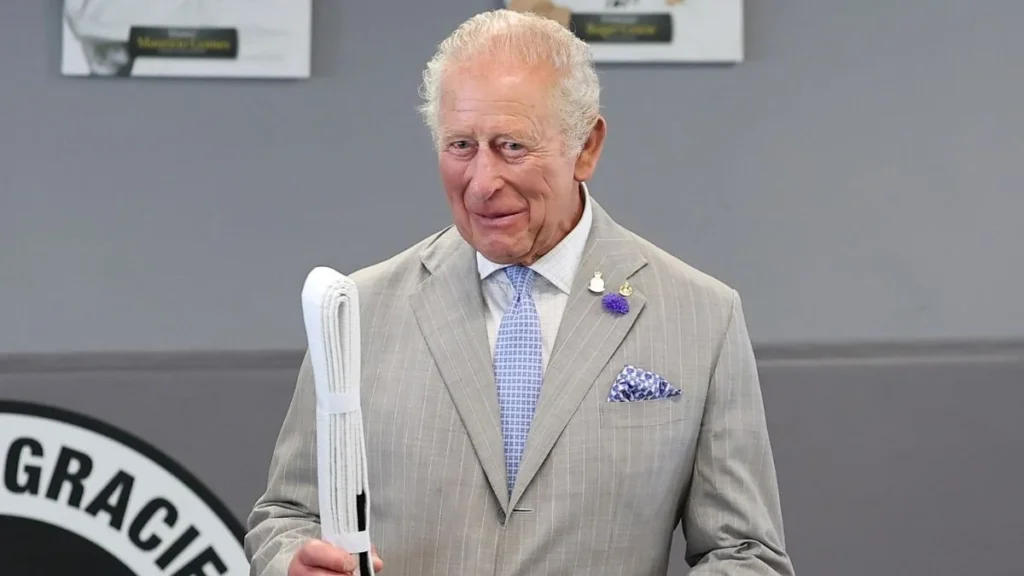

King Charles III engaged in a series of lighthearted and poignant interactions during a recent visit to the Roger Gracie Brazilian Jiu-Jitsu (BJJ) Academy in Hammersmith, London, where he was presented with his own honorary white belt. The monarch, known for his long-standing support of the British Armed Forces and mental health initiatives, visited the facility to witness firsthand the transformative work of REORG, a charity dedicated to supporting veterans, military personnel, and emergency service workers through the discipline of martial arts. During the presentation, the King smiled broadly, lifting the white belt for the gathered crowd to see, signaling his appreciation for the symbolic gesture and the rigorous training undertaken by the academy’s practitioners.
The visit served as a platform to highlight the intersection of physical discipline and psychological recovery. Wearing bright blue disposable covers over his formal leather shoes to protect the integrity of the academy’s mats, King Charles observed demonstrations from students of varying skill levels. The atmosphere was one of mutual respect, as the monarch drew parallels between the intense physical maneuvers of Brazilian jiu-jitsu and his own experiences serving in the Royal Navy decades ago. The event underscored the Royal Family’s continued commitment to veteran welfare, a cornerstone of King Charles’s public service throughout his tenure as Prince of Wales and now as Sovereign.
A Chronology of the Royal Visit to Hammersmith
The Royal visit began with an introduction to the facility’s leadership and the founders of the REORG charity. Upon entering the training area, the King was greeted by Sam Sheriff MBE, a former Royal Marines veteran and a black belt in Brazilian jiu-jitsu, who founded REORG in 2017. Sheriff provided the King with an overview of how the charity utilizes the unique physical and mental demands of BJJ to help individuals navigate the complexities of post-traumatic stress disorder (PTSD), physical injuries, and the often-difficult transition from military to civilian life.
Following the initial briefings, the King moved to the edge of the mats to observe a series of live demonstrations. Practitioners, including veterans with visible physical disabilities, showcased the "ground game" techniques central to BJJ—a martial art that focuses on leverage, joint locks, and chokeholds to neutralize opponents. It was during these demonstrations that King Charles shared a personal anecdote from his time aboard HMS Bronington. Between 1971 and 1976, the King served in the Royal Navy, eventually commanding the minehunter. Observing the grappling, he remarked that the physical struggle reminded him of the naval tradition of tug-of-war.
"It’s almost like you’re in a tug-of-war," the King noted while speaking to a group of student practitioners. He recalled a specific variation of the game played on his ship: "We used to do that on HMS Bronington, but the rope was tied round the stern so you couldn’t see the other team. It was like a pulley system that never ended." The comment drew laughter from the participants, bridging the gap between traditional military grit and the modern therapeutic application of martial arts.
The climax of the visit occurred when the King was presented with his own white belt—the introductory rank in Brazilian jiu-jitsu. While the gesture was ceremonial, it carried significant weight within the community, symbolizing the King’s "entry" into the brotherhood of those who support the REORG mission. In a reciprocal gesture of recognition, the King participated in a ceremonial promotion for Roger Gracie, one of the most decorated BJJ practitioners in history. Sam Sheriff explained to the King that achieving a black belt in the sport is a grueling endeavor, typically requiring 10 to 15 years of consistent, dedicated practice, a feat only a small percentage of practitioners ever achieve.
The Mission of REORG: Supporting Those Who Serve
REORG has emerged as a vital component of the UK’s veteran support network. Founded by Sam Sheriff during his service as a physical training instructor in the Royal Marines, the organization was born from the realization that the camaraderie and physical challenge of the military are often what veterans miss most after discharge. By introducing them to Brazilian jiu-jitsu, REORG provides a new "mission" and a supportive community.
The charity’s impact is backed by a growing body of anecdotal and clinical evidence suggesting that high-intensity physical activity combined with a structured social environment can significantly mitigate the symptoms of PTSD and depression. According to data from the UK Ministry of Defence and various veteran outreach programs, approximately 1 in 20 veterans suffer from PTSD, with many more struggling with social isolation. REORG addresses these issues by fostering a "tribe" mentality on the mats.
During the King’s visit, he met with Mark Ormrod MBE, a former Royal Marine commando and triple amputee who has become a prominent advocate for the charity. Ormrod, who lost both legs and his right arm to an improvised explosive device (IED) in Afghanistan in 2007, spoke candidly with the King about how BJJ allowed him to reclaim a sense of agency over his body. Ormrod’s presence at the academy served as a powerful testament to the sport’s adaptability; BJJ is often called "the gentle art" because it allows smaller or less physically capable individuals to defend themselves using technique rather than brute strength.
Technical Significance and the Global Influence of Roger Gracie
The choice of the Roger Gracie Academy for this Royal visit was highly significant within the martial arts world. Roger Gracie is a 10-time world champion and a member of the legendary Gracie family, who are credited with developing and popularizing Brazilian jiu-jitsu globally. The Hammersmith academy serves as a "mecca" for practitioners, and the King’s presence there provided an unprecedented level of mainstream visibility for the sport.
The King learned about the technical progression within the sport, from the novice white belt to the master-level black belt. Practitioners explained that BJJ is often described as "human chess" due to the deep level of strategy required to anticipate an opponent’s moves. This mental engagement is precisely what makes it an effective tool for mental health; the "flow state" achieved during a sparring session (known as "rolling") requires such total concentration that it provides a temporary but profound respite from intrusive thoughts or anxiety.
By participating in the ceremonial promotion of Roger Gracie, King Charles acknowledged the years of discipline required to master the craft. The promotion was a rare moment where the worlds of British royalty and martial arts royalty converged, emphasizing a shared respect for tradition, discipline, and the pursuit of excellence.
Official Responses and the Broader Impact of Royal Patronage
The Royal Family’s social media accounts later shared footage of the event, describing it as an "inspiring morning" and praising the work of REORG in supporting military personnel and emergency workers. The post highlighted the academy’s role in Hammersmith as a hub for both elite athletes and those seeking healing.
In a statement following the visit, Sam Sheriff MBE expressed the organization’s gratitude: "To have His Majesty the King visit us and take such a genuine interest in the lives of our veterans is a monumental boost for the REORG community. It validates the hard work these men and women put in every day on the mats to improve their physical and mental well-being. The King’s understanding of the military mindset made the interaction incredibly special."
Industry analysts and social commentators suggest that King Charles’s visit to a jiu-jitsu academy reflects a modernization of the monarchy’s public engagements. While traditional patronages remain important, the King’s willingness to engage with a contemporary and physically intense sport like BJJ demonstrates an awareness of modern therapeutic trends. It also aligns with the broader Royal Foundation’s focus on mental health, a cause championed heavily by the Prince and Princess of Wales.
Implications for Veteran Mental Health Policy
The King’s visit comes at a time when the UK government and non-profit sectors are increasingly looking toward "social prescribing"—the practice of referring patients to local, non-clinical services to improve their health and wellbeing. REORG’s model is a prime example of this, offering a community-based solution to a complex medical and social problem.
The visibility provided by the King is expected to drive increased funding and participation for REORG and similar initiatives. As the charity expands its reach to include emergency service workers—police, fire, and ambulance staff who also face high rates of occupational trauma—the Royal endorsement serves as a catalyst for growth.
In conclusion, King Charles III’s visit to the Roger Gracie Academy was more than a series of photo opportunities; it was a substantive engagement with a community dedicated to resilience and recovery. By donning the blue shoe covers and accepting the white belt, the King signaled his respect for the "tatami" (the mat) and the discipline it represents. His lighthearted recollections of his naval service on HMS Bronington reminded those present that while the methods of building resilience may change—from naval tug-of-war to Brazilian jiu-jitsu—the fundamental need for camaraderie and physical purpose remains a constant in the lives of those who serve the Crown. The event reinforced the idea that for many veterans, the path to healing is not found in isolation, but in the shared struggle and mutual support of the training hall.