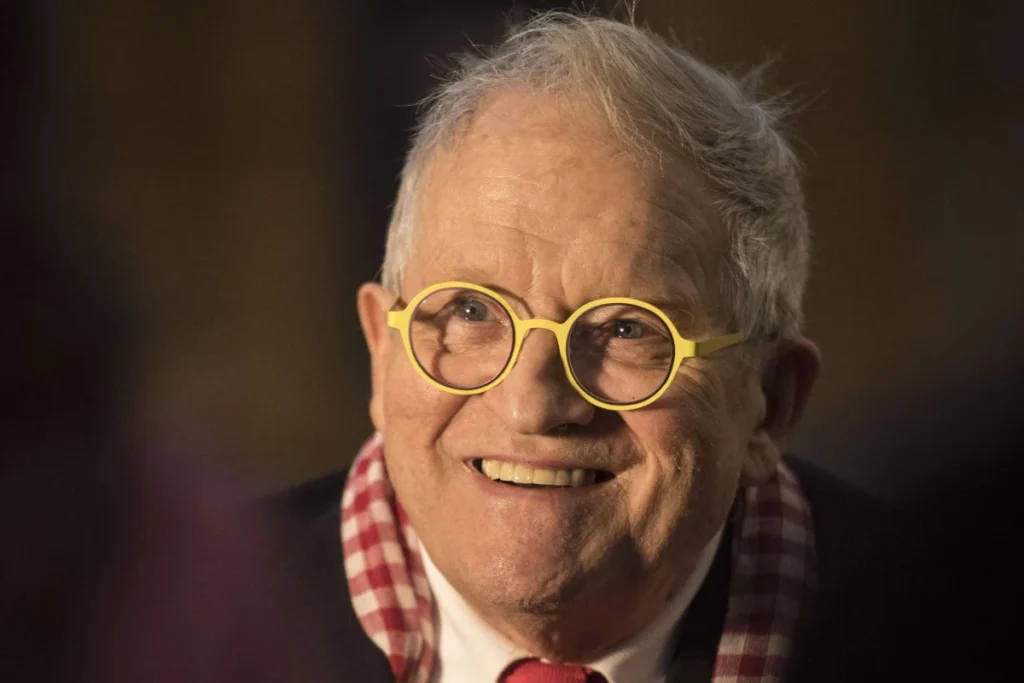

The art world is mourning the loss of one of its most innovative and influential figures, David Hockney, who passed away peacefully at his home on June 11, aged 88. In accordance with the artist’s explicit wishes, his funeral was a private affair, attended solely by his devoted partner, Jean-Pierre Goncalves de Lima, and his great-nephew, Richard. This intimate farewell marks the beginning of a period of reflection and remembrance for a titan whose vibrant canvases and groundbreaking approaches to art redefined contemporary visual culture for over six decades. While the private ceremony honored Hockney’s desire for personal discretion in his final moments, a series of public memorial services is being planned across the globe, set to commence next year, ensuring that his immense legacy is celebrated by admirers worldwide.
The Intimate Farewell and Public Acknowledgment
Erica Bolton, Hockney’s publicist, released a statement confirming the private nature of the funeral and expressing gratitude for the outpouring of tributes received since the artist’s passing. "We have been overwhelmed by your tributes which have meant so much to us and we wanted to thank you," Bolton stated, emphasizing the artist’s clear directive for the funeral arrangements. "As we have already received so many inquiries about David Hockney’s funeral arrangements and memorials, we would like to clarify that it was David’s clear wish that his funeral should be attended only by his partner, JP, and his great-nephew Richard; and that their privacy would be respected. The funeral has already taken place." This decision underscores a facet of Hockney’s character often observed throughout his career: a profound sense of self and an unwavering commitment to his personal vision, whether in art or life. For a figure of such global renown, whose work often explored themes of intimacy and personal connection, a private send-off feels both poignant and fitting.
A Life Defined by Vision and Innovation: Early Years and Artistic Awakening
Born in Bradford, Yorkshire, in 1937, David Hockney’s journey into the art world began against the backdrop of post-war Britain. His early education at the Bradford School of Art in the 1950s provided the foundational skills and critical perspective that would shape his distinctive style. It was during this formative period that Hockney first demonstrated the audacious spirit and keen observational eye that would become hallmarks of his oeuvre. The artistic landscape of the era, marked by a burgeoning interest in abstraction and a move away from traditional figuration, might have seemed at odds with Hockney’s innate inclination towards narrative and representation. Yet, he navigated these currents with an independent spirit, developing a unique voice that blended personal experience with broader cultural commentary.
His move to London in the early 1960s to study at the prestigious Royal College of Art proved to be a pivotal moment. The Royal College was a crucible of creativity, fostering a generation of artists who would redefine British art, including R.B. Kitaj, Allen Jones, and Derek Boshier. Hockney, graduating with a gold medal distinction in 1962, quickly emerged as one of the seminal talents of this new wave. His early works, often imbued with a playful wit and a nascent exploration of his identity as a gay man, placed him squarely within the burgeoning Pop Art movement, though he always maintained a distinctive distance from its more commercial aspects. He absorbed influences from Picasso to Egyptian art, synthesizing them into a style that was uniquely his own—bold, colorful, and deeply personal.

The Californian Dream and the Evolution of a Style
Hockney’s move to California in the mid-1960s marked a profound shift in his artistic output and thematic concerns. The sun-drenched landscapes, shimmering swimming pools, and relaxed hedonism of Los Angeles provided a stark contrast to the grey skies of England and ignited a new intensity in his work. It was here that he produced some of his most iconic pieces, including "The Splash" (1967), "A Bigger Splash" (1967), and "Portrait Of An Artist (Pool With Two Figures)" (1972). These works are not merely depictions of luxury but complex explorations of light, space, desire, and the fleeting nature of moments. The swimming pool, a recurring motif, became a symbol of both pleasure and an almost melancholic detachment, reflecting the elusive nature of the Californian dream.
His celebrated portraits, such as "Mr and Mrs Clark and Percy" (1970-71), showcased his extraordinary ability to capture the psychological nuances of his subjects, often depicting friends, lovers, and colleagues with an intimate yet detached precision. These double portraits, meticulously composed, reveal the intricate relationships between individuals and their environments. Hockney’s use of vibrant acrylics, sharp lines, and carefully orchestrated compositions created a visual language that was both instantly recognizable and deeply resonant.
Embracing Innovation: From Photography to Digital Art
Throughout his career, Hockney consistently pushed the boundaries of traditional art forms, demonstrating an insatiable curiosity for new technologies and methods. He experimented extensively with photography in the 1980s, creating his famous "joiners"—photographic collages that pieced together multiple perspectives of a single scene, challenging conventional notions of perspective and time. These works, often landscapes or portraits, offered a fragmented yet more comprehensive view of reality, reflecting his philosophical inquiries into how we perceive the world.
In his later years, Hockney embraced digital art with characteristic enthusiasm, using fax machines, and later, iPads and iPhones as tools for creation. His digital drawings, often characterized by bright colors and fluid lines, demonstrated that the essence of artistic expression transcends the medium. He viewed these digital platforms not as a departure from traditional painting but as an extension, allowing for unprecedented speed, layering, and experimentation. This fearless adoption of technology underscored his belief that art should evolve, adapt, and continually seek new ways to communicate. His large-scale landscape paintings, particularly those depicting the Yorkshire Wolds, often integrated elements of these digital explorations, revealing a master constantly refining his vision and technique. "Bigger Trees Near Warter" (2007), a monumental multi-canvas landscape, exemplifies his late career fascination with the changing seasons and the immersive experience of nature.
A Legacy of Honors and Public Philanthropy

David Hockney’s profound contributions to art were recognized globally through numerous accolades. In 1997, he was appointed by the late Queen Elizabeth II to the Order of the Companions of Honour, a prestigious award for individuals who have made a significant contribution to the arts, sciences, medicine, or government. This was followed by his appointment to the Order of Merit in 2012, an even more exclusive honor bestowed by the monarch for outstanding service across various fields. These royal recognitions cemented his status as a national treasure.
His international standing was further highlighted in 2026, when he became one of the few non-French citizens to be awarded the rank of Officer in France’s prestigious Legion d’Honneur, a testament to his profound influence on European and global art. Perhaps one of his most personal and enduring public commissions was the stained-glass Queen’s Window in Westminster Abbey, unveiled in October 2018. Designed in his signature vibrant style, the window celebrated Queen Elizabeth II’s reign and her passion for the countryside, becoming a permanent testament to his artistry within one of Britain’s most historic institutions.
Beyond these official honors, Hockney’s legacy is set to be further solidified through a significant philanthropic gesture. His publicist confirmed that the majority of Hockney’s extensive body of work will now be given to foundations and public institutions around the world. This monumental donation ensures that his art remains accessible to the public, fostering education and appreciation for generations to come. This decision aligns with his lifelong commitment to sharing his vision and challenging perceptions. Notably, Ms. Bolton also clarified that Hockney did not maintain a collection of artworks by other painters, nor were any of his own works stored at his properties in the UK, France, and the US, indicating a deliberate separation of his personal life from the vast public domain of his artistic output. This move simplifies the posthumous distribution and guarantees the integrity of his artistic estate, allowing institutions to properly curate and display his works.
A World Remembers: Upcoming Memorials and Tributes
While the immediate farewell was private, the public will soon have ample opportunity to celebrate David Hockney’s extraordinary life and career. "Also in accordance with David’s wishes, we are able to announce that the first memorial service to celebrate David’s life and work will be held in London in spring 2027, followed at later dates by memorials in Yorkshire, Paris and Los Angeles," Erica Bolton confirmed.
These locations are deeply significant, reflecting the geographical tapestry of Hockney’s life and artistic inspiration. London, as the city where he honed his skills at the Royal College of Art and gained early recognition, will host the inaugural public tribute. Yorkshire, his birthplace and the subject of many of his later, immersive landscapes, will offer a more intimate reflection on his roots. Paris, a global cultural capital that awarded him the Legion d’Honneur, and Los Angeles, the city that profoundly shaped his iconic imagery and became synonymous with his most celebrated period, will provide international platforms for remembrance. These memorial services are expected to draw leading figures from the art world, former collaborators, friends, and countless admirers, offering a chance to reflect on his enduring impact and the joy his art brought to millions. They will likely feature eulogies, artistic performances, and possibly even mini-exhibitions, creating a holistic celebration of his multifaceted genius. The timing, starting in Spring 2027, also provides ample time for planning a series of tributes befitting an artist of his stature, ensuring each event is thoughtfully curated to reflect a different facet of his remarkable journey.
David Hockney leaves behind an indelible mark on art history. His legacy is not just in the countless iconic images he created, but in his fearless pursuit of innovation, his profound curiosity about human perception, and his unwavering belief in the power of art to illuminate and inspire. As the world prepares to formally commemorate his life, his vibrant works will continue to challenge, delight, and captivate audiences, ensuring that the spirit of David Hockney lives on through his timeless art.