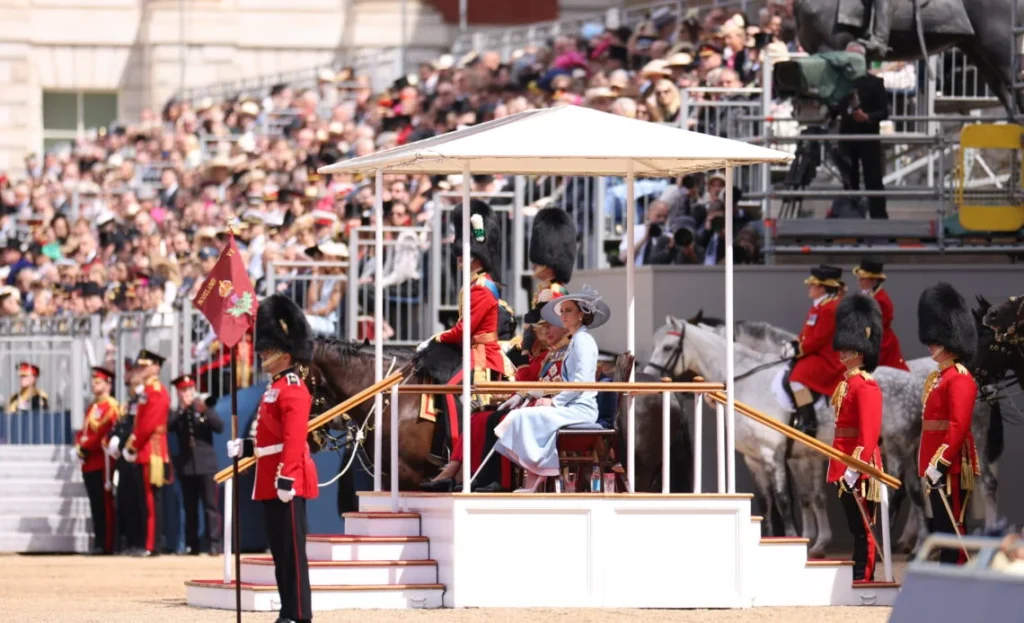

The annual spectacle of Trooping the Colour, a centuries-old tradition celebrating the Sovereign’s official birthday, once again saw the Princess of Wales take a central and highly visible position on the dais at Horse Guards Parade. This marks the second consecutive year Catherine has joined King Charles III and Queen Camilla in this prestigious vantage point, a placement that speaks volumes about her increasingly significant role within the British monarchy and its future trajectory. Her presence alongside the King and Queen during this significant military and ceremonial event underscores a deliberate affirmation of her established standing and her readiness to embrace the responsibilities that come with her position as the future Queen Consort.
H2: A Carriage Procession and Family Presence
The Princess of Wales arrived at Horse Guards Parade via a carriage procession from Buckingham Palace, accompanied by her three children: Prince George, Princess Charlotte, and Prince Louis. This family unit, a familiar and beloved sight for royal watchers, drew considerable attention and generated palpable excitement among the crowds lining The Mall. The enthusiastic waves exchanged between the young royals and the public served as a heartwarming reminder of the monarchy’s connection with its people, even amidst the solemnity of the military display.
In contrast to his wife and children, the Prince of Wales, Prince William, participated directly in the parade on horseback. He rode Darby, a distinguished horse presented to the Royal Family by the Royal Canadian Mounted Police, a gesture that highlights the international connections and enduring relationships fostered by the Crown. His active participation in the military procession, a tradition he has upheld, demonstrates his own commitment to the ceremonial duties that form a cornerstone of the monarchy’s public face.
H2: The Significance of the Dais
The dais at Horse Guards Parade is not merely a viewing platform; it is a symbolic stage reserved for a select group of senior royals and esteemed dignitaries. Its position offers an unparalleled perspective of the meticulously choreographed military spectacle, allowing those seated there to observe the precision, discipline, and historical resonance of the event. For the Princess of Wales to occupy this spot for the second year running, and in succession to a long tradition, signifies a deep level of trust and confidence placed in her by King Charles III and the wider institution.
H3: A Symbol of Continuity and Confidence
Catherine’s presence on the dais last year held particular poignancy. It marked her first major public appearance at Trooping the Colour following her announcement of undergoing a course of preventative chemotherapy. Her return to such a prominent role, engaging fully with royal duties, was interpreted as a powerful statement of resilience and determination. This year’s appearance, therefore, represents not only continuity but also a confident stride forward as she re-engages with a full calendar of royal engagements. It signals a robust return to public life and a clear indication that she is ready to shoulder the duties associated with her future role.
H3: Historical Precedent and Evolving Traditions
For decades, the seat beside Queen Elizabeth II on the dais was often occupied by her cousin, the Duke of Kent. The Duke of Kent, a figure with extensive experience in ceremonial duties and a long-standing connection to the military, represented a continuity of tradition and a seasoned presence within the royal family’s public engagements. The Princess of Wales’s sustained presence in a similar, highly visible position alongside the King and Queen, now echoes this historical pattern, albeit with a new generation at the helm. This placement effectively positions her at the heart of one of the monarchy’s most important annual events, a testament to her elevated status and the evolving dynamics within the Royal Family.
H2: Trooping the Colour: A Deep-Rooted Tradition
Trooping the Colour is more than just a birthday parade; it is a profound expression of British military heritage and royal pageantry. Its origins can be traced back to the 17th century, evolving from the practice of regiments marching their colours (flags) down the ranks to ensure soldiers could recognise them on the battlefield. Today, it serves as a magnificent display of military precision, involving over 1,300 soldiers of the Household Division, more than 200 horses, and over 400 musicians from the Royal Air Force, Army, and Royal Navy. The event culminates in a flypast by the Royal Air Force, a moment that consistently captivates onlookers.
The Sovereign’s official birthday is traditionally celebrated in June, regardless of the monarch’s actual birth date, a practice initiated by King George II in 1748. This dual celebration, combining personal milestone with national commemoration, has become a fixture of the British summer calendar. The elaborate ceremonial, involving the King’s Troop Royal Horse Artillery and the Household Cavalry Mounted Regiment, underscores the deep and intertwined relationship between the monarchy and the armed forces.
H2: The Princess’s Evolving Public Profile
The Princess of Wales’s increasing prominence within the Royal Family is a narrative that has unfolded over years of dedicated service and public engagement. As the wife of the heir to the throne, her role has naturally evolved, but her recent appearances and the specific placements she has been given, such as the dais at Trooping the Colour, signify a deliberate and visible elevation of her status. This is not merely about attending events; it is about being positioned at the forefront of significant national ceremonies, alongside the reigning monarch, a clear indication of her importance to the continuity and future of the institution.
Her dedication to various charitable causes, particularly those focused on early years development and mental health, has also solidified her public image as a compassionate and engaged royal. These initiatives, often undertaken with a strategic and thoughtful approach, have garnered widespread respect and admiration, further enhancing her standing. Her ability to connect with a broad spectrum of the public, from large ceremonial events to more intimate engagements, is a valuable asset to the monarchy.
H3: Data and Context: The Royal Family’s Public Role
Royal engagements are meticulously planned and documented, providing valuable data on the working members of the Royal Family. Trooping the Colour, as one of the most high-profile annual events, consistently draws significant media attention and public interest. The presence of senior royals in key positions at such events serves multiple purposes: it reinforces the continuity of the monarchy, showcases the dedication of its members to public service, and maintains a visible connection with the nation.
The historical context of Trooping the Colour, stretching back centuries, imbues the event with a gravitas that resonates with the British public’s appreciation for tradition and history. The Princess of Wales’s consistent and prominent participation in this event, therefore, aligns her with this deep-rooted national heritage, solidifying her place within the fabric of British ceremonial life.
H2: Future Implications and Royal Stability
The Princess of Wales’s current standing and her visible role in key royal events are indicative of the monarchy’s strategic approach to succession and public perception. By positioning her prominently, the Royal Family is signalling a clear vision for the future, where she will play an integral part alongside Prince William. This projection of stability and continuity is crucial for an institution that relies on public support and an understanding of its enduring purpose.
Her ability to navigate public scrutiny with grace and resilience, particularly in recent times, further underscores her suitability for her evolving role. The Princess of Wales represents a modern face of the monarchy, one that is expected to balance tradition with contemporary relevance. Her continued presence at the forefront of events like Trooping the Colour is a testament to her commitment to this complex and demanding position. As the monarchy continues to adapt to the changing times, the Princess of Wales is clearly positioned as a cornerstone of its future, demonstrating strength, dedication, and a deep understanding of the responsibilities she holds. Her participation in Trooping the Colour is not just a ceremonial duty; it is a powerful visual narrative of her growing influence and her indispensable contribution to the enduring legacy of the British Crown.