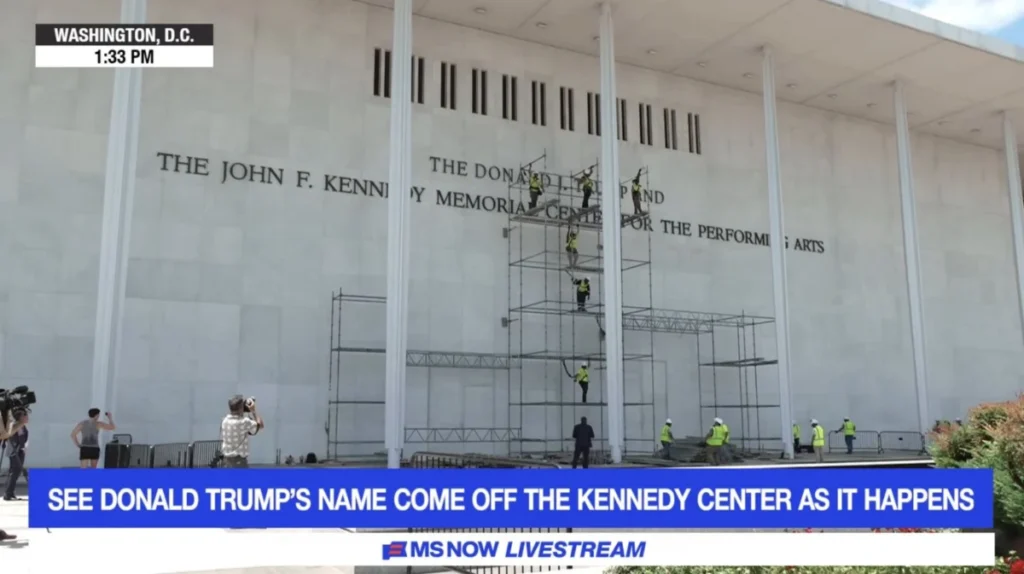

The physical manifestation of a contentious two-year period at one of America’s foremost cultural institutions concluded this week as the name of former President Donald J. Trump was officially removed from the John F. Kennedy Memorial Center for the Performing Arts. This decisive action followed a federal court order, marking the definitive end of a highly scrutinized attempt to affix the former president’s name to the national landmark, a move that had plunged the center into artistic and administrative turmoil. The final act of removal, widely anticipated, was a public spectacle, drawing considerable media attention and signifying a return to the center’s original, Congressionally mandated identity.
The Genesis of a Controversial Renaming Attempt
The saga began in early 2025, just as the political landscape was shifting and the influence of the prior administration was still keenly felt in various federal appointments. It was during this period that former President Trump installed new leadership to the Kennedy Center’s Board of Trustees. These appointments were seen by many observers as a strategic maneuver to assert greater political control over an institution traditionally viewed as non-partisan and dedicated to the arts. Critics at the time voiced concerns that these new trustees, largely aligned with Trump’s political ideology, might deviate from the center’s core mission and historical independence.
By December 2025, these concerns materialized into concrete action. The newly appointed board, under its revamped leadership, initiated a formal process to amend the official name of the revered institution. Their proposal was to append "The Donald J. Trump" to the existing designation, thereby creating "The Donald J. Trump and The John F. Kennedy Memorial Center for the Performing Arts." This change was not merely symbolic; it was swiftly implemented across all official materials, including stationery, digital platforms, and, most prominently, the exterior signage of the iconic building itself. The addition of the name to the physical edifice, a visible and imposing declaration, immediately ignited a firestorm of protest.
Public and Artistic Outcry: A Center in Chaos
The reaction from the arts community, cultural commentators, and a significant portion of the public was swift and overwhelmingly negative. Artists, musicians, and performers, many of whom had deep historical ties to the Kennedy Center, began to vocalize their discontent. Numerous artists announced the cancellation of planned performances and engagements, refusing to associate their work with an institution they perceived as having been politicized and rebranded against its foundational principles. Prominent figures in the jazz, classical, and theatrical worlds publicly withdrew their participation, citing a violation of artistic integrity and a profound disrespect for the legacy of President John F. Kennedy.
These cancellations were not isolated incidents; they cascaded into a widespread boycott, leading to a precipitous drop in ticket sales and a palpable sense of chaos within the center’s operations. What was once a vibrant hub of cultural activity found itself grappling with empty seats and a tarnished reputation. The financial ramifications were immediate and severe, exacerbating the already challenging landscape for performing arts venues. Internal reports, later revealed during court proceedings, indicated a significant decline in revenue streams, including donor contributions and educational program enrollments, directly attributed to the ongoing controversy.
Further escalating the dispute, allies of the Trump-appointed board also attempted to push for a two-year closure of the center, ostensibly for "renovations." However, this proposal was widely viewed by critics as a thinly veiled attempt to stifle dissent and punish those who opposed the name change. Opponents argued that the timing and justification for such an extensive closure were suspicious, especially given the ongoing artistic protests and the center’s precarious financial state.
The Legal Challenge: Upholding Congressional Prerogative
It was against this backdrop of cultural upheaval and administrative overreach that Ohio Democratic Representative Joyce Beatty, who also served as a trustee on the Kennedy Center’s board, took decisive legal action. Recognizing the gravity of the situation and the potential long-term damage to a national treasure, Representative Beatty filed a lawsuit in a Washington D.C. federal court. Her legal challenge was not merely about a name; it was a fundamental assertion of congressional authority and the rule of law.
Beatty’s lawsuit argued that the unilateral decision by the Trump-appointed board to alter the center’s name was illegal. She contended that, by U.S. law, specifically citing the enabling legislation that established the John F. Kennedy Memorial Center for the Performing Arts in 1964 (Public Law 88-260, as amended), only the United States Congress possessed the explicit power to enact such fundamental changes to the venue’s designation. The lawsuit underscored that the center was created by an act of Congress as a living memorial to President Kennedy, and its name was an integral part of its statutory identity, not subject to the whims of an appointed board. The legal filing also sought to halt the proposed two-year closure, arguing it lacked proper legislative approval and was an abuse of administrative power.
Judge Cooper’s Landmark Ruling and Its Immediate Impact
The legal battle culminated in May 2026, when U.S. District Judge Casey Cooper delivered a landmark ruling that decisively sided with Representative Beatty and the plaintiffs. Judge Cooper’s decision was a resounding affirmation of the principle of legislative authority over federally chartered institutions. In his detailed opinion, Cooper explicitly stated that Trump’s allies on the Kennedy Center board had "illegally circumvented Congress" in their efforts to change the center’s name.
The core of Judge Cooper’s ruling hinged on the precise language of the original Congressional act. He emphasized that the law "makes crystal clear that the Center is to be named for President [John F.] Kennedy, and it cannot bear any other formal name or public memorial based on the Board’s unilateral say-so." The judge further underscored this point by declaring, "Congress gave the Kennedy Center its name, and only Congress can change it." This unequivocal language left no room for interpretation regarding the board’s authority.
As part of his judgment, Judge Cooper issued a strict mandate: the Kennedy Center was given a mere 14 days to remove all vestiges of Donald Trump’s name. This order encompassed every official representation of the center, from the prominent signage on the building’s facade to its digital presence, official stationery, and all public-facing materials. An 11th-hour appeal by Trump’s legal team to reverse the decision was swiftly denied by Judge Cooper, solidifying the court’s stance and clearing the path for the immediate implementation of the order.
The Eradication: A Symbolic Removal
Following the court’s stringent deadline, the process of expunging the controversial name commenced with meticulous precision. Initially, the digital footprint of "The Donald J. Trump and The John F. Kennedy Memorial Center for the Performing Arts" was systematically erased. The center’s official website, which had been updated to reflect the new nomenclature, reverted to its original title. Emails and all electronic communications were scrubbed, and paper materials, including brochures, programs, and official letterheads, were either destroyed or reprinted.
The most anticipated and symbolically significant removal, however, was that from the physical building itself. As the deadline approached, public interest surged, culminating in a live broadcast by MS Now that captured the final moments of the name’s removal from the exterior of the Kennedy Center. The sight of workers meticulously taking down the signage, panel by panel, resonated deeply across the nation, marking the visual end of a deeply divisive period. The event was not merely an administrative task but a powerful public demonstration of the judiciary’s role in upholding statutory law and protecting national institutions from political appropriation.
Broader Implications and Reactions
The resolution of the Kennedy Center naming controversy carries significant implications, extending beyond the confines of the performing arts. Foremost among these is the powerful reaffirmation of legislative authority. The ruling unequivocally underscores the separation of powers and establishes a clear precedent that federally chartered institutions, established by acts of Congress, cannot be unilaterally altered or rebranded by appointed administrative bodies. This decision provides a crucial safeguard against future attempts by executive appointees to exert undue influence over cultural or historical landmarks.
Reactions from various stakeholders have been largely consistent with their initial positions. Representative Joyce Beatty issued a statement expressing profound satisfaction, declaring the ruling a victory for the rule of law and the preservation of national heritage. "This decision ensures that the Kennedy Center will continue to honor the legacy of President John F. Kennedy, as Congress intended," Beatty stated, "and serves as a stark reminder that our institutions are not playthings for political agendas."
The arts community, which had been deeply fractured by the dispute, welcomed the outcome with a collective sigh of relief. Many artists who had previously boycotted the center indicated their willingness to return, citing a restored sense of integrity and a renewed commitment to the center’s artistic mission. Cultural commentators lauded the ruling as a crucial protection for the independence of cultural institutions, emphasizing that their value lies in their ability to transcend partisan politics and serve the public good.
While Trump’s allies largely remained silent or offered terse dismissals of the ruling, the general public discourse reflected a widespread sentiment that justice had been served. The Kennedy Center itself, under its now-restored leadership, began the arduous task of rebuilding its reputation, re-engaging with disillusioned patrons, and stabilizing its financial health. Initial reports suggest a gradual resurgence in ticket sales and renewed donor confidence, signaling a path toward recovery.
Related Legal Repercussions: Another Defeat
The naming dispute was not the only legal defeat for the Trump-appointed team at the Kennedy Center. In early June, shortly after the name removal, a Washington D.C. judge trashed another lawsuit brought by the center’s former leadership. This particular case targeted renowned jazz drummer Chuck Redd, alleging he had broken a contract when he canceled a Christmas concert during the height of the naming controversy.
However, the judge in that case ultimately found that no legally binding contract was in place between Redd and the Kennedy Center for the specific performance. The lawsuit was summarily thrown out, adding another layer of legal embarrassment to the Trump-appointed board’s tenure. This second defeat further highlighted a pattern of overreach and legal misjudgment, reinforcing the perception that the controversial leadership had operated outside established norms and legal frameworks.
Conclusion: A Return to Original Mandate
The removal of Donald Trump’s name from the Kennedy Center marks the close of a tumultuous chapter in the institution’s history. From the initial controversial appointments and the unilateral attempt to rename the center, through widespread artistic protests and significant financial disruption, to the definitive legal challenge and court-ordered reversal, the journey has been fraught with tension.
Ultimately, the federal judiciary intervened to uphold the foundational principles of the center, ensuring that its identity as a living memorial to John F. Kennedy remains inviolate. The episode serves as a powerful testament to the resilience of established legal frameworks and the enduring importance of national cultural institutions. As the Kennedy Center moves forward, shedding the shadow of recent controversies, it is poised to recommit to its core mission: to promote and present the performing arts, educate and inspire the next generation, and honor the legacy of a president who championed culture as vital to the nation’s spirit.