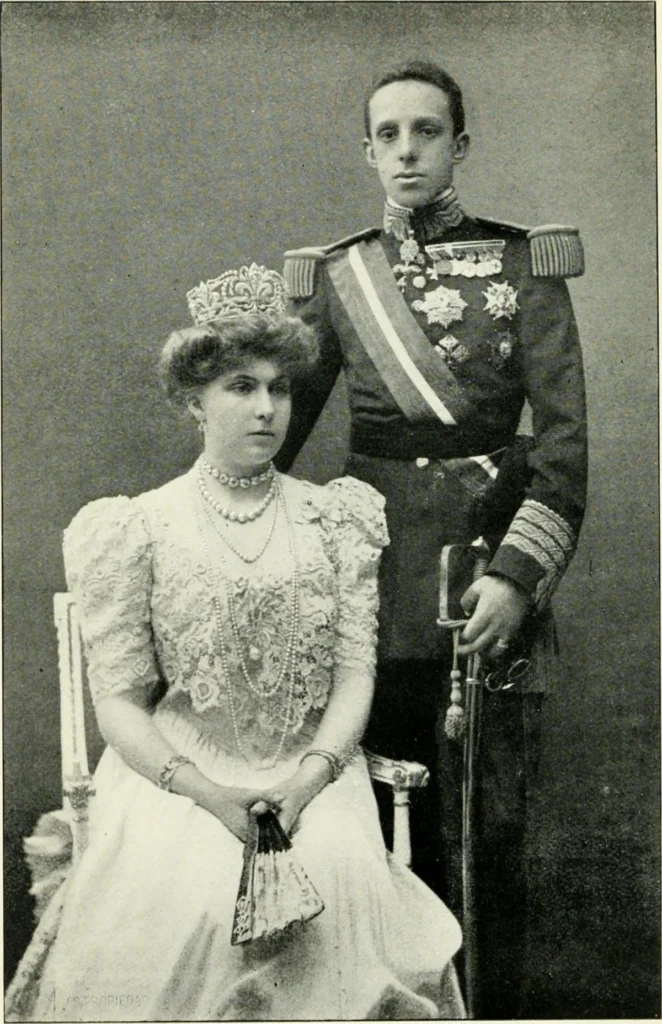

The imposing portrait of a queen, her gaze serene yet carrying the weight of history, cast a long shadow over King Felipe VI of Spain. This was not merely a royal ancestor, but Victoria Eugenie, his great-grandmother, a woman whose life story, marked by both splendor and profound tragedy, is now the subject of a significant new exhibition in Madrid. Her journey from a sheltered British princess to the Queen of Spain, her tumultuous reign, and her eventual exile, offers a compelling narrative of resilience and the often-unseen burdens of royalty, a tale that resonates even today as her great-grandson sits on the Spanish throne.
Born Princess Victoria Eugenie Julia Ena of Battenberg on October 24, 1887, at Balmoral Castle, she was the only daughter of Princess Beatrice, Queen Victoria’s youngest child, and Prince Henry of Battenberg. Her unusual given name, Ena, a mistaken transcription of "Eua," became the name by which she was most commonly known. Her early life was characterized by a degree of royal formality and proximity to her formidable grandmother, Queen Victoria, a constant presence that shaped her upbringing. This upbringing, while providing exposure to the highest echelons of European royalty, was also described as being "quiet and restrained to the point of suffocation," a stark contrast to the dramatic destiny that awaited her.
A Wedding Day Shrouded in Tragedy
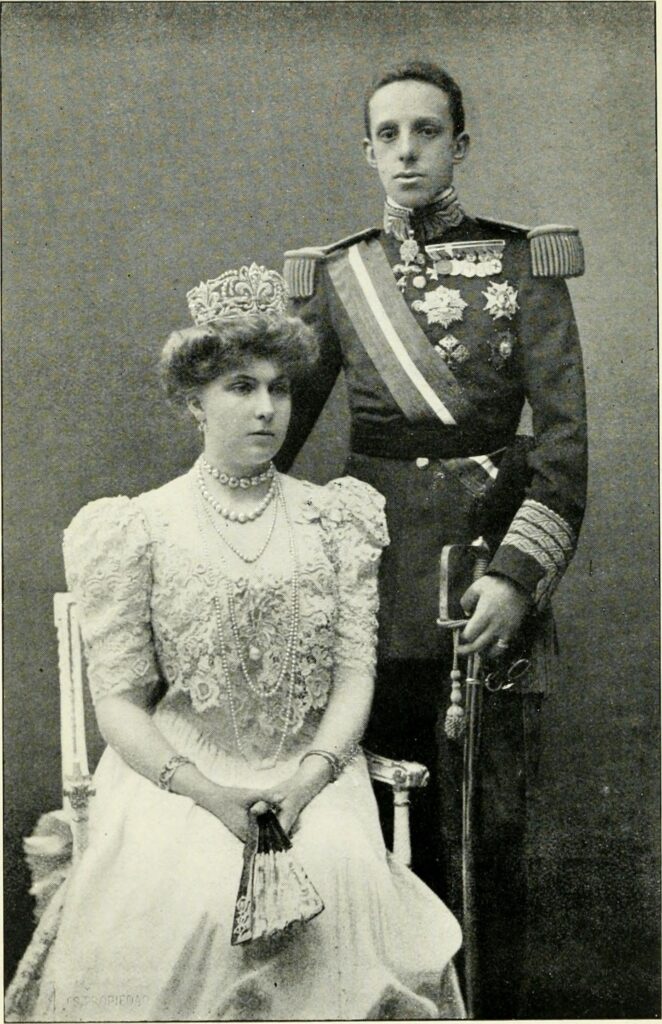
The most infamous episode of Victoria Eugenie’s life, and a stark premonition of the challenges ahead, occurred on her wedding day, May 21, 1906. As she exchanged vows with King Alfonso XIII of Spain at the Royal Monastery of San Jerónimo in Madrid, she transitioned from a princess to a queen. However, the celebratory procession back to the reception was brutally interrupted. An anarchist named Mateu Morral hurled a bomb at the royal carriage. While Alfonso XIII and Victoria Eugenie themselves miraculously escaped physical injury, the explosion claimed the lives of twenty-four people and wounded many more. This violent act, a stark manifestation of the political instability gripping Spain at the time, marked a deeply inauspicious start to their married life, a prelude to years of personal and political turmoil.
Early Life and Royal Connections
Victoria Eugenie’s lineage placed her at the nexus of European royalty. Her godmother was the exiled Empress Eugénie of France, a woman who had herself experienced the upheaval of losing a throne. This early connection to a figure who had known exile perhaps foreshadowed the path Victoria Eugenie would eventually tread. Her childhood was spent under the watchful eye of Queen Victoria, who had secured a promise from her daughter Beatrice that she would remain by her side. This meant that Princess Beatrice’s children, including Victoria Eugenie, were raised in close proximity to their royal matriarch, often at Windsor Castle or Osborne House.
The death of her father, Prince Henry of Battenberg, in 1896 during the Ashanti Wars in modern-day Ghana, further intensified her reliance on her female relatives. His brief military excursion, likely a quest for experiences beyond the confines of his family’s somewhat stifling environment, ended tragically with malaria. This desire for a more expansive life may have been a silent echo in Victoria Eugenie’s own choices years later, when she accepted the proposal of the King of Spain, a decision met with considerable opposition.
A Royal Romance and a Converted Faith
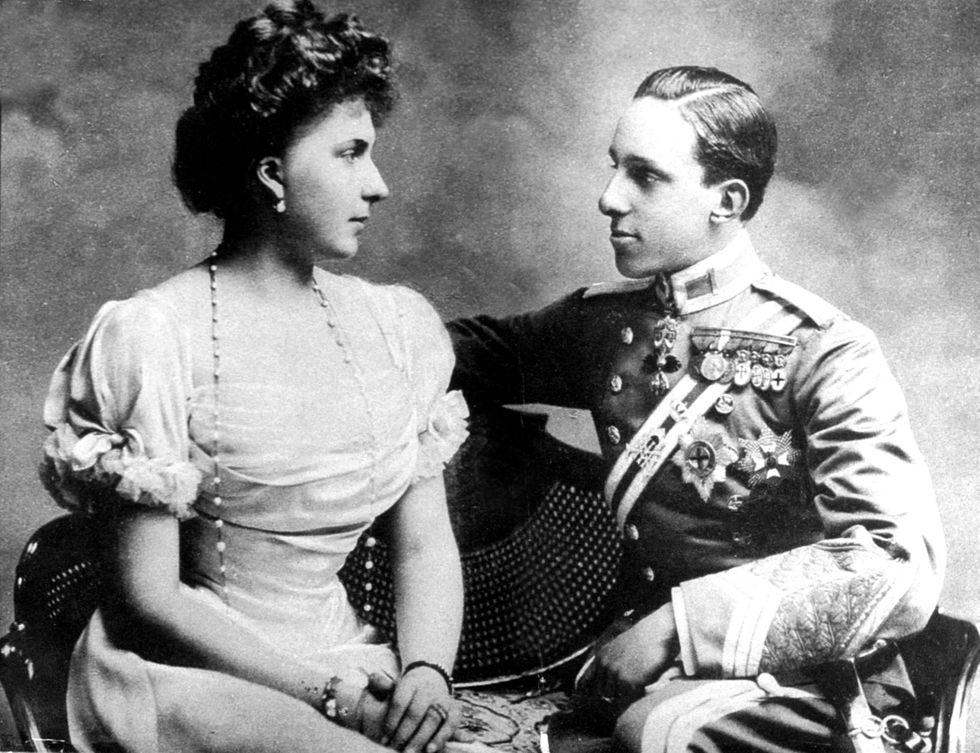
By the time Victoria Eugenie met Alfonso XIII in 1905, Queen Victoria had passed away. Her mother, Princess Beatrice, had embarked on a new phase of her life, dedicating herself to editing her mother’s journals. Victoria Eugenie, having lived a life of quiet duty, found herself captivated by the dashing Spanish monarch. Alfonso XIII, who had reigned as King of Spain since birth, was actively seeking a bride. During a visit to Britain, he was initially struck by Princess Patricia of Connaught, but she was understandably hesitant due to Spain’s political climate. Alfonso then turned his attentions to Victoria Eugenie, and she, weary of her sheltered existence, was swept away by his ardor and the prospect of a new life in a foreign land.
The union, however, was not without its challenges. Alfonso’s mother, Queen Maria Cristina, harbored reservations, preferring a match with a Habsburg princess to ensure a Catholic alliance. Victoria Eugenie, a Protestant, faced the significant hurdle of religious conversion. Despite objections from the Archbishop of Canterbury and concerns raised within England, King Edward VII, Victoria Eugenie’s uncle, lent his support, elevating her to the status of Her Royal Highness. In early 1906, she traveled to Spain, formally converted to Catholicism, and married Alfonso XIII, embarking on a new chapter as Queen of Spain.
The Shadow of Hemophilia and a Fractured Marriage
A more profound and tragic shadow loomed over the marriage: the potential for Victoria Eugenie to carry the gene for hemophilia, a hereditary blood-clotting disorder that primarily affects males. As a descendant of Queen Victoria, who was known to have passed the gene to some of her descendants, this was a known risk. The couple, after discussions, seemingly accepted it as a possibility and proceeded with the marriage. However, the reality of this genetic inheritance became tragically clear with the birth of their first son, Alfonso, in 1907, just a year after their wedding. The young Prince of Asturias was diagnosed with hemophilia, a devastating blow that fractured the affection between the king and queen. Alfonso XIII reportedly blamed his wife entirely for passing on this condition, marking a significant turning point in their relationship, which subsequently deteriorated.
Over the course of their marriage, they had eight children. Of their sons, Jaime suffered from deafness and health issues, while Gonzalo, like his elder brother Alfonso, inherited hemophilia. The burden of these hereditary conditions, coupled with the increasingly volatile political landscape of Spain, placed immense strain on Victoria Eugenie.
Political Turmoil and Exile
Victoria Eugenie’s reign coincided with a period of significant political instability in Spain. King Alfonso XIII’s support for unpopular wars aimed at maintaining Spanish possessions in Africa further eroded his popularity. In 1923, General Miguel Primo de Rivera seized power, establishing a dictatorship with the King’s backing. However, this regime eventually faltered, leading to de Rivera’s downfall in 1930. The monarchy’s standing plummeted, and when republican parties swept to victory in the general elections of April 1931, Alfonso XIII and his family were compelled to go into exile.
The move into exile marked a profound personal separation for the royal couple. Victoria Eugenie and Alfonso XIII largely lived separate lives. She spent much of her time in the United Kingdom and Switzerland, often seeking solace away from the Spanish court’s former grandeur. The personal tragedies continued to mount. In 1934, their youngest son, Gonzalo, died from hemorrhages following a minor car accident. Four years later, her eldest son, Alfonso, succumbed to similar circumstances. By the time Alfonso XIII died in 1941, the relationship between him and Victoria Eugenie was virtually non-existent. She spent the subsequent decades living a life of quiet dignity, marked by profound personal loss.

A Lasting Royal Connection
Despite her exile and personal sorrows, Victoria Eugenie maintained significant royal connections throughout her later life. She offered crucial support and counsel to Grace Kelly when she married Prince Rainier III of Monaco in 1956, assisting her in navigating the complexities of royal life. The Princess of Monaco held Queen Ena in such high esteem that she requested her to be godmother to their son, Prince Albert, in 1958.
Her influence extended even further. Victoria Eugenie, the last Queen of Spain, returned to her adopted country only once after her exile, in February 1968. During this visit, she fulfilled a significant familial role: acting as godmother to her great-grandson, Felipe. At that time, the monarchy had not yet been restored in Spain, but a poignant photograph from his baptism shows the infant Felipe nestled in Queen Ena’s arms. Seven years later, following the death of Francisco Franco, the monarchy was indeed restored, and Felipe ascended to the throne as King Felipe VI on June 19, 2014, upon the abdication of his father, King Juan Carlos I.
Final Resting Place and Enduring Legacy
Victoria Eugenie never witnessed the restoration of the monarchy she had once led. She passed away on April 15, 1969, precisely thirty-eight years after her flight from Spain. Her funeral was held in Lausanne, Switzerland, where she was initially buried. However, her story was not entirely concluded in exile. Six years after her death, the Spanish monarchy was reinstated. In 1985, her grandson, King Juan Carlos I, arranged for her remains to be transferred to the royal burial vault at El Escorial, near Madrid. There, she was interred alongside her husband and the three sons who predeceased her. Eight years later, her fourth son, Juan, was also laid to rest at El Escorial with the full honors befitting a King of Spain.
Victoria Eugenie, a princess of Battenberg who became the Queen of Spain, embodied a life far removed from the stability her grandmother, Queen Victoria, cherished. She reigned as Spain’s queen for twenty-five years but spent far longer in exile, enduring personal tragedies that were, at times, almost unbearable. Her life, from the dramatic assassination attempt on her wedding day to the genetic heartbreak of hemophilia and the political upheaval that led to exile, was a testament to her strength and resilience. She was not just a queen, but a woman who navigated a complex and often painful existence, leaving behind a legacy that continues to resonate within the Spanish monarchy and beyond. The exhibition in Madrid serves as a vital reminder of her profound impact and the compelling narrative of a life lived under the weight of a crown and the shadow of unforeseen adversity.