
By Tamara Khodova, May 22, 2026
Paweł Pawlikowski, a filmmaker whose name has become synonymous with poignant explorations of memory, trauma, and the enduring human spirit, returns to the prestigious Cannes Film Festival with "Fatherland." This latest offering, a concise and elegantly crafted drama, marks the culmination of an unofficial black-and-white trilogy that began with the haunting "Ida" in 2013 and continued with the critically acclaimed "Cold War" in 2018. After a seven-year hiatus from the Croisette, Pawlikowski re-emerges with a film that is both a deeply personal study of historical displacement and a searingly relevant commentary on the moral complexities of our current global landscape. Set against the fractured backdrop of 1949 Germany, a nation still reeling from the devastation of World War II and cleaved by the burgeoning Cold War, "Fatherland" delves into the fraught homecoming of Nobel laureate Thomas Mann.
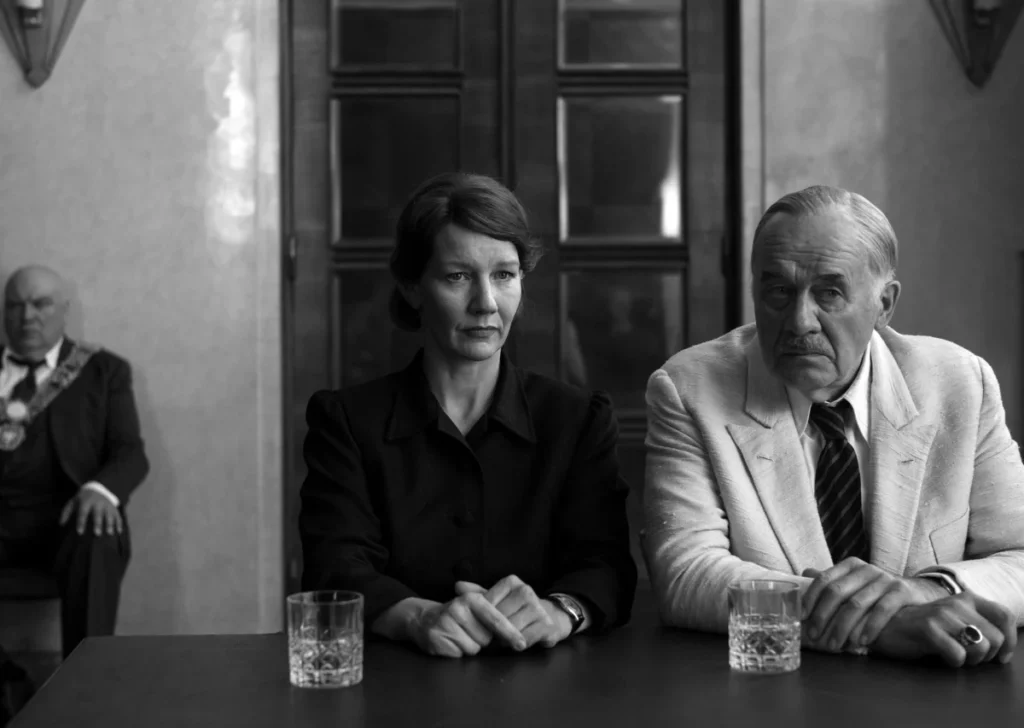
The narrative centers on Mann, portrayed with nuanced gravitas by Hanns Zischler, as he accepts an invitation to receive the prestigious Goethe Prize. This honor, however, comes with a complex itinerary, requiring him to attend ceremonies in both the American-occupied sector of Frankfurt and the Soviet-controlled city of Weimar. Accompanying him on this emotionally charged return to his homeland, after a sixteen-year exile in the United States, is his daughter and personal assistant, Erika. Their journey, fraught with the ghosts of the past and the political machinations of the present, serves as the film’s central axis, exposing the profound fissures within German society and the personal cost of ideological division.
A Legacy of Exile and Betrayal
The film opens with a revealing scene: Erika, played by the formidable Sandra Hüller, on the phone, attempting to persuade her brother, Klaus, to join their journey. This familial dynamic immediately introduces a fascinating layer of real-life history, drawing from the remarkably close and unconventional relationship between the Mann siblings. Thomas Mann’s children, particularly Klaus and Erika, were known for their intellectual prowess and their entanglement in bohemian and political circles. Their personal lives were marked by a unique arrangement of reciprocal "lavender marriages," where they married each other’s same-sex partners. Klaus’s former partner, Gustaf Gründgens, would go on to become a prominent actor in Nazi Germany, a figure who chose to remain and adapt to the regime, ultimately becoming the subject of Klaus’s searing indictment.
August Diehl, in a pivotal, albeit limited, role as Klaus Mann, imbues the character with a palpable sense of moral urgency. Through the interactions between father and son, Pawlikowski subtly juxtaposes their divergent responses to the darkest chapter of German history. While Thomas Mann, having formally condemned the Nazis in 1936 and continued his literary career abroad, chose a path of intellectual resistance from a distance, Klaus adopted a far more visceral approach. He enlisted and served on the front lines, bearing witness to the atrocities of the concentration camps firsthand. This personal confrontation with the horrors of Nazism profoundly shaped his worldview and his artistic output, particularly his seminal novel, "Mephisto," a thinly veiled critique of Gründgens’s opportunistic rise. The novel, initially banned for decades, stands as a testament to Klaus’s unwavering moral conviction and his refusal to sanitize the uncomfortable truths of collaboration.
Navigating the Rubble of a Divided Nation
Pawlikowski’s enduring fascination with societies in states of flux, in liminal spaces where established orders crumble and new ones are yet to solidify, finds its most potent canvas in post-war Germany. The nation, physically and psychologically scarred, becomes the ultimate backdrop for his outsider’s perspective. Mann arrives with a yearning to reconnect with his readership in his native tongue and to champion his vision of a "Good Germany." However, the homeland he left behind is irrevocably altered. Divided and occupied by the Allied powers, particularly the United States and the Soviet Union, Germany is now a battleground of competing political agendas. Mann’s idealistic pronouncements and his literary legacy hold little sway in this new geopolitical reality.
Instead, the revered author finds himself reduced to a symbolic figure, a political pawn paraded by both the Western and Eastern blocs to legitimize their respective regimes. The very readers he hoped to inspire are now divided, with those in the Soviet-controlled German Democratic Republic (GDR) often sending him venomous letters, outraged by his willingness to engage with the Eastern regime. This stark reality underscores the film’s profound exploration of national identity, the elusive nature of belonging, and the devastating consequences of ideological polarization. The film’s setting, 1949, is particularly significant. It marks a critical juncture in the post-war division, with the establishment of two separate German states – the Federal Republic of Germany (West Germany) and the German Democratic Republic (East Germany) – solidifying by 1949. This partitioning created a physical and ideological barrier that would define European geopolitics for decades to come.
Minimalism and Melancholy: A Sonic Landscape of Division
"Fatherland" showcases Pawlikowski at his most artistically restrained. By confining the action primarily to the formal, often austere, interiors of a broken country, he crafts a deceptively simple narrative that is nevertheless rich with submerged emotions and buried secrets. The stark ideological divide between the two Germanys is subtly but effectively conveyed through the film’s evocative soundscape. In the West, Pawlikowski regular Joanna Kulig delivers performances of playful cabaret songs, their lightheartedness serving as a potential counterpoint, or perhaps a desperate attempt to drown out, the nation’s collective guilt and unspoken traumas. Conversely, in the East, a children’s choir belts out utopian anthems, promising a future free from loss, a stark contrast to the lived reality of many.

These musical interludes are not mere aesthetic choices; they are narrative devices that underscore the film’s central themes. The West’s musical offerings, tinged with a certain defiance and perhaps a desperate gaiety, hint at an attempt to move forward, to outrun the past. The East’s children’s songs, while seemingly hopeful, carry an undertone of manufactured idealism, a forced optimism that belies the oppressive realities of Soviet control. This sonic dichotomy mirrors the visual and thematic divisions that Pawlikowski so masterfully presents.
A Tragic Relic in a Changing World
Ultimately, Thomas Mann emerges not as a triumphant figure ushering in a new era for Germany, but as a tragic relic of a bygone epoch. As an émigré who has personally navigated the complexities of living across multiple borders and ideological divides, Pawlikowski possesses a unique insight into the profound and often hollow ache of displacement. This feeling is palpable in Mann’s portrayal; he feels like an alien in every room, a stranger in his own land, realizing that his true "fatherland" now exists only in the fading realm of memory.
His yearning for a place of honor, to step onto a pedestal of national recognition, is constantly thwarted by the intrusive realities of the present. These intrusions take various forms, from the unsettling encounters with descendants of prominent figures like Richard Wagner, whose own legacies are entangled with German nationalism, to the chilling discovery of a Soviet political prison operating within the former Buchenwald concentration camp. This latter revelation is particularly potent, a stark reminder of how the ashes of one atrocity can become the foundation for another, highlighting the cyclical nature of power and oppression. The film’s setting in 1949 is also significant for the ongoing processes of denazification and reconstruction in West Germany, alongside the imposition of Soviet-style governance in the East, creating a deeply unstable and morally ambiguous environment.
A Mirror to Contemporary Divides
"Fatherland" transcends its historical setting to offer a remarkably piercing commentary on the very concepts of "homeland" and national identity in the 21st century. It dissects the painful chasm between those who fled and those who remained, capturing a society stripped bare of its moral compass. The film’s resonance with the present day is uncanny. Pawlikowski’s post-war Germany feels less like a historical lesson and more like a direct mirror held up to our own fractured world.
We witness a society divided: some individuals revel in the perceived opportunities presented by societal breakdown, others blindly pursue utopian futures, often at the expense of individual freedoms, while a few find solace in mourning a lost era, seeking refuge in bombed-out churches of their past. Yet, despite these disparate responses, these individuals are bound together by threads far stronger and more complex than they might realize. Much like Jonathan Glazer’s searing examination of complicity in "The Zone of Interest," Pawlikowski utilizes the trappings of the past to interrogate the present. "Fatherland" poses urgent questions to its modern audience, who find themselves, once again, standing at a historical crossroads, grappling with the resurgence of nationalism, the erosion of democratic norms, and the enduring challenge of forging a cohesive and ethical society from the ashes of division. The film’s success at Cannes 2026 is a testament to its timely and powerful message, solidifying Pawlikowski’s position as a master storyteller capable of illuminating the darkest corners of human experience and connecting them to our present anxieties.
Tamara’s Cannes 2026 Rating: 4 out of 5
Follow Tamara on Telegram – @shortfilm_aboutlove
Find more posts in: Cannes 26, Foreign Films, Review