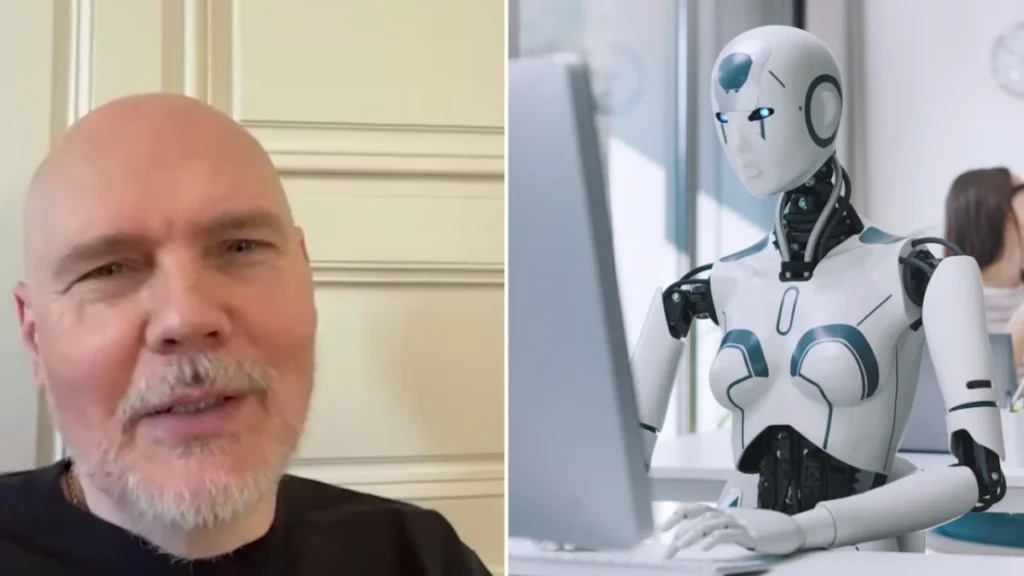

Billy Corgan, the enigmatic frontman of The Smashing Pumpkins, has offered a stark and politically charged assessment of humanity’s future, pinpointing advanced robotics and artificial intelligence (AI) as far greater threats than extraterrestrial life. During a Wednesday, May 20th interview on KROQ’s Klein Ally Show, Corgan articulated a provocative theory regarding the U.S. government’s foreknowledge of impending widespread job displacement and its alleged strategies to mitigate potential societal unrest through universal basic income (UBI) and cannabis legalization. This candid discussion emerged as Corgan promoted the band’s recently announced 30th-anniversary tour for their seminal double album, Mellon Collie and the Infinite Sadness, adding a layer of existential commentary to the celebratory occasion.
The Alien vs. Robot Conundrum
The interview segment, dubbed “epic questions” by host Kevin Klein, presented Corgan with a fundamental query: "Are you more concerned for our future because of aliens or robots?" Corgan’s response was immediate and unequivocal, demonstrating a profound dismissal of the alien threat in favor of a deep-seated apprehension about technological advancement.
Dispelling the Alien Threat
Corgan’s perspective on aliens was characterized by a pragmatic, almost fatalistic logic. "If the supposition is there are aliens . . . and there have been aliens, well, if they wanted to take us over, they would have done it a long time ago. Or they could take us over at any time," he posited. This line of reasoning suggests that if an advanced alien civilization possessed the capacity for interstellar travel and conquest, their inaction thus far implies either a lack of interest in humanity or a power dynamic so overwhelmingly skewed that our concern is negligible. He further elaborated, "That’s like worrying about an alien stomping on a bug," illustrating his view that humanity’s existence would be inconsequential to such beings. This perspective, while perhaps unconventional, effectively sidestepped the popular cultural narratives of alien invasion to focus on more terrestrial, yet equally transformative, challenges.
The Inevitable March of Automation
In stark contrast to his dismissal of aliens, Corgan expressed profound concern over the societal impact of robots. His primary worry centered on the working class, articulating a fear that automation is already beginning to dismantle the foundational economic structures that have supported generations. "I think the havoc it’s going to wreak is on the working class," Corgan asserted. He continued, "I think you already see it. It won’t be long where those jobs that used to support the middle class, like people in my family – the people I grew up with – those jobs are just not going to be there."
This observation resonates with widespread economic anxieties concerning automation. Studies from organizations like the McKinsey Global Institute have consistently highlighted that automation and AI could displace millions of jobs across various sectors, particularly in manufacturing, transportation, and administrative support roles. While these technologies often create new jobs, the transition can be disruptive, leading to skill gaps and economic hardship for those whose traditional occupations become obsolete. Corgan’s concern for the "middle class" jobs, often the bedrock of economic stability for many families, reflects a growing apprehension about the future of work in an increasingly automated world.
A Controversial Government Hypothesis
Corgan then delved deeper, proposing a controversial theory regarding the federal government’s awareness and strategic response to this impending technological upheaval. His hypothesis suggested a calculated, if cynical, approach to managing societal change.
Universal Basic Income as a Pacifier?
According to Corgan, the government has been aware "for a while" that robotics would "take over a lot of the workforce." His evidence for this assertion lay in the burgeoning discussion around Universal Basic Income (UBI). UBI, a concept where all citizens receive a regular, unconditional income from the government, has gained traction in recent years as a potential solution to poverty, income inequality, and, significantly, technological unemployment. Proponents argue it could provide a safety net, stimulate local economies, and empower individuals to pursue education or entrepreneurship. Pilot programs have been trialed in various locations, from Finland to Stockton, California, yielding mixed but often promising results regarding recipients’ well-being and economic stability.
However, Corgan views the government’s exploration of UBI not as a benevolent social safety net, but as a preemptive measure to prevent civil unrest. "Why would you start floating out paying people to stay home and not work?" he questioned. "The only reason you would float that out is because you know they’re going to need something to do and not be out in the streets rioting asking for jobs." This interpretation casts UBI as a form of societal pacification, a means to keep a displaced workforce quiescent rather than a genuine effort to empower citizens.
Cannabis Legalization: A Distraction Tactic?
In a further twist to his theory, Corgan linked the widespread trend of cannabis legalization to the government’s strategy for managing an underemployed populace. He posited, "which is also why they passed pot legalization, because they just want people to stay home and play video games." This argument connects two seemingly disparate policy trends – economic welfare and drug reform – under a single, overarching narrative of social control.
The reality of cannabis legalization is, of course, far more complex and multifaceted. States that have legalized recreational cannabis often cite reasons such as generating significant tax revenue, reducing crime rates by undermining the illicit market, freeing up law enforcement resources, and addressing historical injustices related to drug convictions. Public opinion has also shifted dramatically, with a majority of Americans now supporting legalization. While Corgan’s theory introduces a novel, albeit cynical, interpretation, it largely overlooks the diverse economic, social justice, and public health motivations that have driven the reform movement. Nevertheless, his provocative linkage forces a re-evaluation of commonly accepted policy rationales. Corgan encouraged listeners to "check that quote in 30 years," underscoring his conviction in this long-term governmental strategy.
The Evolving Threat: From Robots to AI
As the conversation progressed, Corgan refined his concerns, pivoting from a general apprehension about "robots" to a specific focus on Artificial Intelligence (AI) as the "real havoc wreaker." This distinction is crucial, as it acknowledges the rapid evolution of technological capabilities. While robotics primarily concerns physical automation and the replacement of manual labor, AI delves into the realm of cognitive automation, replicating and often surpassing human intellectual tasks.
"Honestly, the question you should ask," Corgan posited, "is should we be more scared of AI or robotics? Because really AI is going to be the real havoc wreaker here." This statement reflects a growing sentiment among technologists and futurists that AI, with its potential for autonomous decision-making, creative generation, and complex problem-solving, poses a more profound and systemic challenge to human society than mere robotic automation. The rapid advancements in generative AI, large language models, and machine learning are already demonstrating capabilities that were once considered exclusively human domains.
AI’s Disruptive Force in the Music Industry
The music industry provides a particularly poignant example of AI’s disruptive potential, a field intimately familiar to Corgan. Less than two years prior to his interview, a study conducted in December 2024 projected that musicians could lose almost a quarter of their income – approximately 25% – by 2028 due to AI. This alarming forecast underscores the direct economic threat AI poses to creative professionals.
Further cementing this concern, Spotify and Universal Music Group (UMG) recently announced a deal in May 2026 to create AI-generated cover songs and remixes. This collaboration signals a significant step towards the mainstream integration of AI into music production and distribution, raising critical questions about copyright, fair compensation, and the very definition of artistic originality. While AI tools can offer new avenues for creativity and efficiency, their unchecked proliferation risks devaluing human artistry and shifting economic power further towards technology platforms rather than creators. Musicians and industry bodies are actively grappling with these challenges, advocating for regulations that protect artists’ rights and ensure ethical AI development. Organizations like the Recording Academy and various artist unions are engaging in ongoing discussions with policymakers and tech companies to establish frameworks that allow for innovation without undermining human talent.
The Smashing Pumpkins’ Enduring Legacy and Upcoming Tour
Amidst these weighty technological and societal concerns, Corgan remains deeply engaged with his primary artistic endeavor: The Smashing Pumpkins. The KROQ interview served, in part, as a promotional platform for the band’s significant upcoming activities, highlighting their enduring relevance in the alternative rock landscape.
Celebrating a Landmark Album
The band announced "The Rats in a Cage Tour," a North American trek celebrating the 30th anniversary of their magnum opus, Mellon Collie and the Infinite Sadness. Released in 1995, Mellon Collie was a sprawling double album that cemented The Smashing Pumpkins’ status as one of the most ambitious and influential bands of their era. Critically acclaimed and commercially successful, it featured a diverse range of sounds, from epic rock anthems like "Bullet with Butterfly Wings" to delicate ballads such as "Tonight, Tonight," showcasing Corgan’s distinct lyrical prowess and the band’s dynamic musicality. The album remains a touchstone for a generation of music fans, and its 30th anniversary tour is a testament to its lasting impact. The tour is set to kick off in the fall of 2026, with stops planned in major cities across North America, including Boston, Brooklyn, Chicago, and Los Angeles. Tickets went on sale Thursday, May 21st, 2026, at 10:00 a.m. local time, available through Ticketmaster and resale platforms like StubHub, offering fans the opportunity to relive the album’s iconic sound.
A Return to Collaborations and New Material
In addition to the extensive tour, The Smashing Pumpkins are slated to perform at Lollapalooza in July 2026, a festival where they have a long and storied history. Corgan also revealed exciting news for fans regarding new music: the band has reunited with famed rock producer Butch Vig for a forthcoming song. Vig, a legendary figure in alternative music, was behind the board for the making of The Smashing Pumpkins’ critically acclaimed 1993 album, Siamese Dream, as well as Nirvana’s Nevermind. His collaboration with the band on Siamese Dream is widely considered to have produced some of their most iconic and sonically rich material. The prospect of Vig and Corgan working together again has generated considerable anticipation, promising a return to a potent creative synergy. The new song is expected to be released later in 2026, further signaling the band’s continued artistic vitality.
Broader Societal Implications and Expert Dialogue
Corgan’s unvarnished observations about robots, AI, and governmental responses tap into a broader global dialogue that extends far beyond the music industry. His concerns about job displacement are echoed by economists and sociologists who forecast significant shifts in labor markets. While some experts predict a net gain in jobs through automation, others warn of increasing income inequality and the need for massive retraining initiatives to equip workers with new skills for an AI-driven economy. The World Economic Forum, for example, regularly publishes reports on the future of work, highlighting the need for proactive policy-making and educational reforms to navigate these transformations.
The debate around Universal Basic Income is also intensifying, with various political ideologies finding common ground, albeit for different reasons. Libertarians might see it as a way to simplify welfare systems, while progressives view it as a tool for social justice. Governments worldwide are indeed exploring various forms of basic income or similar social safety nets, not necessarily as a "pacifier" in Corgan’s sense, but as a potential mechanism to ensure economic stability in an uncertain future. These discussions are complex, involving considerations of fiscal sustainability, work incentives, and societal values.
Corgan’s call to distinguish between the threats of robotics and AI underscores a critical point for public discourse. AI, particularly generative AI, is not just about automating existing tasks but about creating new forms of content and decision-making capabilities that challenge established norms in law, ethics, and creativity. The music industry’s grapple with AI-generated content is merely a microcosm of a larger societal reckoning that is underway across sectors from healthcare to finance. The ethical implications of AI, including bias in algorithms, data privacy, and accountability for autonomous systems, are subjects of intense academic and policy debate.
Conclusion: A Call for Future Reflection
Billy Corgan’s interview on KROQ served as more than just a promotional stop for The Smashing Pumpkins’ upcoming tour and music. It offered a raw, unfiltered glimpse into the mind of an artist deeply concerned with the trajectory of human civilization in the face of rapid technological advancement. His predictions, while delivered with a characteristic deadpan wit and a touch of conspiracy, align with many of the anxieties and debates currently shaping our global discourse. Whether one agrees with his specific theories on government motivations, his core message—that robots and, more acutely, AI, will fundamentally reshape the future of work and society—is a sentiment increasingly echoed by experts across various fields. As humanity hurtles towards an ever more automated and intelligent future, Corgan’s challenge to "check that quote in 30 years" serves as a poignant call for reflection and proactive engagement with the profound implications of our technological progress. The music legend, it seems, continues to provide not just anthems for a generation, but also challenging questions for the future.
The Smashing Pumpkins’ 2026 Tour Dates:
07/31 – Chicago, IL @ Lollapalooza
09/30 – Columbus, OH @ The Schottenstein Center
10/02 – Boston, MA @ TD Garden
10/03 – Baltimore, MD @ CFG Bank Arena
10/04 – Brooklyn, NY @ Barclays Center
10/06 – Pittsburgh, PA @ PPG Paints Arena
10/07 – Hamilton, ON @ TD Coliseum
10/09 – Montréal, QC @ Centre Bell
10/11 – Madison, WI @ Kohl Center
10/13 – Saint Paul, MN @ Grand Casino Arena
10/14 – Chicago, IL @ United Center
10/16 – Charlotte, NC @ Spectrum Center
10/17 – Jacksonville, FL @ VyStar Veterans Memorial Arena
10/18 – Tampa, FL @ Benchmark International Arena
10/20 – Indianapolis, IN @ Gainbridge Fieldhouse
10/22 – Nashville, TN @ The Truth
10/24 – Oklahoma City, OK @ Paycom Center
10/25 – Austin, TX @ Moody Center
10/27 – Denver, CO @ Ball Arena
10/29 – Salt Lake City, UT @ Delta Center
10/30 – Las Vegas, NV @ MGM Grand Garden Arena
11/01 – Portland, OR @ Moda Center
11/03 – Calgary, AB @ Scotiabank Saddledome
11/05 – Vancouver, BC @ Rogers Arena
11/06 – Seattle, WA @ Climate Pledge Arena
11/08 – San Jose, CA @ SAP Center
11/11 – Phoenix, AZ @ Mortgage Matchup Center
11/12 – Inglewood, CA @ Kia Forum
11/14 – Huntington Beach, CA @ Darker Waves