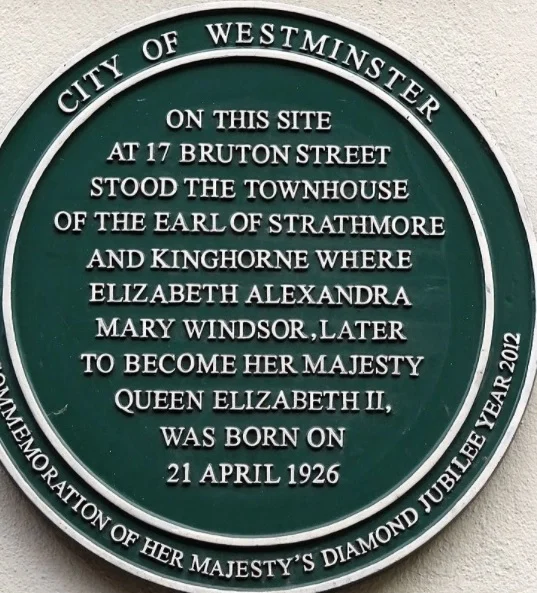

The centennial anniversary of the birth of Queen Elizabeth II, the longest-reigning monarch in British history, prompts a fascinating reflection not only on her extraordinary reign but also on the humble, and indeed rather unexpected, origins of her royal journey. While one might envision a future sovereign entering the world within the hallowed walls of a royal palace, the story of Elizabeth Alexandra Mary Windsor began in a decidedly more domestic setting: a London townhouse at Number 17, Bruton Street, Mayfair. This unassuming address, now a bustling restaurant, stands as a quiet testament to the fact that destiny, even for those born into privilege, can unfold in the most ordinary of circumstances.
A Royal Residence, A Family Home
In the early 1920s, Number 17 Bruton Street served as the London residence of Claude George Bowes-Lyon, the 14th Earl of Strathmore and Kinghorne, and his wife, Cecilia Bowes-Lyon. The Earl and Countess were a prominent aristocratic family, and their townhouse in the fashionable Mayfair district was a hub of social activity. This address held a particular significance for the family even before the birth of the future Queen. In April 1923, their youngest daughter, Lady Elizabeth Bowes-Lyon, famously departed from this very townhouse, clad in her bridal attire, to marry Prince Albert, Duke of York, the second son of King George V. This union, a union of considerable public interest, would irrevocably alter the course of British royal history.
It was within this same family home, nearly three years to the day after her mother’s wedding, that the future Queen Elizabeth II entered the world. Her mother, the then-Duchess of York, had followed a common practice for expectant mothers of the era: returning to her maternal home for the birth of her first child. The Duchess and her husband were residing at Number 17 Bruton Street at the time. On April 21st, 1926, at 2:40 am, a baby girl was delivered via Caesarean section. This infant, Elizabeth Alexandra Mary, was third in line to the throne at birth, a position that offered little indication of the monumental reign that lay ahead. The prospect of her ascending the throne seemed remote, a distant possibility overshadowed by her uncle, Edward VIII, and her father. History, however, had a different plan.
The Dawn of a Royal Obsession
The birth of Princess Elizabeth, though not initially seen as a direct heir to the throne, still generated considerable public interest. Weeks after her arrival, photographs captured the infant princess being carried out of Number 17 Bruton Street by her nanny, with her proud mother walking alongside, her joy evident. This early public fascination with a royal baby underscores a timeless aspect of public sentiment: the enduring appeal of royal nurseries and the lives of royal infants. The media, eager for any glimpse of the newest member of the royal family, maintained a vigil outside the Bruton Street address, awaiting photographic opportunities of the young Princess Elizabeth. This early media attention foreshadowed the intense public scrutiny that would define much of her life.
The significance of Number 17 Bruton Street as the birthplace of a future monarch is now commemorated by a plaque. This marker was installed during the celebrations for Queen Elizabeth II’s Diamond Jubilee, a poignant acknowledgment of the building’s place in the annals of royal history. Today, the former townhouse has been transformed into Hakkasan, a renowned Michelin-starred Chinese restaurant, a testament to the dynamic evolution of London’s urban landscape and the enduring presence of history within its modern facade.
A Timeline of Royal Beginnings
- April 26, 1923: Lady Elizabeth Bowes-Lyon marries Prince Albert, Duke of York, departing from 17 Bruton Street.
- April 21, 1926: Princess Elizabeth Alexandra Mary is born at 2:40 am via Caesarean section at 17 Bruton Street, Mayfair, London. She is third in line to the throne.
- May 1926: Photographs of the infant Princess Elizabeth being carried out of 17 Bruton Street gain public attention.
- December 1936: Following the abdication of Edward VIII, Prince Albert becomes King George VI, making Princess Elizabeth the heir presumptive.
- February 6, 1952: Queen Elizabeth II ascends to the throne upon the death of her father, King George VI.
- June 2, 1953: Queen Elizabeth II is crowned at Westminster Abbey.
- September 9, 2015: Queen Elizabeth II becomes the longest-reigning monarch in British history, surpassing her great-great-grandmother Queen Victoria.
- July 2026 (hypothetical): Commemoration of the 100th anniversary of Queen Elizabeth II’s birth.
Supporting Data and Context
The birth of Queen Elizabeth II occurred during a period of significant societal change in Britain. The 1920s, often referred to as the "Roaring Twenties," was an era marked by post-World War I optimism, burgeoning jazz culture, and evolving social norms. While aristocratic families like the Bowes-Lyons remained figures of immense influence and tradition, the seeds of modernity were being sown. The choice of a townhouse over a royal palace for the birth reflected a certain domesticity that, while perhaps unusual for a direct heir, underscored the personal life of the royal family away from the public gaze.
The fact that Queen Elizabeth II was born third in line to the throne is a crucial piece of historical context. The immediate heir was her uncle, Edward VIII. The line of succession was clearly defined, and the prospect of Elizabeth’s reign was considered a distant one. Her father, the Duke of York, was not expected to inherit the crown. However, the abdication crisis of 1936, when Edward VIII chose to abdicate to marry Wallis Simpson, a twice-divorced American socialite, dramatically altered the trajectory of the monarchy. This unprecedented event propelled Elizabeth’s father to the throne as King George VI, making his elder daughter, Elizabeth, the heir presumptive.
The Broader Impact and Implications
The story of Queen Elizabeth II’s birth at 17 Bruton Street offers a valuable perspective on the nature of royalty. It demystifies the origins of even the most enduring monarchies, highlighting that behind the grand titles and palaces lie human lives, family homes, and the unpredictable hand of fate. This relatable aspect of her beginning likely contributed to the deep affection and connection the public felt with Queen Elizabeth II throughout her reign. Her life, from its unassuming start to its unprecedented longevity on the throne, became a narrative of duty, resilience, and unwavering service.
The contrast between her birth in a London townhouse and her seventy-year reign, marked by immense global change and technological advancement, is striking. It serves as a reminder that the foundations of power and influence can be laid in quiet, domestic settings, far from the grand pronouncements and public ceremonies that often define monarchy. The plaque at 17 Bruton Street stands as a permanent testament to this improbable beginning, a subtle but significant marker in the grand tapestry of British royal history, reminding us that sometimes, the most extraordinary destinies begin in the most ordinary of places. The enduring legacy of Queen Elizabeth II is not only defined by her unwavering commitment to her role but also by the simple, human story of her birth.