
The life of Muhammad Ali is often reduced to the thunderous applause of arenas and the bright lights of championship bouts, yet the narrative of the three-time heavyweight champion is perhaps most poignantly captured within the walls of the homes he inhabited. Long before he was an international icon, Ali’s trajectory was forged in the modest streets of Louisville, Kentucky. His entrance into the sport of boxing was serendipitous, beginning with the theft of a bicycle when he was twelve years old. The police officer to whom he reported the crime, Joe Martin, operated a local boxing gym; that singular interaction launched a career that would redefine global sports and civil rights activism.

From Cassius Clay to Global Icon: A Chronological Overview
Born Cassius Marcellus Clay Jr. on January 17, 1942, the young athlete rose to international prominence in 1960 by winning an Olympic gold medal in Rome. However, his most transformative period arrived in 1964, when he stunned the world by defeating Sonny Liston to secure his first heavyweight title. It was during this pivotal year that he announced his conversion to the Nation of Islam and subsequently changed his name to Muhammad Ali. This decision, while polarizing to the American public at the time, signaled a shift in his identity that would define his legacy as a vocal proponent of racial pride and religious freedom.
The following years were marked by both professional triumphs and significant political turbulence. In 1967, Ali reached a critical juncture when he refused induction into the United States Army on the grounds of his religious beliefs as a conscientious objector during the Vietnam War. The federal government’s reaction was immediate and severe: he was stripped of his heavyweight title, his boxing license was revoked in every state, and he faced a lengthy legal battle that eventually reached the Supreme Court. During this period of forced exile from the ring, the private life of the champion became a sanctuary from the public vitriol directed toward his political stances.

Domestic Life as a Mirror of History
Archival photographs of Ali during his years in Chicago provide a rare glimpse into the man behind the myth. Following his marriage to his second wife, Khalilah Camacho-Ali, in August 1967, the couple resided in a single-story brick house in the Avalon Park neighborhood of Chicago. The home, which was a gift from the Nation of Islam, served as the epicenter of his personal life during his exile. It was here that he spent his days reading, studying the teachings of Elijah Muhammad, and navigating the complexities of his new faith while awaiting the resolution of his legal challenges.
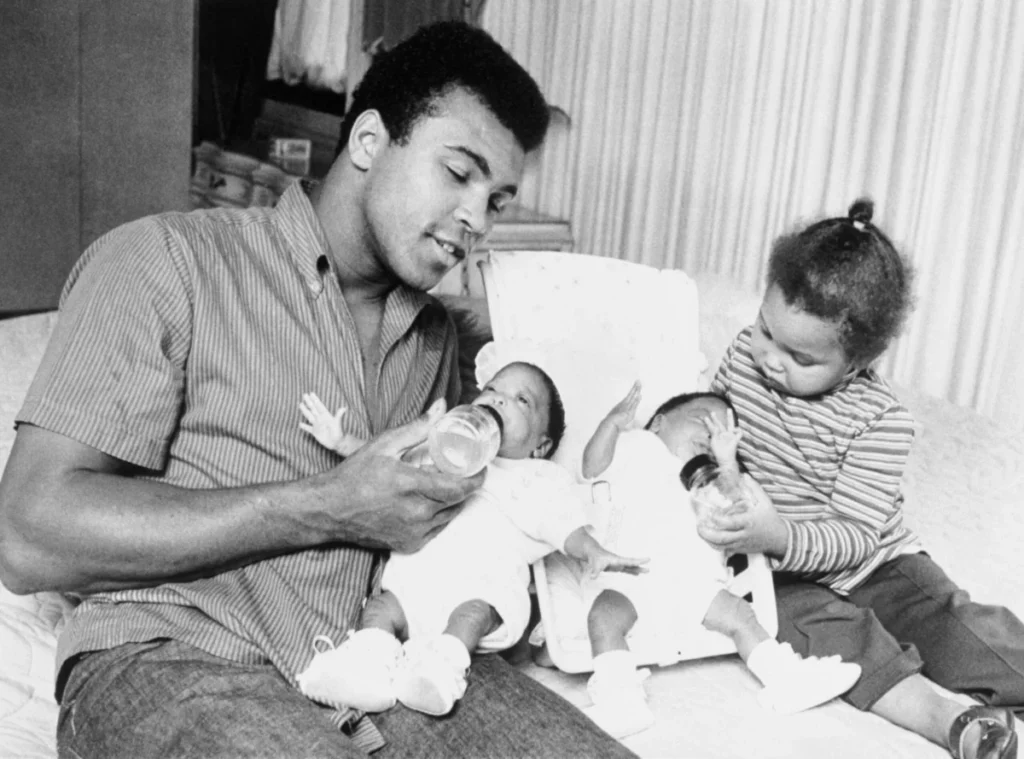
By 1970, the family had relocated to the Overbrook Park neighborhood in West Philadelphia. It was a period of domestic transition, characterized by images of the champion—once known for his aggressive, dancing footwork in the ring—cradling his newborn twins, Rasheda and Jamillah, while his eldest daughter, Maryum, watched on. This property, which would later be purchased by the grandparents of basketball icon Kobe Bryant, remains a historical touchstone in the narrative of Philadelphia’s sporting heritage.

The Legacy of Fighter’s Heaven
Perhaps no structure is as synonymous with the discipline of Muhammad Ali as his Pennsylvania training camp, known as Fighter’s Heaven. Following the 1971 Supreme Court ruling that overturned his draft-evasion conviction, Ali sought a space where he could train in solitude while remaining connected to his fans. He purchased the Deer Lake property in 1972, meticulously designing a complex that included a log-cabin gym, a dining hall, and a private mosque.
Fighter’s Heaven was more than just a training facility; it was an open-door institution. Ali famously invited fans to watch his training sessions, fostering an accessibility that was rare for an athlete of his stature. The camp became a pilgrimage site, reflecting his desire to remain grounded even as his fame reached stratospheric levels. After his retirement, the camp was sold in 1997 to martial arts instructor George Dillman and has since been preserved as a museum, ensuring that the site of his most rigorous training remains a testament to his work ethic.

The Los Angeles Years and the Onset of Parkinson’s
As the 1970s bled into the 1980s, Ali’s professional career entered its twilight. In 1979, he purchased a sprawling 14,500-square-foot Italian Renaissance mansion in Hancock Park, Los Angeles. Designed in 1916 by architect John C. Austin, the estate was a far cry from the modest brick homes of his early days. It featured seven bedrooms, Tiffany-designed stained-glass windows, and a formal dining room that underscored his transition into a life of global celebrity and relative luxury.
It was during this time that the first physical symptoms of Parkinson’s disease began to manifest. Despite the decline in his athletic ability, Ali continued to challenge himself, notably returning to the ring in 1980 to fight Larry Holmes. The loss, followed by a final professional defeat against Trevor Berbick in 1981, marked the definitive end of his career. At the time of his retirement, Ali displayed a reflective maturity, stating, "I’m happy. I’m still pretty. I could have a black eye. Broken teeth. Split lips. I think I came out all right for an old man."

Humanitarian Impact and Final Chapter
Following his official retirement, Ali’s life was defined by his transition from the ring to the global stage as a humanitarian. His marriage to his fourth wife, Lonnie Williams, provided a foundation of stability as his health declined. Lonnie, who would later become his primary caregiver and advocate, was instrumental in managing the public image and private care of the champion following his 1984 diagnosis.
The couple eventually settled in Paradise Valley, Arizona, where they spent his final decades. This era was marked by significant recognition for his lifelong commitment to social justice. In 2005, Ali was awarded the Presidential Medal of Freedom, the highest civilian honor in the United States, and in 2012, he received the Liberty Medal. These honors served to contextualize his legacy: he was no longer just the "Louisville Lip" who had won Olympic gold; he was an elder statesman whose life had been dedicated to the pursuit of equality and peace.

Analysis: The Evolution of a Cultural Icon
The trajectory of Muhammad Ali’s life, when examined through his residential history, reveals a man in constant dialogue with his environment. From the modest, community-focused dwellings in Chicago to the expansive, storied estate in Los Angeles and the quiet, reflective landscape of Arizona, each home was a stage for a different chapter of his evolution.
Statistically, the impact of Ali’s career is undeniable. He retired with a professional record of 56 wins and 5 losses, with 37 knockouts. However, his influence extends far beyond these figures. The breadth of his civil rights activism—including his opposition to the Vietnam War and his role as a global ambassador for Islam—created a blueprint for modern athlete activism. Economists and historians have noted that Ali’s brand was among the first of its kind, transcending the sport of boxing to influence fashion, music, and social politics.

The release of the Prime Video series The Greatest serves as a modern catalyst for re-examining these archival moments. By looking back at the photographs of Ali in his "off-duty" hours, we see the domesticity that balanced his public persona. Whether he was reading a book by Elijah Muhammad in his Chicago living room or eating cereal in his opulent Los Angeles dining hall, these images capture the vulnerability and humanity of a man who was frequently forced to be a symbol of strength and defiance.
Ultimately, the story of Muhammad Ali is one of profound endurance. His battle with Parkinson’s disease for over three decades brought a different kind of public scrutiny, one that he met with grace and a commitment to helping others. His passing in 2016 at the age of 74 concluded a life that had fundamentally altered the social landscape of the 20th century. While he was known to the world as "The Greatest," the intimate history of his homes suggests that his greatest achievement may have been the consistency of his character across the various stages of his life.