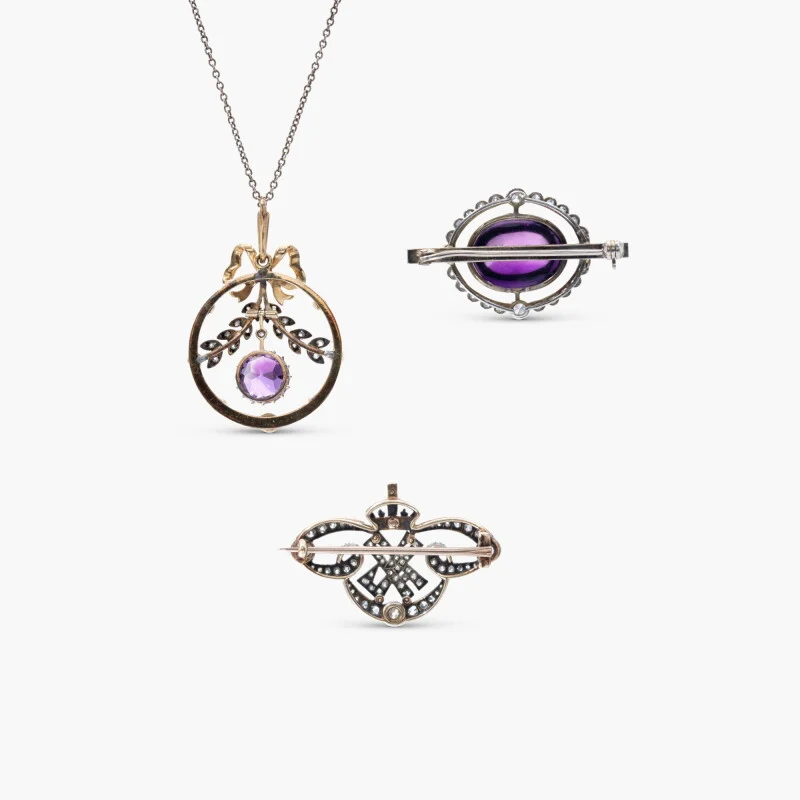

A magnificent three-piece suite of diamonds and amethysts, historically gifted by Queen Maud of Norway to her devoted lady-in-waiting, Marie Fougner, is set to go under the hammer. The exquisite ensemble, steeped in Scandinavian and British royal provenance, forms part of an upcoming high-profile auction at Sotheby’s in Geneva, scheduled for November 11. Known for dealing in the most exclusive pieces of historical and aristocratic jewelry, the auction house has positioned this lot as a fascinating window into the personal relationships, gift-giving traditions, and political alliances of early 20th-century European royalty.
The offering includes an ornate oval brooch featuring a large, vibrant amethyst encircled by a glittering frame of smaller diamonds, alongside a matching pendant. The pendant showcases a central amethyst set delicately within a diamond-crafted laurel wreath—a classical symbol of victory, honor, and enduring legacy. Adding an even higher tier of regal prestige to the suite is a third, distinct component: a diamond-set brooch bearing the royal cypher of King Edward VII and Queen Alexandra, the British monarchs who were Queen Maud’s parents.
Estimated to fetch between 6,000 and 8,000 Swiss francs, the modest pre-sale estimate belies the immense historical value and deeply personal narrative attached to the jewels. The suite offers experts, historians, and collectors alike a rare opportunity to acquire items that trace back to the interconnected dynastic networks of Europe during an era of profound geopolitical transition.
A Legacy Rooted in British and Norwegian Royalty
To fully understand the significance of the amethyst suite, one must examine the life and lineage of Queen Maud of Norway. Born Princess Maud of Wales on November 26, 1869, at Marlborough House in London, she was the youngest daughter of the future King Edward VII and Queen Alexandra of the United Kingdom. As a granddaughter of Queen Victoria, Maud grew up at the absolute zenith of the British Empire, surrounded by immense wealth, dynastic influence, and the highest tiers of European aristocracy.
In July 1896, Maud married her first cousin, Prince Carl of Denmark. For the first decade of their marriage, they lived a relatively quiet life in Denmark, where Carl served as an officer in the Danish Navy. However, the winds of geopolitical change swept them onto a grander stage in 1905. Following the dissolution of the union between Norway and Sweden, the Norwegian government offered the vacant throne of the newly independent nation to Prince Carl.
Accepting the crown, Carl took the regal name Haakon VII, while Maud became Queen of Norway. Her coronation alongside King Haakon VII took place at Nidaros Cathedral in Trondheim on June 22, 1906. As Queen, Maud was known for her elegance, her deep affection for her adopted homeland, and her commitment to charitable causes and the arts. Despite her regal status, she maintained a strong connection to her British roots, frequently traveling back to the United Kingdom throughout her life.
It was within this elite court environment that Marie Fougner served as a lady-in-waiting. Ladies-in-waiting were far more than mere employees; they were trusted companions, confidantes, and essential components of a queen’s daily household. Gifting bespoke jewelry to such individuals was a common practice among European sovereigns to express deep gratitude, mark significant milestones, or honor long-standing loyalty. The presentation of the amethyst and diamond suite to Fougner underscores the personal warmth and appreciation Queen Maud held for her companion.
The November 11 Geneva Auction: Context and Highlights
The upcoming Sotheby’s auction in Geneva is shaping up to be a landmark event for collectors of aristocratic and royal provenance. Scheduled for November 11, the catalogue brings together a breathtaking collection of jewels that have passed through the hands of Europe’s most storied dynasties.
Alongside the Norwegian royal suite, the auction features an array of extraordinary pieces, including jewels that once belonged to Amalia, the last Queen of Portugal. Queen Amalia of Portugal, born Princess Amélie of Orléans, was a prominent figure of the late 19th and early 20th centuries, known for her patronage of the arts and social welfare before the Portuguese monarchy was overthrown in the 1910 revolution. The inclusion of pieces from her estate, paired with the Queen Maud items, highlights Sotheby’s strategy of curating sales that appeal to serious historians and museum-grade collectors.
However, the auction has also found itself at the center of unexpected controversy and intense media scrutiny, particularly surrounding another lot of jewels originating from the estate of the late Princess Birgitta of Sweden.

Dynastic Friction: The Swedish Royal Estate Controversy
While the inclusion of Queen Maud’s amethyst suite has been met with widespread enthusiasm, the presence of jewelry from the estate of Princess Birgitta of Sweden has sparked significant debate in Scandinavian media outlets.
Princess Birgitta, who passed away recently, was the sister of the reigning King Carl XVI Gustaf of Sweden. Reports emerging from Swedish media indicate that King Carl XVI Gustaf and other members of the Swedish royal family may have been entirely unaware that members of Birgitta’s immediate family or estate executors intended to liquidate these historic pieces.
The controversy is compounded by the fact that many of the jewels in question carry deep sentimental and historical links to the king’s mother, Princess Sybilla, and his grandmother, Crown Princess Margaret. Crown Princess Margaret, born a British princess as a granddaughter of Queen Victoria, brought a vast collection of invaluable heirlooms into the Swedish royal house upon her marriage to the future King Gustaf VI Adolf in 1905. The potential dispersion of these pieces outside the direct royal line has raised questions regarding heritage preservation, family protocol, and the management of royal estates.
While representatives for the auction house and the various consignors have operated within legal frameworks, the situation underscores the delicate balance between private property rights and national or dynastic heritage. Observers note that situations like this often prompt reigning monarchs to consider stepping in as bidders to repatriate items of profound familial importance, though whether King Carl XVI Gustaf will officially register to bid at the Geneva auction remains unconfirmed.
An Analysis of the Market for Royal Provenance
The market for royal and aristocratic jewelry remains exceptionally robust, driven by a global pool of ultra-high-net-worth individuals, institutional buyers, and private collectors who view such items as tangible pieces of history. Unlike contemporary designer jewelry, pieces tied to specific historical figures carry a narrative weight that significantly enhances their intrinsic value.
The valuation of Queen Maud’s amethyst suite—set conservatively between 6,000 and 8,000 Swiss francs—reflects the materials used (amethysts and diamonds set in period mounts) rather than a multi-million-dollar royal price tag typically associated with state crown jewels. Amethysts, while treasured for their deep purple hues and favored by royalty throughout the Victorian and Edwardian eras, are semi-precious stones, which keeps the starting estimate accessible compared to top-tier rubies, emeralds, or flawless diamonds.
Nevertheless, experts suggest that pieces with verifiable, intimate provenances—such as a direct gift from a queen to her lady-in-waiting, complete with parental royal cyphers—frequently outperform their pre-sale estimates. Collectors are increasingly drawn to the human stories behind the gems. The fact that this suite bridges the British royal family (via King Edward VII and Queen Alexandra) and the Norwegian crown (via Queen Maud) adds layers of appeal that will likely attract competitive bidding on the auction floor.
Broader Implications and Outlook
As the November 11 auction date approaches, attention in the international jewelry and royal watching communities is locked firmly on Geneva. The sale serves as a reminder of the fluid nature of royal possessions, which often transition from private royal vaults into the open market through inheritance, estate settlements, or financial restructuring.
For historians, the event provides a rare, albeit bittersweet, opportunity to study and document pieces that might otherwise remain hidden away in private collections. For the market, it represents another benchmark in the valuation of early 20th-century aristocratic treasures.
Whether the amethyst suite surpasses its estimated range will depend on the appetite of the room, but its journey from the jewelry boxes of a Norwegian queen to the display cases of Sotheby’s ensures that the legacy of Queen Maud and her devoted lady-in-waiting, Marie Fougner, will endure on the global stage.