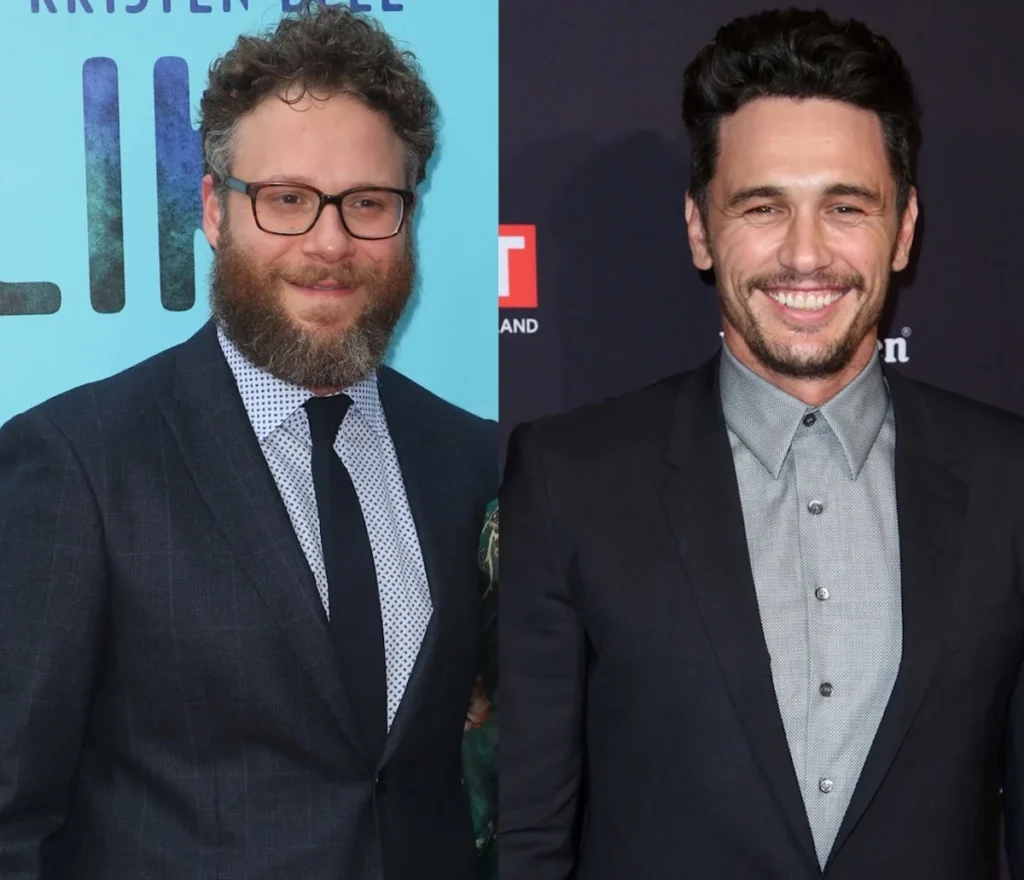

Hollywood veteran Seth Rogen has unequivocally stated that a professional reunion with his former long-time collaborator and friend, James Franco, is not on the horizon, confirming a definitive and enduring separation that has marked a significant chapter in both actors’ careers. In a recent interview with the New York Times, Rogen made it clear that despite their shared history and the once-inseparable bond that defined a popular era of comedy, their personal and professional paths remain divergent, with no prospect of reconciliation. This pronouncement solidifies a stance Rogen has maintained for several years, following a series of sexual misconduct allegations that surfaced against Franco in 2018.
The Genesis of a Dynamic Duo: A Shared Ascent in Hollywood
The partnership between Seth Rogen and James Franco began at the turn of the millennium, blossoming from the set of Judd Apatow’s critically acclaimed but short-lived television series, Freaks and Geeks (1999-2000). Rogen played the awkward Ken Miller, while Franco portrayed the charismatic, often troubled Daniel Desario. This initial collaboration laid the groundwork for a professional and personal friendship that would soon become one of Hollywood’s most recognizable comedic pairings. Their chemistry, characterized by a blend of irreverent humor and genuine camaraderie, quickly resonated with audiences and industry insiders alike.
Following Freaks and Geeks, their careers intersected repeatedly, often under the mentorship of Apatow, who became a crucial figure in shaping a new wave of comedy that Rogen and Franco prominently fronted. Their first major big-screen collaboration was Pineapple Express (2008), a stoner action-comedy that showcased their unique dynamic – Rogen as the endearing slacker Dale Denton and Franco as the eccentric drug dealer Saul Silver. The film was a critical and commercial success, grossing over $100 million worldwide on a modest budget and firmly establishing their brand of humor. This success paved the way for more ambitious projects.
The duo further cemented their status with films like This Is the End (2013), a darkly comedic apocalyptic fantasy where they played fictionalized versions of themselves alongside a star-studded cast including Jonah Hill, Michael Cera, and Danny McBride. The film, which they co-wrote and co-directed (Rogen with Evan Goldberg), was lauded for its originality and humor, earning over $126 million globally. Their collaborative efforts also extended to animated features, such as Sausage Party (2016), an R-rated animated comedy that pushed boundaries and received positive reviews, though Franco’s involvement was primarily vocal.
Perhaps their most ambitious and critically acclaimed joint project was The Disaster Artist (2017). Franco directed and starred as Tommy Wiseau, the enigmatic filmmaker behind the cult classic The Room, with Rogen playing Sandy Schklair, the film’s script supervisor. The Disaster Artist was a significant departure from their usual comedic fare, offering a more nuanced and dramatic portrayal of Wiseau’s creative process. Franco’s performance earned him a Golden Globe Award for Best Actor, and the film garnered an Academy Award nomination for Best Adapted Screenplay, marking a career high point for their collaboration just before the allegations against Franco emerged. Through these projects, Rogen and Franco built an undeniable "comedy empire," becoming synonymous with a certain brand of intelligent, often raunchy, and deeply character-driven humor that resonated deeply with a generation of filmgoers.
The Turning Point: Allegations and Accountability in the #MeToo Era
The landscape of Hollywood underwent a seismic shift in late 2017 with the emergence of the #MeToo movement, which brought widespread attention to issues of sexual harassment and abuse across various industries. It was against this backdrop that James Franco’s career took a dramatic turn. In January 2018, just after his Golden Globe win for The Disaster Artist, multiple women publicly accused Franco of sexually inappropriate behavior. The Los Angeles Times published a detailed report featuring statements from five women, including former acting students, who described a pattern of exploitation and misconduct by Franco, often in professional or educational settings. These allegations included claims of pressuring students into sexual acts, removing protective guards during simulated sex scenes, and creating an uncomfortable and exploitative environment.
Initially, Franco denied the allegations, stating on The Late Show with Stephen Colbert that the claims were "not accurate" but that he supported the women speaking out. However, the controversy escalated, leading to a significant downturn in his public image and career prospects. In October 2019, two of his former acting students, Sarah Tither-Kaplan and Toni Gaal, filed a class-action lawsuit against Franco and his business partners, alleging fraud and sexual exploitation. The lawsuit claimed that Franco "engaged in a widespread pattern of harassment and sexual exploitation at the schools he founded."
The legal battle culminated in July 2021 when Franco agreed to a settlement of more than $2 million to resolve the lawsuit. Court records indicated that while Franco maintained the allegations were false, he agreed to the settlement to avoid the "cost and distraction of continued litigation." This resolution marked a critical moment, acknowledging the validity of the claims through a financial agreement, even without an admission of guilt.
Seth Rogen’s Evolving Public Stance
Throughout the initial stages of the allegations, Seth Rogen found himself in a difficult position. As Franco’s most prominent and frequent collaborator, Rogen was inevitably questioned about the situation. His initial responses were cautious, reflecting the complexity of his personal relationship with Franco. However, as the allegations gained traction and the #MeToo movement continued to expose systemic issues, Rogen’s stance evolved.
In a candid interview with The Sunday Times in May 2021, Rogen publicly addressed the allegations and his relationship with Franco with unprecedented directness. He expressed regret for a 2018 interview where he had stated he would continue to work with Franco, acknowledging that his initial comments had caused pain to others. "What I can say is that I despise abuse and harassment and I would never cover up the actions of someone doing it, or knowingly put anyone in a situation where they were around someone doing that," Rogen told the publication. He confirmed that their professional relationship had indeed ceased, stating, "I look back at that and go, ‘Oh, I didn’t at the time say what I should have said and I wasn’t really prepared to talk about it.’ … I do look back at that interview in 2018 where I comment on it and I just didn’t have the clarity of thought at the time. I was just talking and I said something that was stupid."
Rogen further clarified the personal toll the situation had taken, emphasizing the difficulty of navigating such a public and painful issue involving a close friend. "It is not a coincidence that I have not worked with James Franco, and I do not plan to right now. … I don’t know if I can define that, but I think what I can say is that it is not a coincidence that I have not worked with James Franco, and I do not plan to right now." These 2021 statements were a clear indication that the allegations had irrevocably fractured their professional partnership and deeply impacted their personal friendship.
James Franco’s Acknowledgment and Reflection
While Rogen was grappling with his public stance, James Franco also eventually broke his silence on the allegations and the subsequent breakdown of his friendships and career. In a December 2021 interview on The Jess Cagle Podcast, Franco addressed the allegations, his past behavior, and his struggles with addiction. He admitted to having sex with students in the past, acknowledging a problematic power dynamic. "In my position, I was in a power position. I did not want to hurt people. I did not want to be the person who was taking advantage of people," Franco stated, adding, "But I did, and I wasn’t aware of it at the time."
Franco also spoke directly about the end of his friendship with Seth Rogen, expressing understanding for Rogen’s decision to distance himself. "He was asked about me, and I just don’t want Seth or anyone else to have to answer for me anymore," Franco said. "Because I don’t want to embarrass them. And I don’t want them to have any awkwardness at all." He revealed that he had been in recovery for sex addiction and had been working on himself for several years, recognizing the need for personal accountability and change. Franco’s statements, while coming several years after the initial allegations, marked a public admission of problematic behavior and a visible attempt at taking responsibility for the consequences, including the professional and personal estrangement from Rogen.
The Latest Confirmation: Rogen’s Definitive Stance
The recent New York Times interview published on Saturday further solidifies the finality of the split between Rogen and Franco. When pressed on the topic, Rogen reiterated his unwavering position, leaving no room for ambiguity regarding a potential future collaboration or reconciliation. He stated, "I honestly think the nuance of it is too personal for me to get into right now. It is a very personal thing. There’s the public-facing side of it, which I’ve spoken about, and I have the same stance publicly that I’ve had, and I think the proof is in the pudding — I have not worked with him in years."
This statement is significant for several reasons. Firstly, Rogen explicitly acknowledges the "personal" nature of the rift, suggesting complexities beyond the public allegations that he is not comfortable discussing. This discretion hints at deeper layers of pain or disagreement that have solidified the separation. Secondly, by invoking "the proof is in the pudding," he points to the concrete reality of their non-collaboration for a sustained period as the ultimate evidence of their fractured relationship. Finally, his follow-up, "Nothing has changed since the last time I talked about all this. I haven’t worked with him in a really long time and I have no plans to," serves as a definitive closure. It dismisses any lingering speculation about a possible future reunion, professional or otherwise. The finality of "no plans to" underscores an absolute boundary.
Broader Implications for Hollywood Partnerships and Accountability
The enduring rift between Seth Rogen and James Franco serves as a stark case study in the evolving dynamics of Hollywood partnerships in the era of heightened accountability. The #MeToo movement has profoundly reshaped how the industry addresses allegations of misconduct, compelling individuals and institutions to re-evaluate their associations and commitments. For Rogen, maintaining his professional distance from Franco is not merely a personal choice but also a strategic one, aligning with broader industry expectations for ethical conduct and a stance against abuse.
The implications extend beyond the two individuals. The Rogen-Franco split highlights the difficult decisions actors, producers, and studios now face when long-standing collaborations become entangled in personal controversies. It underscores a shift from a culture of quiet tolerance or protection to one demanding public acknowledgment and, often, separation from those implicated in serious misconduct. This situation also reflects the pressure on public figures to take a stand, as silence or continued association can be perceived as complicity. For Rogen, a beloved figure known for his affable public persona, severing ties was crucial for maintaining his own integrity and public trust.
Furthermore, the case illustrates the potential for "cancel culture" (or rather, accountability culture) to permanently alter career trajectories, particularly for those accused of misconduct. While Franco has attempted a gradual return to independent film projects and stage work, his path back to mainstream Hollywood prominence remains highly challenging. The definitive nature of Rogen’s latest comments signals that, at least from the perspective of one of his most important past collaborators, the door to their shared professional world is firmly shut.
The Future for Rogen and Franco: Divergent Paths
Since the allegations and the subsequent breakdown of their partnership, Seth Rogen and James Franco have embarked on significantly different career paths. Seth Rogen has continued to flourish, both as an actor and a highly successful producer and director through his company, Point Grey Pictures, which he co-founded with Evan Goldberg. He has starred in acclaimed television series like Pam & Tommy (2022) and Platonic (2023), lent his voice to animated hits such as Teenage Mutant Ninja Turtles: Mutant Mayhem (2023), and continued to produce a steady stream of films and shows. His career trajectory has remained robust and largely untainted by the controversy surrounding his former partner.
James Franco, on the other hand, has faced a much more arduous road. Following the 2018 allegations and the 2021 settlement, his mainstream acting career effectively stalled. He retreated from the public eye for a period, focusing on teaching and working on independent, smaller-scale projects that have received limited distribution and public attention. While he has expressed a desire to return to acting and directing, the industry’s cautious approach to figures implicated in #MeToo controversies means that significant roles in major studio productions remain elusive. His attempts at a comeback are slow and deliberate, highlighting the lasting impact of the allegations on his professional standing.
The once inseparable duo, who together crafted some of the most memorable comedies of their generation, now stand as a testament to how personal conduct can irrevocably alter professional destinies. For fans who fondly remember their iconic run through Freaks and Geeks, Pineapple Express, and The Disaster Artist, Rogen’s latest update serves as a poignant reminder that some Hollywood partnerships, no matter how successful or celebrated, simply do not get a sequel. The chapter of Seth Rogen and James Franco’s collaborative “empire” appears to be definitively closed, reflecting both personal decisions and the broader, evolving ethical standards within the entertainment industry.