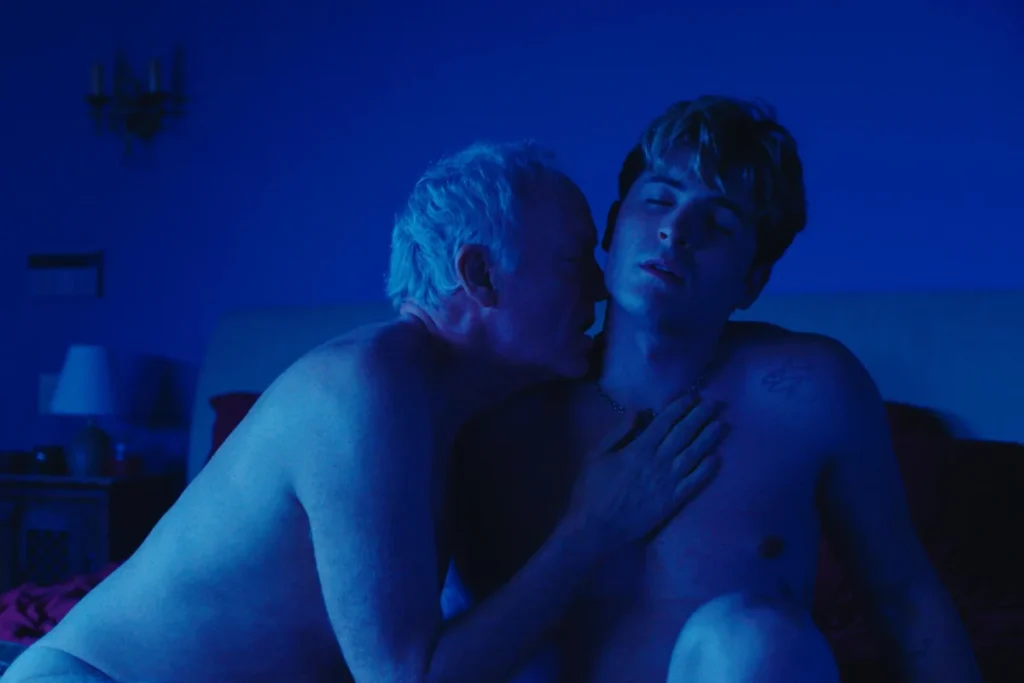

At 71 years old, the veteran character actor Reed Birney finds himself at an unprecedented career juncture, navigating the tempestuous waters of critical acclaim and intense controversy surrounding his lead role in Elliot Tuttle’s debut feature, Blue Film. This independent production, crafted on a shoestring budget of under $100,000, has thrust Birney into the spotlight, not just for a performance critics are hailing as a career-best, but for its unflinching and deeply unsettling exploration of a subject rarely tackled with such raw honesty in American cinema.
A Challenging Narrative Unfolds
Blue Film centers on Hank Grant, a former middle-school English teacher who served seven years in prison for attempting to sexually assault one of his students. The narrative opens with Hank hiring an adult sex worker, Aaron Eagle (portrayed by Kieron Moore), who, unbeknownst to Aaron, was once one of Hank’s students, Alex, over a decade prior. This meticulously engineered encounter serves as Hank’s desperate attempt to confess his past feelings for Alex, explain his actions, and confront the aftermath of his devastating impact. What ensues is a profoundly discomfiting and emotionally charged exploration of intimacy, trauma, and the complex, troubled origins of their student-teacher bond. The film’s stark realism offers a portrait of a pedophile that deviates significantly from conventional cinematic portrayals, delving into the psychological depths of a man grappling with shame, regret, and a warped sense of humanity.
Birney’s performance as Hank Grant has been universally lauded for its fearlessness and profound commitment. Known for his extensive work on Broadway, including a Tony Award for The Humans, and memorable, albeit smaller, roles in television series such as House of Cards, The Blacklist, and Gossip Girl, Birney here commands the screen with a singular intensity. His portrayal avoids simplistic villainy, instead plumbing the depths of a character many would deem irredeemably monstrous, unearthing an uneasy genuineness beneath layers of sorrow and self-loathing. This is the kind of transformative work that would, under different circumstances, place an actor of Birney’s caliber squarely in the awards conversation. However, the film’s intensely disturbing subject matter has proven to be a significant barrier, overshadowing the artistic merit of the performances and Tuttle’s directorial vision.
Birney’s Deep Collaboration and Personal Investment
Beyond his acting duties, Birney also served as an executive producer on Blue Film, a role that cemented his profound emotional and creative investment in the project. "I have such a huge emotional investment in the movie, not only because I am playing this difficult role and I feel it’s the best film work I’ve ever done, but I also really collaborated with Elliot on it," Birney shared, highlighting several months spent working alongside director Elliot Tuttle on the script. This deep collaboration suggests a shared artistic vision, a commitment to exploring uncomfortable truths, and a deliberate decision to tackle the narrative with sensitivity and psychological realism, rather than sensationalism. Such close involvement from a seasoned actor like Birney underscores the project’s artistic ambition and the conviction of its creators.
A Tumultuous Journey to Release: A Timeline of Controversy
The path to public exhibition for Blue Film was fraught with challenges, illustrating the inherent difficulties faced by independent cinema, particularly those that push the boundaries of conventional storytelling.

- 2024: Principal photography for Blue Film commenced. The swift, low-budget production allowed for a focused and intense shooting schedule.
- Late 2024 – Early 2025: Post-production was completed, and the film began its submissions to various film festivals globally.
- Mid-2025: The film faced numerous rejections from prominent film festivals, which Birney attributes to its divisive and "radioactive" subject matter, even before a single public screening. This period highlighted the industry’s apprehension towards its controversial themes.
- Summer 2025: Blue Film finally secured its world premiere at the Edinburgh Film Festival, where it debuted to significant critical acclaim, particularly for Birney’s performance, but also ignited fervent debate among attendees.
- October 2025: The Hollywood Reporter published its review, praising the film’s visceral impact, noting it "crawls directly under the skin, burrowing deep and drawing blood," while simultaneously acknowledging its ongoing struggle to secure distribution, three months post-premiere.
- Early 2026: Obscured Releasing, a nascent distributor specializing in independent and often challenging cinema, stepped forward to acquire the film, recognizing its artistic merit despite its commercial risks.
- May 2026: Blue Film received a limited theatrical release in select cinemas, primarily in arthouse venues, allowing a small but dedicated audience to experience it on the big screen.
- June 2026: The film became available for rental and purchase on various digital platforms, expanding its reach to a broader audience who might not have access to its limited theatrical run.
Birney admits his surprise at the intensity of the film’s reception. "I guess I’m not as smart as I think I am, but I wasn’t prepared for the divisiveness, honestly," he confessed. His personal interpretation of Hank Grant as a "sad and broken man," rather than a "monster" or "manipulator," stands in stark contrast to how many viewers perceive the character, underscoring the subjective and deeply personal nature of cinematic interpretation, especially when dealing with such sensitive material.
Audience Reactions and the Dilemma of Interpretation
The divisiveness surrounding Blue Film extends beyond festival committees and industry gatekeepers, permeating deeply into audience reactions. Birney has closely monitored online discussions and attended several screenings, observing a wide spectrum of responses. On one end, viewers have lauded the film for its bold provocations, feeling seen by its unflinching portrayal of complex human darkness and recognizing the value in its artistic courage. These audiences often appreciate the film’s attempt to humanize, not condone, a figure of profound moral ambiguity, prompting difficult but necessary conversations about the nature of evil, trauma, and potential for change or understanding.
On the other end, a significant portion of the audience has vehemently condemned the film, arguing that its existence is "irresponsible" and that such a story should never have been told. These reactions are often rooted in personal experiences with trauma or sexual abuse, for which the film’s subject matter is simply too loaded and triggering. As Birney insightfully notes, "You meet the movie where you can, and so if you’ve had trauma or sexual abuse, you’re not going to be generous towards Hank. You’re just not. You can’t be. It’s too loaded." This highlights a critical ethical dilemma in art: the tension between artistic freedom to explore challenging themes and the potential for re-traumatization for vulnerable audiences.
A secondary, unexpected issue has emerged for Birney: the blurring of lines between actor and character. Because he is not a widely recognized celebrity, many viewers’ first exposure to him is through Blue Film. This lack of pre-existing public persona makes it difficult for some to separate Birney, the actor, from Hank Grant, the character. "Because I’m not famous and this feels like a fair amount of people’s first exposure to me, they’re not able to separate the performance from the character – which in a weird way is a compliment, I guess, that I was able to accomplish something in that I am in fact acting," he muses. This phenomenon, while a testament to his immersive performance, poses a unique challenge for an actor whose craft is to embody characters, not become them.
A Career Defined by Perseverance and Challenging Roles
Reed Birney’s journey in the entertainment industry is a testament to perseverance, resilience, and a consistent gravitation towards complex, often polarizing material. His stage career in New York commenced in the 1970s, steadily building a reputation for nuanced performances. However, his early forays into film were marked by a series of near-misses and significant setbacks.
His apparent film breakthrough arrived in 1981 with Arthur Penn’s dramedy Four Friends. Birney, playing a disabled, dying college student, generated considerable Oscar buzz pre-release. Despite critical admiration for his work, the film ultimately flopped commercially, dampening the momentum. His next significant feature role didn’t materialize for another four years, in 1985’s Crimewave, a horror-comedy co-written by the Coen Brothers and directed by Sam Raimi, two filmmakers who would later become giants in the industry. Birney even secured the lead role. However, studio interference from Embassy Pictures, which wrested control from Raimi after a notoriously difficult shoot, led the director to disavow the final cut. "That failed too," Birney recalls ruefully, adding, "Anyway, that was my big starring thing. And then my film career went into a weird non-existence."
Indeed, Birney did not appear in another movie for a grueling 13 years, returning in 1998 as "Merchant Prince #1" in A Perfect Murder, a thriller starring Michael Douglas and Gwyneth Paltrow. "All that’s in the movie is the back of my head at a poker table," he laughs, acknowledging the stark reality of his film career trajectory. "I thought, ‘Oh wow, it didn’t work out – that’s a pity.’ As I’m telling you this story, it seems like I have really had a cursed film career."

His fortunes began to shift dramatically in his mid-50s with the 2008 Off-Broadway revival of Sarah Kane’s audacious and brutal play Blasted. In a significant departure from his usually affable persona, Birney was cast as a bigoted and predatory tabloid writer. Initially, he was shocked by the offer, finding it "all wrong" and comparing it to being asked to play Stanley Kowalski. Yet, his performance garnered rave reviews, solidifying his stature within the New York theater community after decades of strong, consistent work. This breakthrough led to a string of acclaimed Broadway roles, culminating in his 2016 Tony Award for Best Featured Actor in a Play for his performance in Stephen Karam’s The Humans.
This theatrical resurgence coincided with a renewed interest from the film industry. While he was notably recast with Richard Jenkins for the 2021 screen adaptation of The Humans, Birney continued to secure significant roles, earning a Gotham Award nomination for his searing work in the equally uncompromising 2021 drama Mass. In Mass, he played one of two sets of parents meeting years after a deadly school shooting, a role that further demonstrated his capacity for navigating emotionally charged and morally complex narratives.
Broader Implications: Artistic Freedom, Ageism, and the "Hot Potato" of Challenging Cinema
Birney’s career trajectory illuminates several key aspects of the entertainment industry: the relentless nature of setbacks, the importance of patience for plum roles, and the distinct advantage of being unafraid to tackle challenging and polarizing material. He defies the conventional wisdom that roles diminish in complexity and prominence as actors age. "I want to play rich, complicated people who are maybe at a crossroads – it’s weird to be at a crossroads at my age, but certainly we are," he states. While acknowledging that his film career has largely consisted of supporting roles, Blue Film has provided him with the opportunity to "carry a movie," a gratifying experience he hopes other industry professionals will recognize. However, he remains realistic about the scarcity of such opportunities for a 71-year-old man, expressing a desire to be "in the middle of the story instead of on the side of the story."
Blue Film itself exists as an "arthouse hot-potato," a term that perfectly encapsulates its niche appeal and limited embrace. Birney’s pride in the project is palpable, yet he understands its complex nature as a starring vehicle. "It’s the biggest thing that’s ever happened to me professionally, but it may be just a blip somewhere," he reflects.
He draws a poignant comparison to Call Me by Your Name, another critically acclaimed film that, in his view, also features a pedophilic relationship but was largely embraced for its aesthetic beauty and romanticized portrayal. "That movie is also about a pedophile, which nobody seemed to care about at the time," Birney observes. "I sat there thinking, ‘This is so wrong,’ but everybody’s like, ‘It’s so beautiful!’" This comparison highlights a significant double standard in how cinema treats controversial themes, suggesting that presentation and aesthetic framing can dramatically alter public and critical reception, sometimes overlooking core ethical dilemmas. Blue Film, with its gritty, claustrophobic realism and lack of beautification, offers no such easy entry point for the viewer, forcing an uncomfortable confrontation with the darker corners of humanity.
In a landscape where radical cinema struggles more than ever to secure funding, distribution, and an audience, Blue Film‘s very existence and the ongoing conversation surrounding it represent a substantial victory. "It’s already done so much more than it ever should have – look, a $50,000 movie about a pedophile should never have been seen by anybody, honestly," Birney concludes. He holds firm in his belief that the film’s unique quality, beautiful craftsmanship, and intelligence will ensure its enduring impact. For Reed Birney, if Blue Film marks the biggest and last big part of his singular career, it is, by his own admission, "not so bad, either." It stands as a testament to an actor’s courage and an uncompromising vision in an industry often resistant to challenging truths.