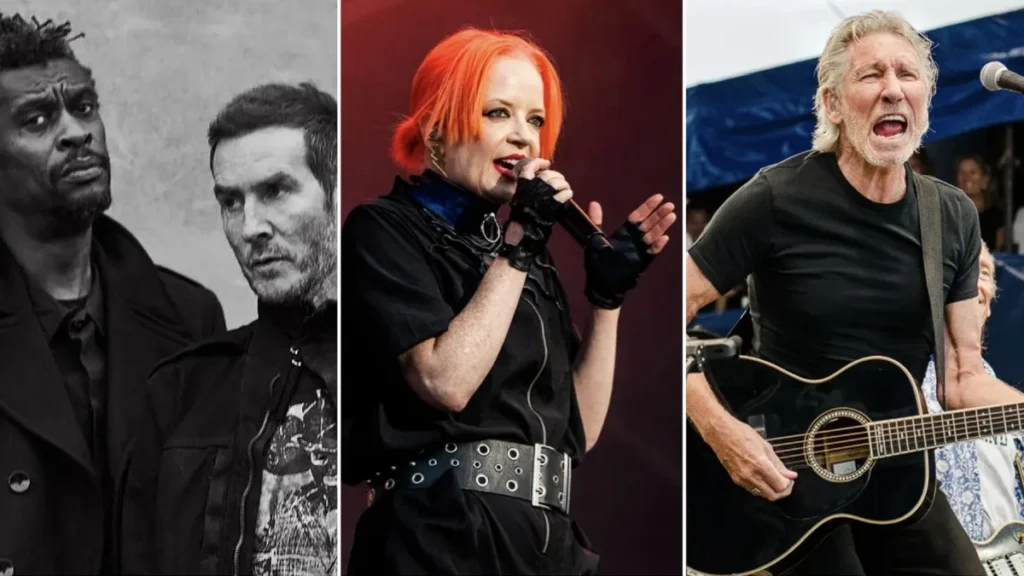

The music industry is currently embroiled in a high-stakes controversy following the removal of rapper Macklemore from Ed Sheeran’s current concert tour. The decision, which followed Macklemore’s vocal support for "Free Palestine" during his performances at MetLife Stadium in New Jersey, has sparked a firestorm of criticism from veteran artists, including Massive Attack, Garbage, and Roger Waters. The situation has reignited long-standing debates regarding the intersection of celebrity, political speech, and the influence of corporate stadium ownership in the modern entertainment landscape.
Chronology of the Dispute
The catalyst for the current impasse occurred on September 4th and 5th, 2026, when Macklemore used his platform at MetLife Stadium to issue statements regarding the ongoing conflict in Gaza. His comments, which explicitly called for the liberation of Palestine, were met with swift backlash from a coalition of stadium owners, spearheaded by billionaire businessman and New England Patriots owner Robert Kraft.
Following intense pressure from this group, Macklemore was formally removed from the remaining dates of the tour. Ed Sheeran, the tour’s headliner, released a public statement shortly thereafter, asserting that the decision was not his own. Sheeran claimed that the directive originated from promoters and venue management, noting that he had attempted to navigate the situation to keep the rapper on the bill. However, this defense has been roundly rejected by several high-profile peers who argue that silence in the face of such actions equates to complicity.
The Critique of Ed Sheeran’s Stance
The response from the artistic community has been swift and unforgiving. Massive Attack, the influential trip-hop collective known for their long history of political activism, issued a scathing critique of the "neutrality" claimed by Sheeran. In a statement posted to social media, the band argued that entertainment cannot be separated from the moral imperative of resisting what they described as an ongoing genocide in Gaza.
"No artist should tolerate the censorship of another artist, however many millions of dollars are in play," the band wrote. They further challenged the industry-standard "apolitical" stance often adopted by global pop stars, suggesting that the pressure exerted by corporate entities creates a culture of silence that prevents artists from addressing human rights abuses.
Garbage, led by Shirley Manson, echoed these sentiments with equal force. In their own statement, the group highlighted that the global consensus regarding the conflict has shifted significantly over the past decade. They characterized the removal of Macklemore as a symptom of a broader, systemic effort to sanitize the public discourse surrounding the Israeli-Palestinian conflict. Garbage noted that several of Sheeran’s other opening acts and members of his own backing band had opted to depart the tour in solidarity with the rapper, signaling a growing fracture within the artist’s professional circle.
Roger Waters, a founding member of Pink Floyd and a prominent advocate for the Boycott, Divestment, and Sanctions (BDS) movement, took a more direct approach. In a video address, Waters contrasted the actions of artists like Macklemore, whom he praised for taking a principled stand, with those he labeled as complicit in the suppression of political dissent. His comments have intensified the polarization surrounding the event, drawing both support from activist circles and criticism from those who argue that such rhetoric is unnecessarily inflammatory.
Industry Context and Historical Precedents
The incident involving Macklemore and Ed Sheeran is not an isolated event but rather the latest flashpoint in a long-standing tension between touring artists and the corporate entities that control major performance venues. Stadium ownership in the United States is increasingly consolidated, with private equity firms and high-net-worth individuals wielding significant influence over booking policies.
Historically, the "Blacklist" culture in the music industry has surfaced during times of intense geopolitical strife. For instance, during the Vietnam War, artists often faced pressure from promoters to keep anti-war sentiments out of their sets. However, the current digital age—where social media allows for instantaneous dissemination of an artist’s views—has made it more difficult for management and promoters to contain "unauthorized" political messaging.
Massive Attack’s history of activism provides a stark contrast to the current situation. The group was recently banned from performing in Singapore after displaying a Palestinian flag during a concert, and Robert Del Naja, a core member of the band, was arrested in London earlier this year during a pro-Palestine protest. By positioning themselves as advocates for the "alliance for musicians," Massive Attack has sought to build a support network for performers who face censorship or career repercussions for their political beliefs.
The Economic and Cultural Implications
The removal of an artist from a high-grossing stadium tour has profound financial implications. Tour contracts typically include "morality clauses" that grant promoters and venue owners the right to terminate agreements if an artist’s conduct is deemed "disparaging" or "harmful" to the venue’s reputation. While these clauses are standard, their application in the context of political speech is highly controversial.
Critics of the decision to remove Macklemore argue that it sets a dangerous precedent for artistic freedom. If stadium owners can unilaterally dictate the political content permitted on stage, it effectively grants these entities veto power over the public discourse. Conversely, proponents of the decision argue that venues are private businesses entitled to protect their interests and ensure that their events remain aligned with their own corporate or personal values.
From a sociological perspective, the "cancellation" of an artist for their political stance is increasingly being viewed through the lens of institutional power. As Garbage noted in their statement, the attempt to "both sides" a conflict that many see as a clear-cut humanitarian crisis is becoming an untenable position for many younger, socially conscious artists. The departure of support staff and opening acts suggests that the culture within touring ecosystems is shifting, potentially leading to more fragmented tours where artists and support teams choose to work only with those who share their political alignment.
Data and Public Sentiment
The conflict in Gaza has undeniably become a wedge issue within the entertainment industry. Data from industry tracking groups indicates that since October 2023, there has been a marked increase in artists using their platforms to comment on the conflict. However, this has also led to a rise in "cancellation" incidents, where artists have lost festival slots, endorsement deals, and tour opportunities.
The "Macklemore-Sheeran" incident is being cited by analysts as a litmus test for the industry’s tolerance for political expression. With millions of dollars at stake in stadium tours, the pressure to remain "safe" and "neutral" is higher than ever. However, the vocal backlash from established acts like Massive Attack and Roger Waters indicates that there is a powerful counter-movement among veteran artists who are willing to jeopardize their own commercial standing to defend the right to political speech.
Looking Ahead
As the tour continues, the fallout from this decision is expected to persist. Fans have already begun calling for boycotts of the remaining tour dates, while other artists are being pressured to clarify their own stances on the conflict. The incident has effectively transformed a standard pop music tour into a focal point for a much larger, global conversation about the role of the artist in society.
Whether this controversy will lead to a change in how stadium contracts are structured or whether it will further entrench the divide between artists and corporate venue owners remains to be seen. What is clear, however, is that the era of the "apolitical superstar" is facing unprecedented challenges. As the boundaries between personal conscience and professional obligation continue to blur, the music industry will likely see more instances where the stage becomes a battleground for global politics. The industry’s ability to navigate these pressures will define the future of live performance, as artists, promoters, and fans continue to grapple with the complexities of accountability in an increasingly polarized world.