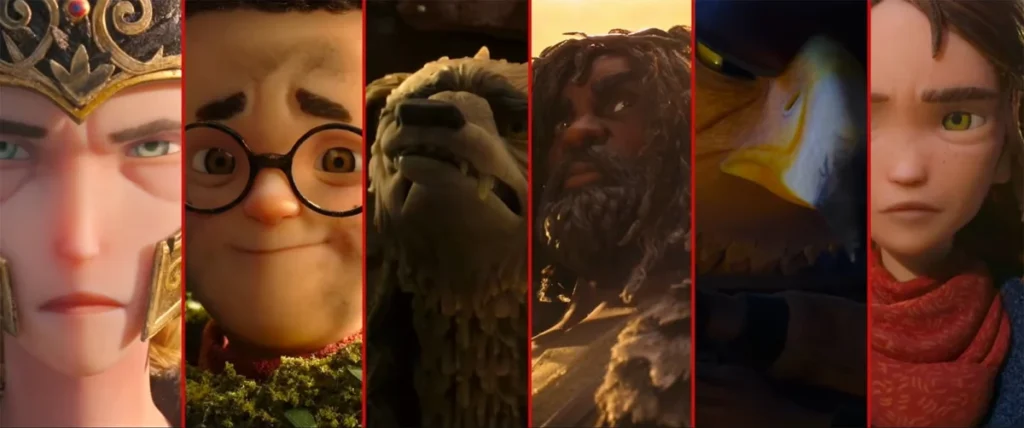

The animation industry reached a monumental milestone on October 23, 2026, as Laika Entertainment officially launched its latest stop-motion feature film, Wildwood, into commercial theaters nationwide. To commemorate the wide release, the acclaimed Oregon-based studio released a final pairing of promotional featurettes detailing the intensive creative labor, complex voice performances, and meticulous craftsmanship required to bring Colin Meloy’s beloved literary fantasy universe to life. Directed by Laika CEO Travis Knight, the film represents the culmination of years of collaborative artistry, technological innovation, and patient hand-crafted animation that has come to define the studio’s cinematic legacy.
Main Facts and Plot Overview
Wildwood adapts the acclaimed 2011 illustrated children’s fantasy novel of the same name, written by Colin Meloy—frontman of the indie rock band The Decemberists—and illustrated by Carson Ellis. The narrative centers on protagonist Prue McKeel, voiced by Peyton Elizabeth Lee, whose ordinary life in Portland, Oregon, is upended when a mysterious murder of crows and an enigmatic woman abduct her infant brother, Mac. Driven by desperation and courage, Prue and her classmate Curtis venture deep into the forbidden, magical woodland on the outskirts of the city, known simply as Wildwood.
Inside this hidden ecosystem, the children discover a sprawling civilization caught in the crossfire of an impending political and physical struggle. The forest is populated by talking animals, rebel factions, mystics, and powerful monarchs, evoking a scale of world-building frequently compared to epic high-fantasy literature like The Lord of the Rings.
The production boasts an extraordinary ensemble voice cast. Alongside Peyton Elizabeth Lee, the film features performances by Angela Bassett, Jacob Tremblay, Carey Mulligan, Awkwafina, Jemaine Clement, Charlie Day, Jake Johnson, Amandla Stenberg, Tom Waits, Richard E. Grant, and Mahershala Ali, who portrays the charismatic and formidable Bandit King of Wildwood.
Chronology of Production and Development

The journey of bringing Wildwood to the screen spans well over a decade of conceptualization, development, and meticulous physical production. Laika originally optioned the rights to Colin Meloy’s novel shortly after its publication in 2011, recognizing the thematic overlap between the book’s gothic, Pacific Northwest aesthetic and the studio’s distinct stop-motion medium.
Initial screenwriting duties were undertaken by Chris Butler, whose previous credits at Laika include ParaNorman, Kubo and the Two Strings, and Missing Link. Butler worked to condense the intricate, expansive plot of Meloy’s novel—the first in a trilogy—into a cohesive feature-length narrative without sacrificing the rich lore of the forest inhabitants.
Production ramped up significantly following the release of Laika’s fifth feature, Missing Link, in 2019. Over the subsequent years, hundreds of artists, sculptors, set designers, costume makers, and animators worked inside the studio’s Hillsboro, Oregon facility. The COVID-19 pandemic introduced substantial logistical hurdles, forcing the studio to adapt remote workflows for pre-production and digital pipeline management while physical puppet fabrication and stage shooting required strict adherence to safety protocols on-site.
By late 2025 and early 2026, the marketing campaign began to unfold incrementally. Early teaser trailers established the atmospheric tone, followed by specialized making-of featurettes focusing on individual set pieces, such as the monumental Council Tree—a central hub for the forest’s rebel factions—and the majestic eagles that dominate the skies of Wildwood. The final promotional rollout on October 23, 2026, directly coincided with the film’s theatrical distribution via Fathom Events and traditional studio partnerships.
The Art of Stop-Motion: Behind the Final Featurettes
Laika’s newly released dual featurettes offer audiences a rare, transparent look into the intersection of analog craftsmanship and modern cinematic technology. The first featurette focuses primarily on the vocal performances, examining how actors establish character intent, emotional depth, and psychological resonance using only their voices prior to the animation process. Voice director and animators rely on these audio tracks to guide the cadence of frame-by-frame puppet manipulation.
"Simply with the human voice, you have to imply intention and purpose," noted members of the creative team in the promotional material, emphasizing that vocal delivery forms the foundational anchor for characters molded from silicone, resin, and fabric.

The second featurette delves into the physical design philosophy of the studio. For more than ten years, Laika’s artisans have refined techniques in rapid prototyping (utilizing advanced 3D printing to generate thousands of subtle facial expressions), miniature costume tailoring, and complex miniature set construction. The Council Tree set, featured prominently in the promotional clips, required months of engineering to function not merely as a static background, but as a dynamic, organic staging ground where major alliances are forged and narrative turning points occur.
Creative Leadership and Institutional Vision
At the helm of Wildwood is Travis Knight, whose career trajectory mirrors the evolution of modern stop-motion animation. Having directed the critically acclaimed Kubo and the Two Strings (2016) and the Transformers live-action spinoff Bumblebee (2018), Knight returned to his stop-motion roots to direct Wildwood. As both CEO of Laika and director, Knight has consistently championed the preservation of physical art forms in an industry increasingly dominated by fully computer-generated imagery (CGI).
Produced by Arianne Sutner alongside Knight, Wildwood represents the continuation of Laika’s mission to produce ambitious, prestige animated features that appeal equally to children and adults. Speaking on the thematic weight of the project, production insiders have noted that the film explores themes of environmental stewardship, sibling devotion, and the friction between urban expansion and natural preservation—motifs deeply embedded in the cultural identity of the Pacific Northwest.
Industry Analysis and Market Implications
The theatrical release of Wildwood arrives at a pivotal moment for the animation sector. While major studios have increasingly gravitated toward high-profit margins associated with digital animation and streaming-first models, Laika remains one of the few entities globally dedicated to theatrical stop-motion production on a grand financial and artistic scale.
Industry analysts observe that stop-motion films operate under vastly different economic constraints compared to traditional Hollywood blockbusters. The sheer man-hours required to produce a single second of finished footage—often averaging just a few seconds of usable footage per animator per week—translate to elevated production budgets and extended timelines. Consequently, the commercial performance of Wildwood carries significant implications for the long-term viability of high-budget, independent stop-motion studios.

Early critical reception suggests strong positive momentum, with reviewers praising the film’s visual splendor, emotional gravity, and technical sophistication. By positioning Wildwood as a theatrical-first event, Laika and its distribution partners aim to capture family audiences and cinephiles seeking a tactile, visually distinct alternative to mainstream digital animation.
Broader Cultural and Regional Impact
Beyond its cinematic achievements, Wildwood serves as a cultural celebration of Oregon’s unique landscape. The dense, rain-soaked temperate rainforests of the Pacific Northwest function as more than a backdrop; they are treated as living, breathing characters within the narrative. The adaptation bridges the literary success of Colin Meloy—a prominent figure in Portland’s artistic community—with Laika’s local institutional footprint, reinforcing the region’s status as a global hub for stop-motion animation excellence.
As audiences stream into theaters to experience the world crafted by Knight, Butler, and the hundreds of anonymous artisans behind the scenes, Wildwood stands as a testament to the enduring power of physical craftsmanship in cinema. The final featurettes serve not only as marketing tools for the current release, but as an archival acknowledgment of the patience, precision, and passion required to bring an impossible forest to life.